Skip to content

Southern Fried Science

Over 15 years of ocean science and conservation online

  • Home
  • About SFS
  • Authors
  • Support SFS

Category: Science

Namibian Government Announces 18-month Moratorium on Seabed Mining

Posted on September 24, 2013October 27, 2013 By Andrew Thaler
Conservation, Science

Good news came out of Namibia last night, as the government declared an 18-month moratorium on all experimental seabed mining in Namibian waters, pending a more comprehensive environmental impact assessment. Pressure from both environmental groups and the fishing industry ultimately led to this decision. Both sets of stakeholders, as well as scientists and members of the international community, have legitimate concerns regarding the safety of seabed mining. This is the precautionary principal as it was meant to be implemented.

According to Swakopmund Matters, a seafloor mining protest group in Namibia:

The message conveyed by the Namibian decision is bold and clear. It will resonate throughout the world where battles are being fought against actions by mining companies that will harm, if not destroy, important marine areas. It will embolden all those who are standing up for the protection of their marine environments. But even more important, it will demonstrate to other governments that environmental concerns do take precedent over companies’ questionable actions when it comes to their exploitation of the oceans. Furthermore, that the Namibia government is not prepared to be a guinea pig for an untested and unknown endeavor. It refused to let its ocean and marine resources become the proverbial experimental playground.

(Source is a press release e-mailed to me.)

Read More “Namibian Government Announces 18-month Moratorium on Seabed Mining” »
Happy Friday! Here’s some pictures of Blue Footed Boobies

Posted on September 20, 2013October 27, 2013 By Andrew Thaler
Science

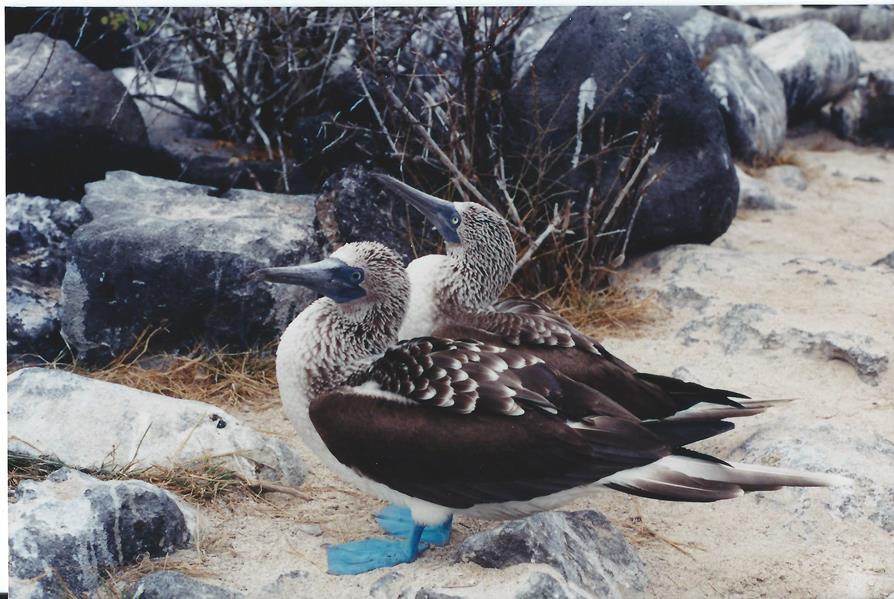
This week we learned that several blue footed boobies were sighted along the California coast, a rare, but not unprecedented occurrence. The news reports flooding in reminded me of my own experience with blue footed boobies in the Galapagos, so I decided to dig out my old photo album (yes, this predates the age of digital cameras) and pull out the booby photographs. Here, for your Friday enjoyment, are a bunch of pictures of Blue Footed Boobies.

Photo by Andrew David Thaler.

Read More “Happy Friday! Here’s some pictures of Blue Footed Boobies” »

Eleven Marine Organisms that would make Amazing Aquaman Villains

Posted on September 19, 2013October 27, 2013 By Andrew Thaler 2 Comments on Eleven Marine Organisms that would make Amazing Aquaman Villains
Popular Culture, Science
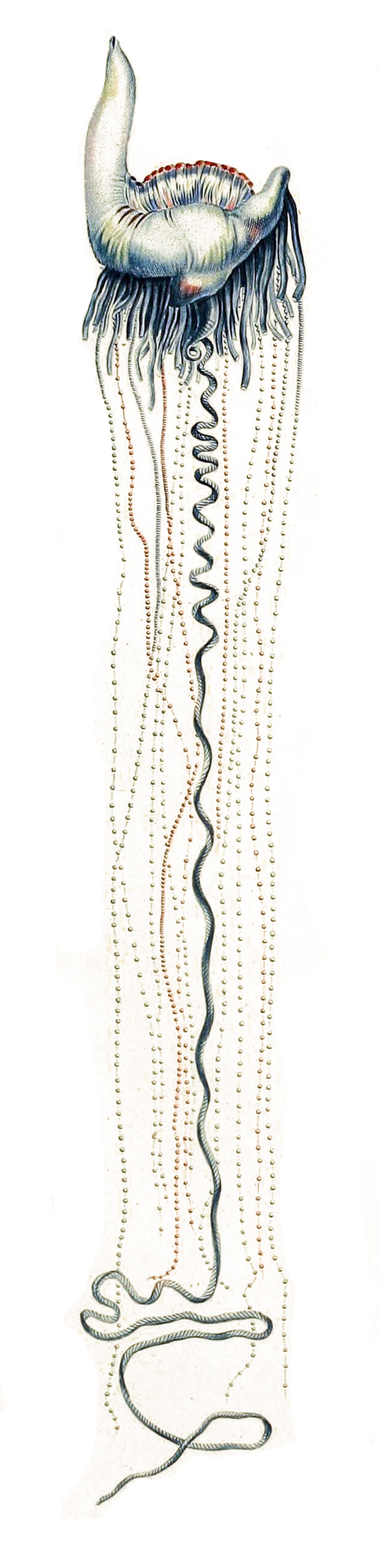
Physalia_physalis1
Physalia physalis. Public domain.

Black Manta. Ocean Master. The Trench. Scavenger. King Shark. Toxin. The Fisherman. Aquaman has had some pretty memorable villains over the last 80 years. Also, the Fisherman. This is Southern Fried Science, a blog famous for two things – inspiring the world with our unique blend of marine science and conservation and doing horrible, horrible things to Aquaman.

Catch me flounder for I have finned. It has been 98 days since my last Aquaman is Awesome post.

Sure, Black Manta has some pretty sweet gear, a compelling back story that justifies his hatred of the Atlantean king, and he looks like he’s poised for some serious awesome during DC’s Villains Month. The Trench even appear to be able to utilize chemosynthesis, when they’re not trapping dogs in cocoons. You know where I’m going with this, don’t you?

That’s right. No matter how ridiculous Aquaman’s comic book foes become, you can bet all your clams I’ll find real marine organisms that would make equally amazing villains. Here’s eleven of them.

Meet Man-o-War, the colonial killer that understands the value of teamwork.

Imagine a super villain composed of thousand of individual organisms that form one giant super-organism. Rather than a body filled with vital organs, this villain can take massive damage without a loss of ‘self’, only to spawn new minions to replaced the damaged parts. Now give this deadly foe 60-foot long venom-filled tentacles whose sting brings excruciating pain. Such a villain would certainly assume the identity ‘Man-o-War’.

The Portuguese Man-o-War (Physalia physalis), arguably the best known of the siphonophores (it is a cnidarian, but it is not a jellyfish) possess tentacles that unleash an unbelievably painful sting, the weapon of choice for our newest menace. But the weapon does’t make the man (o-war), and our villain has a strategic secret. Man-o-Wars are not singular animals, they are a colony of highly specialized polyps — each one an individual animal that combines to form a deadly super-organism.

The pneumatophore is a polyp the creates a gas-filled bladder for flotation. This produces the distinctive ‘sail’ of the Man-o-War, a bilaterally symmetric air sac that allows the colonial to remain at the surface and provides some propulsion by catching the wind. The sail is not just a sac of air, it also has defensive capabilities. When attacked, the sail is able to deflate, allowing the colony to sink below the surface and avoid predators. The gonozooids, which occur in tight clusters, are responsible for reproduction. Man-o-Wars engage in both asexual and sexual reproduction. Young colonies can reproduce clonally by budding, but as the colony becomes more mature, that gonozooids become sexually differentiated and release eggs and sperm to form new colonies. The gastrozooid takes care of all the digestion-related needs and surround the dastardly dactylozooids. Finally, the dactylozooids produce 10-meter (or longer!) tentacles that capture prey and drag them towards the gastrozooids. This is some serious teamwork.

Man-o-War even has minions. The shepherd fish is immune t the stinging tentacles and hangs out within the tentacles. The fish gains the protection of its lethal ally while the Man-o-War gets to use the shepherd fish as bait to lure other fish into its deadly trap.

Imagine Aquaman facing off against a colony of polyps that combine to form a deadly super-organism with massive stinging tentacles. Siphonophores have no nervous system, so Aquaman’s fish-talking power are useless. No matter how many dactylozooids, gatrozooids, and pneumatophores he destroyed, the gonozooids are there, churning out more.

But Man-o-Wars are not without their own predators, the largest of which is the enormous, cnidarian nom nom-ing Leatherback Turtle. Despite their size, leatherbacks are the largest live sea turtle, they survive exclusively on large numbers of jelly-like organisms — to the tune of the equivalent of eating 16 cucumbers per day. Leatherbacks aren’t the only animals that prey on Man-o-War, the salacious siphonophore has many foes, two of which join this list as super-villains in their own right.

Read More “Eleven Marine Organisms that would make Amazing Aquaman Villains” »

Blackfish: the Science Behind the Movie

Posted on September 18, 2013June 11, 2015 By Chris Parsons 13 Comments on Blackfish: the Science Behind the Movie
Conservation, Popular Culture, Science

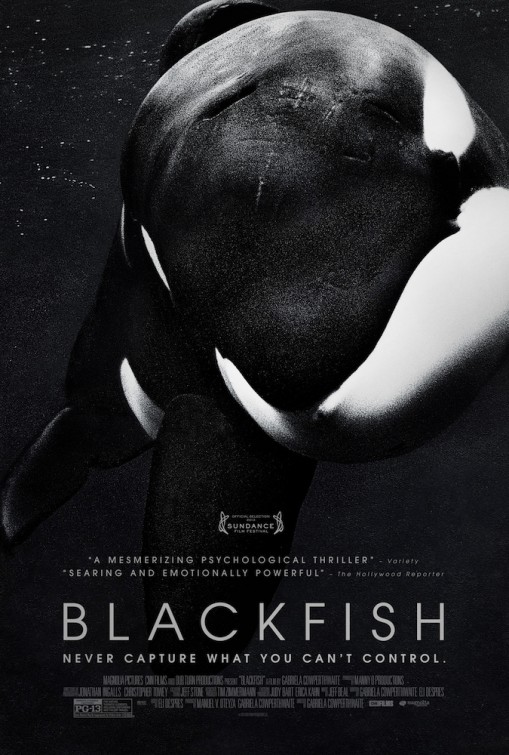
Blackfishn649728329_1260668_3283

The Oscar-winning documentary “The Cove” told the story of the dolphin hunt in the Japanese town of Taiji. Dolphins there are driven into a shallow cove and killed for meat and other products, with a select few set aside alive for sale to dolphinariums. Many are now saying that this year’s documentary on killer whales (Orcinus orca) in captivity, “Blackfish,” will be nominated for next year’s Oscar. Documentaries rarely get many viewers in movie theaters, but Blackfish, which cost only $76,000 to make and was initially released at only five movie theaters, has already grossed about $2 million nationwide and has been ranked among the 10 best performing nature documentaries, which include “March of the Penguins” and the much vaunted IMAX-friendly “Earth” and “Oceans” documentaries.

Blackfish focuses on the four people who have been killed by captive killer whales, bad corporate behavior by marine theme parks (especially SeaWorld) and the ethics of keeping killer whales in captivity. The film focuses particularly on the story of Tilikum, a 12,000lb male killer whale who was captured from Iceland in the early 1980s, has been living at SeaWorld of Florida since 1992, and to date has been involved in the deaths of three people. His last victim, his trainer of six years Dawn Brancheau, was brutally dismembered after he pulled her into the tank with him on February 24, 2010.

Read More “Blackfish: the Science Behind the Movie” »

Dolphin intelligence researcher did not say that dolphins aren’t intelligent as Daily Mail, Sunday Times claim

Posted on September 12, 2013October 27, 2013 By David Shiffman 11 Comments on Dolphin intelligence researcher did not say that dolphins aren’t intelligent as Daily Mail, Sunday Times claim
Science

davesquare

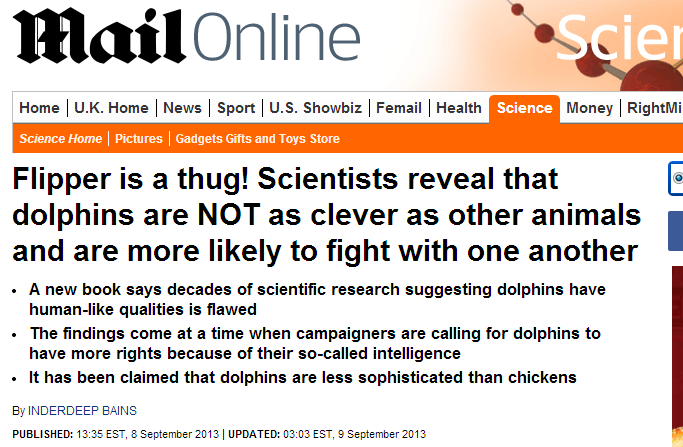
A screen capture of the Daily Mail's headline for this article
A screen capture of the Daily Mail’s article headline

Earlier this week, the Daily Mail ran an article which claimed that dolphins are not as intelligent as is commonly believed. The crux of this provocative argument comes from an interview with Dr. Justin Gregg, a research associate with the dolphin communication project who studies social cognition.

According to the Daily Mail article, Justin Gregg said, “Dolphins are fascinating in their own right, but in terms of intelligence they are nowhere near as special as they have been portrayed…they are less sophisticated than chickens.” In an editorial that was likely the source of the Daily Mail article, the Sunday Times claims that he said “Not only are dolphins dimmer than the average chicken, says Justin Gregg, a zoologist, but they are also capable of gang rape and acts of violence. So don’t be taken in by those winning smiles.”

Unsurprisingly, this article has ruffled some feathers in the marine mammal researcher community.

Read More “Dolphin intelligence researcher did not say that dolphins aren’t intelligent as Daily Mail, Sunday Times claim” »

Cocktail Week Reboot: How to brew beer in a coffee maker, using only materials commonly found on a modestly sized oceanographic research vessel.

Posted on September 11, 2013October 27, 2013 By Andrew Thaler 1 Comment on Cocktail Week Reboot: How to brew beer in a coffee maker, using only materials commonly found on a modestly sized oceanographic research vessel.
Science

It’s Cocktail Week over at Deep Sea News. In honor of this most auspicious event we’ve dredged up the post that put Southern Fried Science on the chart, nearly five years ago. Enjoy this blast from our southern fried past.


The Flip - One research vessel you may a drink on
The Flip – one research vessel that mandates a drink

Introduction

Beer brewing is the delicate and dedicated blending of art and science.  Finding the perfect balance of grains, hops, malt, adding just the right flavoring agents, boiling for exactly enough time to release the tannins, starches, humic acids from you wort, activating enzymes to break down those starches, forging the perfect mash from the ether of sobriety to give birth to that most glorious pint, these are skills that take a lifetime to master. Perfect beer is meticulously planned and carefully crafted.

Screw that.

You’re six days into a 2 month expedition, and if you were lucky enough to not be on a dry ship, it’s de facto dry by now anyway. You’re eying the ethanol stores, the crew is eying each other, and all hell will break loose if y’all don’t get some sweet water soon. This is no time for artistry.

This is not, as a rule, a terribly good beer (though, with a good brewmaster on board, it can be). This is a beer to pass the time and ease the pain of life at sea. I can guarantee that if you are careful, it will be at least as good as the cheapest commercial alternative.

Read More “Cocktail Week Reboot: How to brew beer in a coffee maker, using only materials commonly found on a modestly sized oceanographic research vessel.” »

Six sea monsters that make their horror movie counterparts look tame

Posted on September 8, 2013January 3, 2017 By Andrew Thaler
Popular Culture, Science

Evolution is infinitely creative. Sometimes, amid the beauty and wonder, the awe that emanates from the shear power of natural selection, and the poetry of descent with modification, evolution produces something that terrifies. I am not talking about our natural predators, for whom fear is part of our evolutionary heritage, but rather creatures that appear as though they emerged from our darkest nightmares. But even our nightmares are limited by our finite minds.

Evolution has no such limits and the immense size and incomprehensible diversity of the oceans has produce animals that make us yearn for the comforting familiarity of the common Pumpkinhead. Submitted for the approval of the Midnight Society, I present six sea monsters that make their horror movie counterparts look tame:

1. These mind-bending tapeworms crawled straight out of Slither.

Here is a classic horror movie scenario for you: alien/parasite/mutant invaders enter your body, latch on to you brain, and take control, forcing you to do their bidding as they multiply and infect those around you. From Body Snatchers to Slither, mind-controlling parasites are a mainstay of the genre. But you’re a reader of Southern Fried Science. You already know all about barnacles that take over crab brains and induce sex-changes when necessary or fungi that invade ants and force them to climb to their doom. Mind control parasites aren’t really all that uncommon, but they mostly infect invertebrates. There aren’t any deadly mind-melting monsters that can take over us higher organisms, right? Right?!

Wrong.

Read More “Six sea monsters that make their horror movie counterparts look tame” »

The Pizza of Privilege: My Experiences with Anti-Semitism in Academia

Posted on August 22, 2013October 27, 2013 By David Shiffman 45 Comments on The Pizza of Privilege: My Experiences with Anti-Semitism in Academia
Science

davesquare

Anti-Semitic graffiti similar to this has been found on U.S. universities. This comes from a private residence in New York. Photo credit: Alex Silverman/WCBS 880.

Since I joined Southern Fried Science in 2009, I’ve written almost 1,000 blog posts. This post has unquestionably been the most difficult one for me to write. Although I’ve always enjoyed sharing and debating my opinions (even when they’re unpopular in certain circles,) I’ve never been comfortable discussing negative personal experiences. And yet, I feel that the topic of anti-Semitism in academia , something that is in fact much more pervasive than most non-Jews believe, is too important for me to remain silent any longer. More than 40% of Jewish students reported being the victim of some degree of anti-Semitism at their college or university. This can range from mockery to exclusion to  the Michigan State student who was beaten while his attackers made the Nazi salute last summer.

I want to state upfront that it is not my intention in writing this post to start a “which minority group is the most oppressed” competition, nor am I naive enough to believe that my post will be the proverbial straw that breaks the camel’s back and fixes these issues once and for all. I also want to state that while I could write a whole book about my experiences with anti-Semitism in the context of my personal pro-Israel advocacy, this post is not about that, other than to say that while not all criticism of Israel and Israel’s policies and actions can be considered anti-Semitic in nature, some of it certainly can.  Finally, it’s important to note that while not all of these examples are necessarily anti-Jewish specifically, all are anti-someone-different-from-me and contrary to a culture of diversity and inclusiveness. My goal is simply to continue an important and ongoing conversation about academic culture by sharing my personal experiences, and perhaps to bring another group into that conversation.  Please feel free to share your own experiences in the comments section.

Read More “The Pizza of Privilege: My Experiences with Anti-Semitism in Academia” »

10 Tips for grad students to make the most of a scientific conference

Posted on August 21, 2013October 27, 2013 By David Shiffman 22 Comments on 10 Tips for grad students to make the most of a scientific conference
Science

davesquare

Presenting research at the International Marine Conservation Congress in Victoria, BC.
Presenting research at the International Marine Conservation Congress in Victoria, BC (2011).

I just returned from the Society for Conservation Biology’s International Congress for Conservation Biology. It was a great meeting, and I learned a lot. It also marked a milestone for me, as although I am just starting the 3rd year of my Ph.D.,  the ICCB was the 20th scientific conference I’ve attended. Inspired by this milestone, by Josh Drew’s recent post on the subject, and by the excellent graduate student networking workshop held at the ICCB, I wanted to share my tips and tricks for graduate students to get the most out of a conference

Please note that while these tips have served me well and are generally applicable to professional meetings in the sciences, they may not be appropriate for every field or every person’s goals for a conference.  Additionally, some may be considered quite basic, but I assure you that I’ve met people (particularly graduate students attending a conference for a first time) who don’t know them. I welcome a discussion in the comments.

Read More “10 Tips for grad students to make the most of a scientific conference” »

Happy Fun Science Friday!!

Posted on August 16, 2013October 28, 2013 By Kersey Sturdivant
Science

kerseysquae

HAPPY FUN SCIENCE FRIDAY.

Let me begin by imploring any readers who are interested in a more ‘Open Ocean,’ to help support our crowd funding initiative – #OpenCTD.

http://www.rockethub.com/projects/26388-oceanography-for-everyone-the-openctd#description-tab

So for a number of years I have been celebrating Fun Science Friday; a mini-holiday that originated years ago when I was in graduate school. Our professor would bring Smarties to class each Friday, and we students would have some fun science exercise before diving into the more intricate nuances of the course. I was thoroughly enamored with FSF,  and not just because of those delicious Smarties, and endeavored to spread FSF wherever I went (some places were more receptive than others). I have finally been convinced by the Southern Fried crew to move my rather informal celebration of FSF, where I normally post a fun science fact each Friday, to generating a short blog about what I would normally post. So to all the Southern Fried readers, welcome to Fun Science Friday!!

Read More “Happy Fun Science Friday!!” »

Posts pagination

Previous 1 … 32 33 34 … 81 Next

Popular Posts

What Ocean Ramsey does is not shark science or conservation: some brief thoughts on "the Shark Whisperer" documentaryWhat Ocean Ramsey does is not shark science or conservation: some brief thoughts on "the Shark Whisperer" documentaryJuly 2, 2025David Shiffman
That's not a blobfish: Deep Sea Social Media is Flooded by AI SlopThat's not a blobfish: Deep Sea Social Media is Flooded by AI SlopDecember 19, 2025Andrew Thaler
The story of the pride flag made from NASA imagery: Bluesky's most-liked imageThe story of the pride flag made from NASA imagery: Bluesky's most-liked imageSeptember 27, 2024David Shiffman
What can the funniest shark memes on the internetz teach us about ocean science and conservation?What can the funniest shark memes on the internetz teach us about ocean science and conservation?November 8, 2013David Shiffman
The Trouble with Teacup PigsThe Trouble with Teacup PigsOctober 14, 2012Andrew Thaler
Shark of Darkness: Wrath of Submarine is a fake documentaryShark of Darkness: Wrath of Submarine is a fake documentaryAugust 10, 2014Michelle Jewell
I can serve on your graduate thesis committee. Here’s what you can expect of me, and what I expect in return.I can serve on your graduate thesis committee. Here’s what you can expect of me, and what I expect in return.October 16, 2025David Shiffman
Norway and Cook Islands put their deep-sea mining plans on pause.Norway and Cook Islands put their deep-sea mining plans on pause.December 3, 2025Andrew Thaler
Nodules, Lost Mines, and Dark Oxygen: A new documentary on deep-sea mining asks important questions about the future of the industry.Nodules, Lost Mines, and Dark Oxygen: A new documentary on deep-sea mining asks important questions about the future of the industry.July 24, 2025Andrew Thaler
Blackfish: the Science Behind the MovieBlackfish: the Science Behind the MovieSeptember 18, 2013Chris Parsons
Subscribe to our RSS Feed for updates whenever new articles are published.

We recommend Feedly for RSS management. It's like Google Reader, except it still exists.

Southern Fried Science

  • Home
  • About SFS
  • Authors
  • Support SFS


If you enjoy Southern Fried Science, consider contributing to our Patreon campaign.

Copyright © 2025 Southern Fried Science.

Theme: Oceanly Premium by ScriptsTown