Skip to content

Southern Fried Science

Over 15 years of ocean science and conservation online

  • Home
  • About SFS
  • Authors
  • Support SFS

Category: Science

What does a day of discarded plastic from a molecular lab look like?

Posted on November 14, 2012 By Andrew Thaler
Science

To complement my post earlier today on the need for best practice guidelines to minimize plastic waste in a conservation genetics lab, I asked my labmates to save all of their consumables from a day of molecular benchwork. The above picture (Sharpie for scale) is the result. All told, we produced about 1/2 kilogram of plastic … Read More “What does a day of discarded plastic from a molecular lab look like?” »

Establishing Best Practices to Minimize Waste in a Conservation Genetics Lab

Posted on November 14, 2012 By Andrew Thaler
Conservation, Science

I am, among other things, a conservation geneticist. What that means is that I use the tools of molecular ecology and population genetics to make observations about species and populations in at-risk ecosystems, assess the status of anthropogenically disturbed populations, and generate data that has direct applications to conservation and management issues. Essentially, the only difference between what I do and what a population geneticist or molecular ecologist does is the motivation—I select systems to work in that have a high conservation priority.

This motivation leads to a constant intellectual conflict at the bench. The tools of molecular ecology—PCR, gene sequencing, and, more frequently, high-throughput sequencing—are waste intensive. In order to avoid cross-contamination and practice precise, clean, technique, we use thousands of tiny plastic consumables every day. These come in the form of pipette tips, sterile packaging material, micro-centrifuge tubes, and numerous other plastic widgets. Often, because of the biohazard potential, these consumable cannot be recycled.

So we have a problem. As a conservation geneticist, we need these tools to produce the data necessary to make wise conservation and management decisions. As a sustainability minded individual, I find the massive daily accumulation of plastic waste inexcusable. Do we just accept this waste as the cost of conservation genetics? I believe that the answer is no. I think we can and should develop best practices to minimize the amount of plastic waste produced by a molecular lab while maintaining good, sterile technique. I would like to propose four guidelines, based off the principles of Reduce, Reuse, and Recycle, for minimizing waste in a conservation genetics lab.

Read More “Establishing Best Practices to Minimize Waste in a Conservation Genetics Lab” »

New special issue of elasmobranch nervous systems “highlights the evolutionary relevance” of sharks and rays

Posted on November 1, 2012 By David Shiffman
Science

The journal Brain, Behavior, and Evolution has just released a special issue on the nervous systems of cartilaginous fishes (sharks, skates, rays, and chimeras). The six research articles contained in the special issue  both summarize and greatly expand what’s known about elasmobranch brains. Dr. Kara Yopak, an elasmobranch nervous system expert who served as the editor … Read More “New special issue of elasmobranch nervous systems “highlights the evolutionary relevance” of sharks and rays” »

Alberta, Canada is the proud owner of the largest man-made pyramid on the planet

Posted on October 16, 2012October 16, 2012 By Andrew Thaler
Science

Great Pyramid of Giza. Photo by Nina Aldin Thune.

Pharaoh Khufu must be rolling in his monumental grave. Since its construction in 2560 BC, the Great Pyramid of Giza stood as the largest man-made pyramid ever built*. For 3800 years, it held the title of the tallest man-made structure of any kind. It wasn’t until the Industrial Revolution that our buildings began dwarfing this wonder of the ancient world. Even still, the Great Pyramid is massive, with a volume of 2,580,000 cubic meters. But there is another pyramid, more massive than Giza, and it wasn’t built to entomb a mighty king. It’s not a monument of any kind. The largest (by volume) pyramid in the world resides in Alberta, Canada and it’s made entirely of sulfur.

Wait, what?

Read More “Alberta, Canada is the proud owner of the largest man-made pyramid on the planet” »

The Trouble with Teacup Pigs

Posted on October 14, 2012June 12, 2017 By Andrew Thaler 13 Comments on The Trouble with Teacup Pigs
Popular Culture, Science

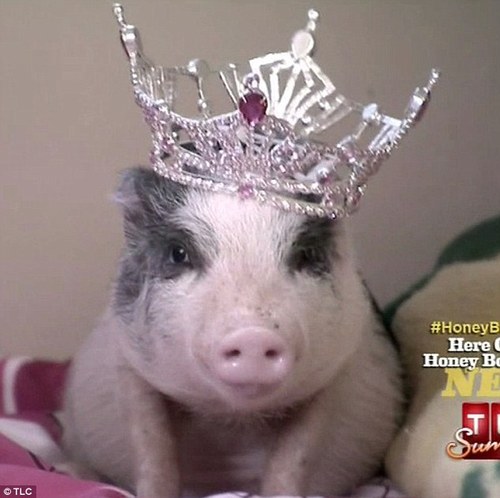
I adore Here Comes Honey Boo Boo. That’s right, I said it. There’s a soft spot in my brittle old heart for that whole family, Sugar Bear, Mamma June, and all. Especially Glitzy.

Glitzy the Pig. Image from The Learning Channel.

Glitzy, for those of you who don’t know, is a “Teacup” Pig (as you can tell from the video, pigs don’t like to be held). Pigs are cute. Piglets are super cute. Pigs are very intelligent, highly social, and make surprisingly good, house-trainable pets. Unfortunately, 800-lb hogs are not cute. Over the years, various breeders have tried to create pigs that retain all of the adorableness of a piglet without reaching the potential half ton plus mass of a full grown adult hog. Among the most popular “miniature” is the Vietnamese pot-bellied pig, a delightfully spry porcine that tops the scales at a manageable 300 pounds. When legitimate breeders talk about miniature pigs, they’re talking about these 300-lb cuties. Pot-bellied pigs are surprisingly diverse, and, although extremely rare, adults have been reported as small as 20 pounds (most breeders would regard an adult pig that size to be extremely malnourished). This huge size range prompted many breeders to attempt to create even smaller pig breeds, selecting from only the smallest stock. Enter the teacup pig.

A teacup pig (or a micro pig, nano pig, or any of a half dozen variations of “small”) is supposedly a tiny pig breed. Some breeders claim that their pigs only reach up to 30 pounds in weight. Combined with the intelligence and sociability that pigs possess, it would seem that teacup pigs should make a perfect pet. There is only one problem: there’s no such thing as a teacup pig.

Read More “The Trouble with Teacup Pigs” »

Breaking news: CITES protections for hammerheads, manta rays, and oceanic whitetips proposed

Posted on October 5, 2012October 5, 2012 By David Shiffman
Conservation, Science

A newly-released list of proposed amendments  for the upcoming CITES Conference of the Parties includes proposals to protect ten species of sharks and rays, a record-breaking number. These include three species of hammerheads, oceanic whitetip sharks, porbeagle sharks, three species of freshwater stingray, and both species of manta ray. In total, 37 countries are involved in … Read More “Breaking news: CITES protections for hammerheads, manta rays, and oceanic whitetips proposed” »

Are sharks ecologically important? Fact-checking another idiotic anti-shark rant from Paul Mulshine

Posted on October 3, 2012October 2, 2012 By David Shiffman 9 Comments on Are sharks ecologically important? Fact-checking another idiotic anti-shark rant from Paul Mulshine
Conservation, Science

The government of Western Australia recently announced a plan to kill great white sharks that come close to popular swimming beaches, resulting in justifiable outrage from the scientific and conservation communities. I’ve written before (here and here) about why this is a bad idea that will harm a species in need of  protection without making the ocean significantly safer for humans, and won’t rehash the details here. Instead, I want to focus on a claim recently made in support of this plan by Paul Mulshine, best known for taunting environmentalists by stating that shark fin dumplings would taste better if only more sharks were killed.

In a recent blog post on the subject, provocatively titled “Aussie’s common-sense approach to great white sharks has shark huggers’ jaws flapping” , Mulshine makes a lot of wildly inaccurate claims about great whites, shark attacks, and shark conservation.

Read More “Are sharks ecologically important? Fact-checking another idiotic anti-shark rant from Paul Mulshine” »

An open letter to my newborn niece

Posted on September 29, 2012September 29, 2012 By Andrew Thaler 4 Comments on An open letter to my newborn niece
Science

Dear Tinsley,

Welcome to the world. I know it must feel like a very small world right now–just big enough to keep you safe and sheltered and loved–but trust me, as you keep growing, so will the world. Even after you stop growing, it will keep getting bigger. This big, old world that you have suddenly appeared in is huge and strange and beautiful and mysterious. There is more to discover in this world than all of us who have ever lived, working together, can ever know. Even before you can speak, you will think things and know things that no one has ever thought or known before. That is wonderful.

We are explorers. Not just your aunt and uncle, or your family, but all of us: this whole, gigantic group of people that call ourselves “humanity”. Today, there are over 7 billion of us and every last one, every person you will ever meet, can trace their heritage back, through thousands of millennia, to a small tribe of primates somewhere on the African savannah  We were explorers then, too. This tribe made its way across Europe and Asia. They sailed across the Pacific to Australia and a thousand tiny islands. They marched across the Bering Sea–land once connected Alaska to Russia–and traveled all the way down to the tip of South America. And, no matter how far they traveled, no matter how much they explored, the world just kept getting bigger.

We’re still exploring, today. We’ve built an enormous machine called the Large Hadron Collider–some say it’s the most complicated machine humanity has ever built—that allows us to explore the tiniest things in the universe: the sub-atomic particles that hold our world (and every world) together. We’ve even begun to explore beyond our own world. We have massive telescopes that allow us to explore distant galaxies. We’ve built probes that have left our own solar system. We have satellites orbiting Jupiter and Saturn. This summer, we landed a robot on Mars. It has already discovered that Mars was once more like our own world than we previously believed. We named that robot “Curiosity”.

Read More “An open letter to my newborn niece” »

What the $&!* happened? A summary of the “contradictory, confusing, and inconsistent” EU finning ban votes

Posted on September 24, 2012September 24, 2012 By David Shiffman 17 Comments on What the $&!* happened? A summary of the “contradictory, confusing, and inconsistent” EU finning ban votes
Conservation, Science

Last Wednesday morning, the Fisheries Committee of the European Parliament voted on proposed amendments that would, if passed, form their response to the European Commission’s 2011 proposal to end all removal of shark fins at sea (and thereby close loopholes in the EU finning ban).  As the EU is the single largest supplier of shark fins to … Read More “What the $&!* happened? A summary of the “contradictory, confusing, and inconsistent” EU finning ban votes” »

5 things you need to know about the proposed European Union shark finning ban, including how you can help

Posted on September 17, 2012September 21, 2012 By David Shiffman 145 Comments on 5 things you need to know about the proposed European Union shark finning ban, including how you can help
Conservation, Science

Image from Jessica King, Marine Photobank

All eyes in the shark world are focused on Belgium, where the European Parliament’s Fisheries Committee votes Wednesday on one of the most significant conservation policies in years: a stronger EU-wide ban on shark finning via a prohibition on removing sharks at sea, with no more  exceptions. Since some of the details are quite technical, emotions are running high, and a lot of misinformation is spreading, I’ve prepared a quick guide to help our readers understand the proposed policy. For much more detailed updates, follow the Shark Alliance’s blog.

1) The proposed policy would strengthen the current EU finning ban, not ban fins. As has previously been discussed, some of the language surrounding shark conservation policy can be confusing. As a reminder, shark finning is the act of removing fins from a shark at sea and dumping the body overboard. Finning of live sharks is incredibly inhumane (the “finned” shark will bleed to death or drown when dumped overboard), and incredibly wasteful whether the shark is alive or dead (less than 5% of the shark is used). Scientists are almost universally opposed to shark finning because it is often associated with  unsustainable fishing and the practice makes it difficult for managers to know what species of shark the fin came from. The policy that the European Parliament is voting on is an amendment to the current EU  “finning ban”,” which relies on a complicated and lenient fin to carcass ratio for enforcement.  The European Commission has proposed requiring that sharks be landed with fins still attached, which would strengthen enforcement and data collection capabilities. This is not a “fin ban” that would make it illegal to buy, sell, or possess fins.

Read More “5 things you need to know about the proposed European Union shark finning ban, including how you can help” »

Posts pagination

Previous 1 … 42 43 44 … 83 Next

Popular Posts

At least 74 practicing shark researchers: How a silly thing I said online raised thousands for conservationAt least 74 practicing shark researchers: How a silly thing I said online raised thousands for conservationFebruary 26, 2025David Shiffman
Why the new Trump order to shoot wolves is both illegal and a dreadful precedent for endangered speciesWhy the new Trump order to shoot wolves is both illegal and a dreadful precedent for endangered speciesSeptember 5, 2026Ali Gaster
Severely injured great white shark found, are scientists responsible?Severely injured great white shark found, are scientists responsible?March 29, 2011David Shiffman
5 things I learned helping to reassess the global conservation status of every species of tuna and billfish5 things I learned helping to reassess the global conservation status of every species of tuna and billfishSeptember 15, 2026David Shiffman
That's not a blobfish: Deep Sea Social Media is Flooded by AI SlopThat's not a blobfish: Deep Sea Social Media is Flooded by AI SlopDecember 19, 2025Andrew Thaler
Getting a sense of porpoiseJanuary 20, 2009Andrew Thaler
How to build a canoe from scratch on a graduate student stipendHow to build a canoe from scratch on a graduate student stipendApril 17, 2010Andrew Thaler
13 wrong things about sharks that conservation advocates should stop saying in 2013 (and what they should say instead)December 27, 2012David Shiffman
What is a Sand Shark?What is a Sand Shark?November 12, 2017Chuck Bangley
The Trump Administration’s latest attack on endangered speciesThe Trump Administration’s latest attack on endangered speciesSeptember 17, 2026Ali Gaster
Subscribe to our RSS Feed for updates whenever new articles are published.

We recommend Feedly for RSS management. It's like Google Reader, except it still exists.

Southern Fried Science

  • Home
  • About SFS
  • Authors
  • Support SFS


If you enjoy Southern Fried Science, consider contributing to our Patreon campaign.

Copyright © 2026 Southern Fried Science.

Theme: Oceanly Premium by ScriptsTown