Skip to content

Southern Fried Science

Over 15 years of ocean science and conservation online

  • Home
  • About SFS
  • Authors
  • Support SFS

Category: Uncategorized

Intertidal spiders and starfish night vision: Thursday Afternoon Dredging, February 22nd, 2018

Posted on February 22, 2018February 22, 2018 By David Shiffman
Uncategorized

Cuttings (short and sweet):  Follow Jessica Meeuwig, the Director of the UWA Centre for Marine Futures, on twitter. Check out #WowScienceFact, a science communication hashtag game that I started!  Ocean tides could have driven ancient fish to walk. By Alexandra Witze, for Nature News. Spoils (long reads and deep dives): Webs under water: the bizarre lives … Read More “Intertidal spiders and starfish night vision: Thursday Afternoon Dredging, February 22nd, 2018” »

A precautionary approach to health and safety while using awesome, awesome laser cutters in the home.

Posted on February 15, 2018March 11, 2018 By Andrew Thaler
Uncategorized

Holy Mola, Laser Cutters! If you follow me on Instagram, you’ve probably seem some pretty cool projects coming out of my freshly arrived Glowforge laser cutter.

But laser cutters are not all sunshine and cool, wooden hinges. Laser cutters were, until very recently, the domain of industrial fabrication shops with extensive safety systems. As a new generation of low(er) cost, hobby and household cutters enter the market, we need to step back an think critically about the potential health and safety impacts of these incredible machines.

Like I did with 3D printers a few years back, I’m taking a deep dive into the hazards of laser cutters in the home and how to avoid them.
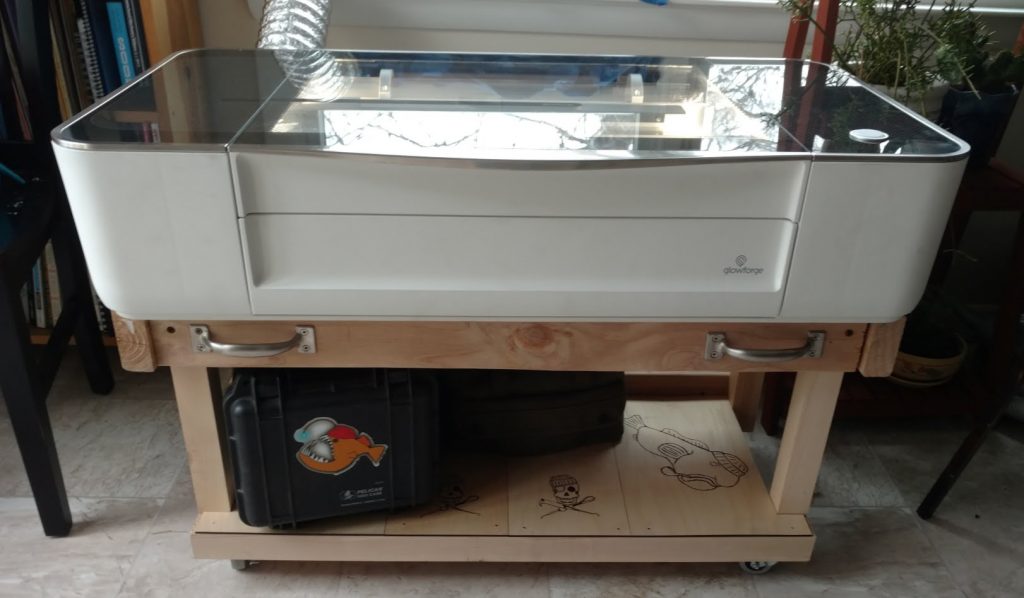
First, the issues of least concern (not because they aren’t bad, just that they’re far less likely to occur).

Fire. Lots of materials can catch fire, including, to no one’s surprise, wood. A fire safety plan will go a long way, but you can avoid ruining your laser cutter by being aware of what materials frequently catch fire. ABS, HDPE, polystyrene and polypropylene, and anything with poor thermal properties is going to ignite rather than cut cleanly. And then you’re going to have a bad day.

Beam escape. If your machine is not well taken care of and well shielded, there’s a small chance the wrong materials or loose connections can result in a beam escape, which can injure the user, bystanders, pets, or anything else that gets in the laser’s path. Most hobby grade lasers have good safety features to prevent this (although cheap knock-off machines are starting to hit the markets that may not be up to par), but monitoring you equipment and keeping it properly maintained will go a long way to avoiding this.

But those aren’t the biggest concerns. Th biggest concern with laser cutters is the byproduct that happens every time you cut, no mater what. That’s right, I’m talking about:

Fumes! 

This is the big one and the issue that I’m most concerned about. Laser cutters haven’t really left industrial settings until now, so we don’t have very good data on chronic exposures of laser cutting fumes, especially on young children and pregnant people. What we do know is that the fumes produced by laser cutter depend heavily on the materials you choose to cut.

All materials will produce fumes when cut, which is why it’s essential that your set-up is well-ventilated. Most hobby cutters have a vent port that you can connect to a dryer vent or to the outside. I actually don’t recommend using a dryer vent. In all the rental houses I’ve lived in, not one has ever had the dryer properly vented, and hooking up to your dryer port might mean that you’re just venting into the crawlspace or the wall, rather than out of you house. Go for the window. There’s no hard and fast rule for how much ventilation you need, other than as much as possible. For 3D printers we recommended that your ventilation system moves 3 times as much air as the volume of the room per hour. For laser cutters, it should probably be more.

Everything you cut is going to release volatile organic compounds (VOCs), which is why ventilation is essential. For things like hardwoods and paper products, the VOCs released are comparable to a woodburning stove, frying too much bacon, or sitting around a campfire (though sitting around a campfire will give you a much higher dose). Prolonged exposure can cause respiratory problems and asthma. More complex materials like plywoods and plastics can have some pretty nasty compounds, so you want to make absolutely sure you know what’s going into your laser cutter, be aware of what materials should never, ever go into you household cutter, and always ventilate, ventilate, ventilate.


Read More “A precautionary approach to health and safety while using awesome, awesome laser cutters in the home.” »

Walking fish and microbe warfare: Thursday Afternoon Dredging, February 15, 2018

Posted on February 15, 2018 By David Shiffman
Uncategorized

Cuttings (short and sweet):  Follow Katelyn Heman, a marine conservation biologist working at the Georgia Aquarium, on twitter! What this walking fish can teach us about evolution. By Sarah Gibbens, for National Geographic Fish forego sleep thanks to this molecule in their brain. From Nature’s Animal Behavior news. Microplastics pollute even the most remote parts of … Read More “Walking fish and microbe warfare: Thursday Afternoon Dredging, February 15, 2018” »

Dear Shark Man, do open ocean sharks use nursery areas?

Posted on February 14, 2018February 14, 2018 By David Shiffman
Uncategorized

Welcome to  Dear Shark Man, an advice column inspired by a ridiculous e-mail I received. You can send your questions to me via twitter (@WhySharksMatter) or e-mail (WhySharksMatter at gmail).


Dear Shark Man,

I know that sharks that live close to the coast sometimes use “nursery areas” when they are young. Do open ocean sharks also use nursery areas?
Sincerely,
Nosey in North Carolina 

Read More “Dear Shark Man, do open ocean sharks use nursery areas?” »

Insect-eating salmon and cloned crayfish: Thursday Afternoon Dredging, February 8th, 2018

Posted on February 8, 2018 By David Shiffman
Uncategorized

Cuttings (short and sweet):  Follow wildlife illustrator Marc Dando on twitter! The rise of fishing apps. By the Fisheries Blog. Misled penguins swim to fishing grounds that no longer have food. By Katie Peek, for Scientific American Spoils (long reads and deep dives): A pet crayfish is cloning itself and spreading around the world. By Sarah … Read More “Insect-eating salmon and cloned crayfish: Thursday Afternoon Dredging, February 8th, 2018” »

Texting about ichthyology and climate change’s effects on indigenous culture: Thursday Afternoon Dredging, February 1st, 2018

Posted on February 1, 2018February 1, 2018 By David Shiffman
Uncategorized

Cuttings (short and sweet):  Follow Skye Augustine, a marine biologist studying traditional indigenous fisheries management practices, on twitter! A plate of lies: seafood mislabeling. By Meghan Fox, for the Fisheries Blog. 2017 was the hottest year yet for the world’s oceans. By Sarah Gibbens, for National Geographic. Helping sound out of water: new materials could help … Read More “Texting about ichthyology and climate change’s effects on indigenous culture: Thursday Afternoon Dredging, February 1st, 2018” »

Dear Shark Man, is the aquarium trade a major shark conservation issue?

Posted on January 31, 2018 By David Shiffman
Uncategorized

Welcome to  Dear Shark Man, an advice column inspired by a ridiculous e-mail I received. You can send your questions to me via twitter (@WhySharksMatter) or e-mail (WhySharksMatter at gmail).


Dear Shark Man,

What are your thoughts on elasmobranchs in the pet and aquarium trade? Is this a serious conservation issue?

Sincerely,
Nonchalant in New Zealand 

Read More “Dear Shark Man, is the aquarium trade a major shark conservation issue?” »

Imaginary islands, lobster pain, porgs and puffins: Thursday Afternoon Dredging, January 25th, 2018

Posted on January 25, 2018January 25, 2018 By David Shiffman
Uncategorized

Cuttings (short and sweet):  Follow Kelsey James, a graduate student studying the age and growth of batoid fishes, on twitter! Ancient maps show islands that don’t really exist. By Greg Miller, for National Geographic. Global registry of invasive species is a milestone for conservation. By Jonathan Watts, for the Guardian. Want to buy a tshirt, mug, … Read More “Imaginary islands, lobster pain, porgs and puffins: Thursday Afternoon Dredging, January 25th, 2018” »

Sinking squid, salmon-eating seals, and rebounding cod: Thursday Afternoon Dredging, January 18th 2018

Posted on January 18, 2018January 19, 2018 By David Shiffman
Uncategorized

Cuttings (short and sweet): 

  • Follow Dr. Toby Daly-Engel’s shark research lab on twitter!
  • Cod catch at an all-time low, but a rebound could be near. By Patrick Whittle, for the Associated Press.
  • Right whale died from fishing gear. From CBC News

Read More “Sinking squid, salmon-eating seals, and rebounding cod: Thursday Afternoon Dredging, January 18th 2018” »

Dear Shark Man, can rubbing a shark’s snout cause blindness?

Posted on January 17, 2018January 17, 2018 By David Shiffman
Uncategorized

Welcome to  Dear Shark Man, an advice column inspired by a ridiculous e-mail I received. You can send your questions to me via twitter (@WhySharksMatter) or e-mail (WhySharksMatter at gmail).


Dear Shark Man,

Someone I follow on Instagram posted this earlier this week. In this post, she claims that a shark became blind in one eye because SCUBA divers were regularly rubbing it’s snout. Is that a thing? It doesn’t seem like a thing.

Sincerely,
Frustrated in Fort Lauderdale 

Read More “Dear Shark Man, can rubbing a shark’s snout cause blindness?” »

Posts pagination

Previous 1 … 10 11 12 … 120 Next

Popular Posts

Getting a sense of porpoiseJanuary 20, 2009Andrew Thaler
That's not a blobfish: Deep Sea Social Media is Flooded by AI SlopThat's not a blobfish: Deep Sea Social Media is Flooded by AI SlopDecember 19, 2025Andrew Thaler
This is the worst academic presentation in the world ... tributeApril 23, 2015Chris Parsons
Have we found the city of Atlantis?Have we found the city of Atlantis?September 1, 2026Chris Parsons
What Ocean Ramsey does is not shark science or conservation: some brief thoughts on "the Shark Whisperer" documentaryWhat Ocean Ramsey does is not shark science or conservation: some brief thoughts on "the Shark Whisperer" documentaryJuly 2, 2025David Shiffman
The 45 most influential female ecologists alive today according to twitterThe 45 most influential female ecologists alive today according to twitterFebruary 10, 2014Guest Writer
Ethical Debate: Killing sharks for science?Ethical Debate: Killing sharks for science?June 1, 2010David Shiffman
What is a Sand Shark?What is a Sand Shark?November 12, 2017Chuck Bangley
Our favorite sea monsters – Ningen (#4)Our favorite sea monsters – Ningen (#4)September 7, 2010Andrew Thaler
No, harassing a shark for fun is not ethically equivalent to scientific research that helps conserve a speciesNo, harassing a shark for fun is not ethically equivalent to scientific research that helps conserve a speciesMarch 26, 2014David Shiffman
Subscribe to our RSS Feed for updates whenever new articles are published.

We recommend Feedly for RSS management. It's like Google Reader, except it still exists.

Southern Fried Science

  • Home
  • About SFS
  • Authors
  • Support SFS


If you enjoy Southern Fried Science, consider contributing to our Patreon campaign.

Copyright © 2026 Southern Fried Science.

Theme: Oceanly Premium by ScriptsTown