Happy Friday Everyone! We frequently link to other important marine and general science blogs, to the extent that regular readers can probably guess which science blogs we read and how often, but science isn’t everything. We decided to take a moment to tell y’all about the non-science blogs that we enjoy.
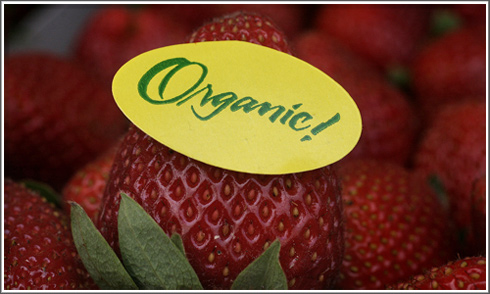
knowledge of plants has mean money, if not power, www.mindfully.org
Foucault saw the concepts of knowledge and power as one entity, which he called “pouvoir-savoir”, based on the philosophy that knowledge and power are co-evolved. There are a number of examples where Foucault’s assertion seem to be correct. In France, a group of patients with muscular dystrophy coordinated and collected vast amounts of collective data on the rare disease by detailed recordkeeping by family members. They even held their own conferences and shared information, eventually bringing in a couple of doctors to do standard medical analysis on their data. Armed with knowledge of the disease, they were able to confront the medical establishment, which had previously ignored their cases because so little was known about the disease and the doctors did not want to look ignorant. Public attention brought by these events also brought funding to an otherwise unprofitable treatment regiment (Rabeharisoa and Callon in Jasanoff 2004). In other parts of the world, knowledge of medicinal plants and other helpful plant genotypes has been linked to indigenous rights movement through intellectual property (Whatmore 2002). Plant germplasms have become a way for communities to connect to international groups supporting biodiversity, which in turn helps secure indigenous rights over both intellectual and land properties.
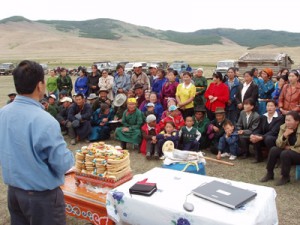
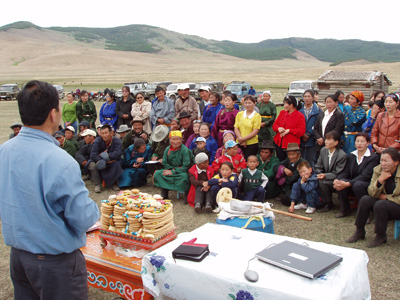
policymaking during comanagement in Mongolia, rcinet.ca
Two of Ostrom’s (1990) institutional design principles emphasize the role of the local –rules must be adapted to local conditions and resource users must participate in the rulemaking process. These principles were determined empirically through cross-site analysis, but a large body of research from science studies supports these finding theoretically as well. The most clear example of including the community in management is through comanagement, which works at the collective level to shift how and where rules are made (Jentoft, McCay et al. 1998). The comanagement process also highlights the importance of different types of knowledge to the policy process by providing a more complete base of information on which to make decisions.
The supporting theory reaches back to early studies in game theory that determined the fairness of a rule was one of the critical factors in determining if cooperation would emerge (Axelrod 1984). Fairness does not necessarily mean that every citizen benefits equally, but instead that people are punished according to their transgressions and benefit according to their contributions. However, the perception of fairness matters more than actual fairness when people evaluate a policy. That perception depends on transparency of the policymaking process. Gusterson goes so far as to say “instead of seeking a definitive technical judgment, then, we should ask about the processes by which judgments come to be considered definitive and their authors authoritative” (Nader 1996). People are more likely to consider a policy fair if they consider the process fair. One way, arguably the best way, to make the process transparent and therefore fair is to involve citizens in that process.
This 2011 Beneath the Waves Film Festival entry comes from Kathleen Frith of Harvard Medical School. It tells the story of a spell that has been cast on the world to make us forget the ocean, and a little girl who tries to remember.
Southern Fried Science is back online. We hope you didn’t miss us too much. If you hadn’t noticed, we had a bit of server trouble this week, but everything is back to normal. Special thanks to the tech support at BlueHost.com who were patient, professional, and exceptionally helpful walking us through the repairs.
This week’s comment of the week is in response to last week’s open thread. Mark Gibson gave a thoughtful response to the challenges of high seas governance, ending with the following strategy: End fishing subsidies at the WTO. Fishing subsidies have greatly distorted the world’s fishing capacity. By one study, the global fishing fleet needs … Read More “Comment of the Week” »
So far this month, we’ve asked what sustainability mean to you, what changes you’ve made to lead a more sustainable life, and what changes society needs to make. Our final open thread for Science and Sustainability month is not about the things we know, or the things we believe, but the things we don’t know. Sustainable living is fraught with … Read More “What we don’t know can hurt us – the final open thread” »
The squishiness of the term sustainability also offers people pick of what they choose to think about and what kinds of changes they want to make in their lives. I return this week from a week of thinking about spaces of sustainability during the American Assocation of Geographers conference, where the series of sessions entitled “food alterity” was standing room only. One of the speakers started off her talk with the question “why are we all so obsessed with food, what it is about food that gets people excited where we really should be excited about energy”. She went on to give a fascinating talk about who gets to write the grower’s manual for organic strawberries (literally, it’s apparently a power struggle over legitimate knowledge). But her first question really stuck with me.


 The squishiness of the term sustainability also offers people pick of what they choose to think about and what kinds of changes they want to make in their lives. I return this week from a week of thinking about spaces of sustainability during the American Assocation of Geographers conference, where the series of sessions entitled “food alterity” was standing room only. One of the speakers started off her talk with the question “why are we all so obsessed with food, what it is about food that gets people excited where we really should be excited about energy”. She went on to give a fascinating talk about who gets to write the grower’s manual for organic strawberries (literally, it’s apparently a power struggle over legitimate knowledge). But her first question really stuck with me.