Skip to content

Southern Fried Science

Over 15 years of ocean science and conservation online

  • Home
  • About SFS
  • Authors
  • Support SFS

Category: Uncategorized

Assumptions on Human Behavior

Posted on April 12, 2011April 12, 2011 By Bluegrass Blue Crab
Uncategorized

Sustainability is as much about personal decisions as it is about broad social movements or top-down government rules. Those personal decisions are rooted deeply in how we behave as human beings, and that is something that science is far from understanding.

Adam Smith once said “we are not ready to suspect any person of being defective in selfishness (Smith 1804). In many neoclassical economics studies, humans are assumed to act rationally – that is, they act in their own self-interest (known as rational choice theory. Self-interest is generally calculated by financial gain, but more progressive economists will include other factors in the formation of their utility curves such as time resources. The idea spreads beyond economics, however, into other disciplines such as evolutionary biology. For example, Richard Dawkins has argued for the “selfish gene”(2006) attributing all animal behavior to propagation of their genes. He goes so far as to say that any observed “altruism” is actually benefitting individuals with shared genes, so is still essentially selfish behavior.


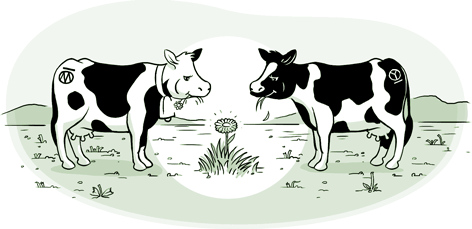
Hardin's original example: cows sharing a field, cred.columbia.edu

Perhaps the most cited example of the rational actor is Garrett Hardin’s “Tragedy of the Commons” (1968). Hardin describes the scenario of a common field in which people have the opportunity to graze their cows. Each person adding an additional cow degrades the field a little more, but the costs are split among all users while the benefits go solely to the owner of the cow. According to the rational choice model of human behavior, people then have the incentive to add more and more cows until the field is no longer useable. He concludes his analysis by implying only two solutions – privatization or strong central governmental control.

Read More “Assumptions on Human Behavior” »

Spanning the Bordeaux Belt – what does local mean in a global economy

Posted on April 11, 2011 By Andrew Thaler 8 Comments on Spanning the Bordeaux Belt – what does local mean in a global economy
Uncategorized

A small news article from Science has been taped above my desk for the last few years. I don’t remember who originally gave it to me, or why I even hung it up, but there it is, nestled between a couple XKCD cartoons. The article is titled “The Wine Divide” and it raises many questions about sustainability, inherent biases in conventional wisdom, and what the term “local” means in a global economy. And it’s about wine.

Read More “Spanning the Bordeaux Belt – what does local mean in a global economy” »

What steps have you taken to lead a more sustainable life?

Posted on April 11, 2011April 18, 2011 By Andrew Thaler 3 Comments on What steps have you taken to lead a more sustainable life?
Uncategorized

It’s the second week of Science and Sustainability month, and this time we want to know what you have done to lead a more sustainable life. Be as specific or as general as you want. Do you reuse items that you’d normally throw away, bike instead of drive, compost your trash? Have you made dramatic … Read More “What steps have you taken to lead a more sustainable life?” »

Science and Sustainability Comment of the Week

Posted on April 10, 2011April 10, 2011 By Andrew Thaler 1 Comment on Science and Sustainability Comment of the Week
Uncategorized

We launched Science and Sustainability month with an open thread, asking our readers “What does sustainability mean to you?” We received several truly stellar comments, but can, unfortunately, only choose one to be our comment of the week. Congratulations to Mark Gibson, who said:

Read More “Science and Sustainability Comment of the Week” »

Weekly dose of TED: Hans Rosling and the Magic Washing Machine

Posted on April 8, 2011April 3, 2011 By Andrew Thaler 2 Comments on Weekly dose of TED: Hans Rosling and the Magic Washing Machine
Uncategorized

Hans Rosling has an important and often overlooked message about how the decisions made by the wealthiest affect the poorest and where we need to focus our goals when we talk about sustainability.  

Donate to Bonehenge!

Posted on April 7, 2011 By Andrew Thaler
Uncategorized

As part of our month of Sustainability and Science, we’re raising money to help complete Bonehenge. Bonehenge is the skeleton of a Sperm Whale that stranded on Cape Lookout several years ago. Over the last three years, Keith Rittmaster and an army of volunteers from the North Carolina Maritime Museum have been working to re-articulate the skeleton for a display at their Gallants Channel campus.

The protect is a shining example of outreach and community engagement. School groups tour the assembly facility regularly and get a first hand look at the process of reconstructing a full sized whale. Over the course of the project, several new discoveries about sperm whale physiology have been made, including the extreme degree of asymmetry that results in one side of the whale have fewer and smaller bones than the other.

During this month we will match all donations up to $250. There is a widget to your left to make donation through paypal. Even a couple of dollars goes a long way towards making this exhibit a reality.

Read More “Donate to Bonehenge!” »

An Alaskan Lesson

Posted on April 6, 2011April 6, 2011 By Bluegrass Blue Crab 4 Comments on An Alaskan Lesson
Uncategorized

The pig to clean the pipeline, http://www.fotopedia.com/items/flickr-3906190629

Every time I see the slogan “drill baby drill” appear as a response to recent rises in gas prices, I think back to the short time I lived in Alaska. Spanning the summer of 2007, my short adventure in Fairbanks left me with much to think about. One of the most surprising was the lessons learned from $5.30 gas prices – in a state that pays its residents dividends from its large oil production.

Long story short, Alaskan oil isn’t the cleanest – in fact, refineries in the U.S. don’t touch the stuff. Alaskan oil is thick and heavy, to the point where the pipeline has a special cleaning tool known as a pig to keep the oil flowing. Most of the oil is then shipped to relatively nearby markets in Japan and Korea, while oil in Alaska itself is either put through a more rigorous processing or shipped from elsewhere in the world.

Read More “An Alaskan Lesson” »

Biodiversity Wednesday: The Green Spaces of New York

Posted on April 6, 2011April 5, 2011 By Andrew Thaler
Uncategorized

Biodiversity matters, even in the heart of one of America’s largest cities. New York City is possibly one of the most altered environments in which humans live. Even here, among the towering buildings of the concrete jungle, there are green spaces, and in these green spaces, biodiversity thrives.

Read More “Biodiversity Wednesday: The Green Spaces of New York” »

Beneath the Waves Film Festival: Some Things Aren’t Reversible

Posted on April 4, 2011April 4, 2011 By David Shiffman 1 Comment on Beneath the Waves Film Festival: Some Things Aren’t Reversible
Uncategorized

The latest 2011 Beneath the Waves Film Festival movie, Some Things Aren’t Reversible, comes to us from students at the Wrigley Institute for Environmental Studies (USC).  Students in Dr. Randy Olson’s course had 48 hours to write, film, and edit their movies.  

What does sustainability mean to you?

Posted on April 4, 2011April 10, 2011 By Andrew Thaler 13 Comments on What does sustainability mean to you?
Uncategorized

The word ‘sustainable’ has been appearing everywhere recently. New eco-friendly products, certain fisheries, agricultural and land management programs, even new housing developments bear the sustainable brand. People talk about leading more sustainable lives, buying sustainable food, and using sustainable energy. What do we really mean when we says sustainable? Is something sustainable just because it … Read More “What does sustainability mean to you?” »

Posts pagination

Previous 1 … 49 50 51 … 119 Next

Popular Posts

Playing God - How the ESA "God Squad" just voted for the extinction of a uniquely American whalePlaying God - How the ESA "God Squad" just voted for the extinction of a uniquely American whaleApril 9, 2026Southern Fried Science
The story of the pride flag made from NASA imagery: Bluesky's most-liked imageThe story of the pride flag made from NASA imagery: Bluesky's most-liked imageSeptember 27, 2024David Shiffman
Here's how to join my IMCC8 symposium, "Ocean Science Communication: What's New and What's Next?"Here's how to join my IMCC8 symposium, "Ocean Science Communication: What's New and What's Next?"April 22, 2026David Shiffman
What Ocean Ramsey does is not shark science or conservation: some brief thoughts on "the Shark Whisperer" documentaryWhat Ocean Ramsey does is not shark science or conservation: some brief thoughts on "the Shark Whisperer" documentaryJuly 2, 2025David Shiffman
Our favorite sea monsters – Ningen (#4)Our favorite sea monsters – Ningen (#4)September 7, 2010Andrew Thaler
Join Me at Upwell: A Wave of Ocean Justice — Our Fourth Year!Join Me at Upwell: A Wave of Ocean Justice — Our Fourth Year!March 24, 2026Angelo Villagomez
On the clarity of animals: the art and science of clearing and stainingOn the clarity of animals: the art and science of clearing and stainingDecember 17, 2013Guest Writer
Shark of Darkness: Wrath of Submarine is a fake documentaryShark of Darkness: Wrath of Submarine is a fake documentaryAugust 10, 2014Michelle Jewell
What can the funniest shark memes on the internetz teach us about ocean science and conservation?What can the funniest shark memes on the internetz teach us about ocean science and conservation?November 8, 2013David Shiffman
That's not a blobfish: Deep Sea Social Media is Flooded by AI SlopThat's not a blobfish: Deep Sea Social Media is Flooded by AI SlopDecember 19, 2025Andrew Thaler
Subscribe to our RSS Feed for updates whenever new articles are published.

We recommend Feedly for RSS management. It's like Google Reader, except it still exists.

Southern Fried Science

  • Home
  • About SFS
  • Authors
  • Support SFS


If you enjoy Southern Fried Science, consider contributing to our Patreon campaign.

Copyright © 2026 Southern Fried Science.

Theme: Oceanly Premium by ScriptsTown