Skip to content

Southern Fried Science

Over 15 years of ocean science and conservation online

  • Home
  • About SFS
  • Authors
  • Support SFS

Category: Uncategorized

Ocean apps and beluga migrations: Thursday Afternoon Dredging, April 19th, 2018

Posted on April 19, 2018 By David Shiffman
Uncategorized

Cuttings (short and sweet):  Follow marine scientist and public educator Maeva Gauthier on twitter! Want to save the ocean? There’s an app for that! By Tim Fitzgerald, for the EDF blog. Historic deal to curb shipping emissions. By Anna Hirtenstein, for Bloomberg. Spoils (long reads and deep dives): How culture guides belugas arctic odyssey. By Joshua … Read More “Ocean apps and beluga migrations: Thursday Afternoon Dredging, April 19th, 2018” »

America’s Second-Largest Estuary is a Lagoon Full of Sharks

Posted on April 12, 2018April 15, 2018 By Chuck Bangley 5 Comments on America’s Second-Largest Estuary is a Lagoon Full of Sharks
Uncategorized
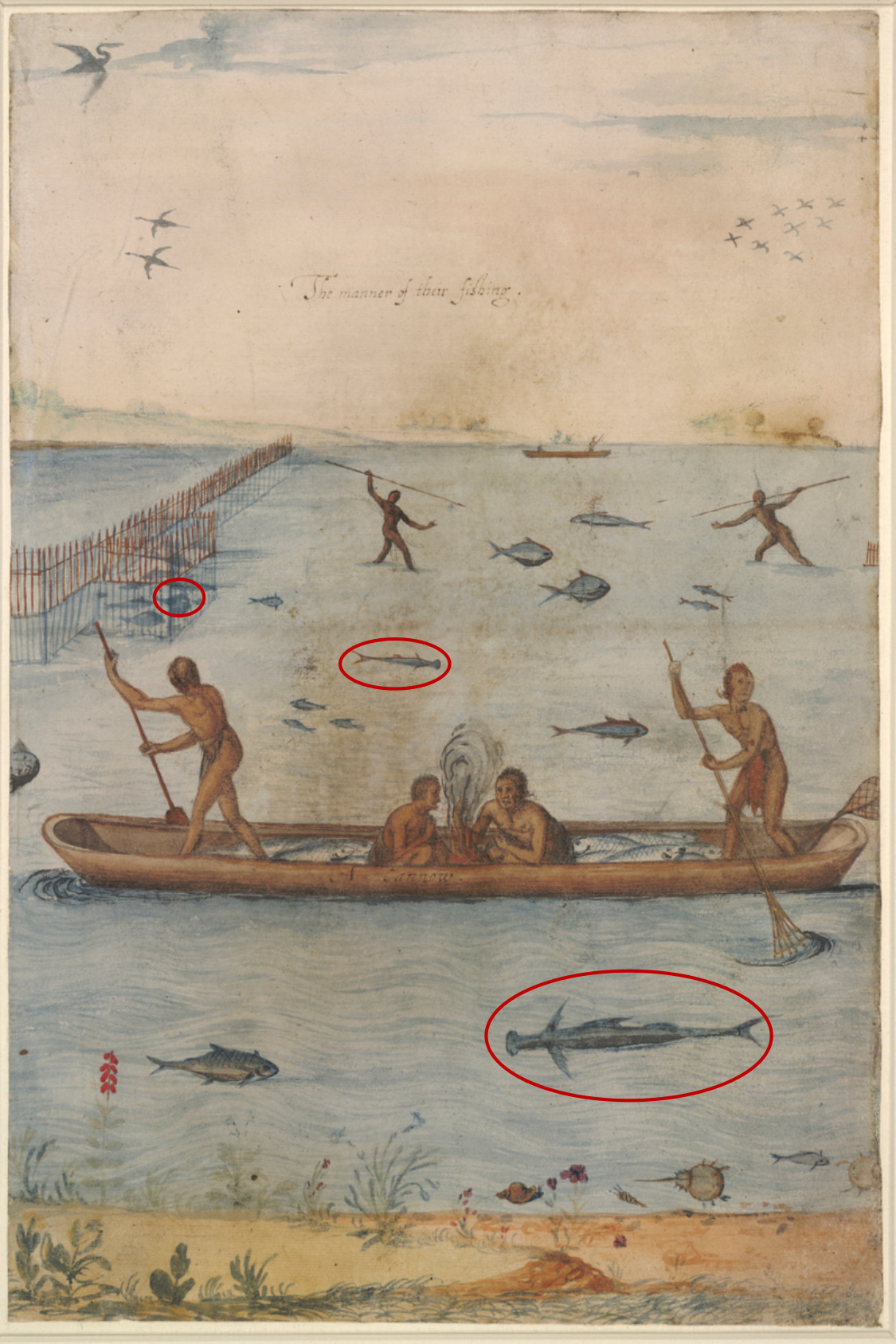
I’ve defaced this colonial-era image of Native American fishing methods from Roanoke Island, NC to show that sharks have been observed in North Carolina’s estuaries for quite some time. Original art: “The Manner of Their Fishing” by John White.

It’s a bit of a cliché to reference the movie Jaws when talking about sharks, but I’m going to do it anyway. There’s a pivotal scene where the giant White Shark is spotted moving into a salt pond, where it proceeds to terrorize the children of protagonist Chief Martin Brody. While no sharks are in the business of regularly eating humans, at least part of this scene is realistic: sharks do make use of inshore, estuarine environments like lagoons, bays, and the lower portions of rivers. Despite the fact that sharks are generally thought to stay out in the ocean, many species are not only comfortable entering estuaries, they actually depend on them. Some species make extensive use of estuaries as shelter from predators and/or a place to grab a bite themselves.

So it should come as no surprise that North Carolina’s Pamlico Sound, part of the Albemarle-Pamlico estuary (the second-largest in the continental U.S. after Chesapeake Bay) offers a lot of potential real estate for sharks. Unlike Chesapeake Bay, Pamlico Sound is a lagoon, which means it’s wide, shallow, mostly water, and connected to the ocean via fairly small inlets between barrier islands. It straddles the transition zone marked by Cape Hatteras between temperate and subtropical marine ecosystems, and the amount of seagrass growth there is second only to Florida in sheer area. This estuary is already well-known for its importance as habitat for such varied (as well as tasty and/or fun to catch) species as Blue Crab, Penaeid shrimps, Flounder, and Red Drum. However, the sharks of Pamlico Sound have mostly been known by scattered reports and sightings from fishermen. That is, until my co-authors and I were able to look through a nice data set to get an idea of which sharks are present in the sound and where in the estuary they might like to be. The results are now published in PLOS One, and here’s a quick summary of how we got them.

Read More “America’s Second-Largest Estuary is a Lagoon Full of Sharks” »

Sea monsters and saving kelp: Thursday Afternoon Dredging, April 12, 2018

Posted on April 12, 2018April 11, 2018 By David Shiffman 1 Comment on Sea monsters and saving kelp: Thursday Afternoon Dredging, April 12, 2018
Uncategorized

Cuttings (short and sweet):  Follow graduate student Justine Hudson, who studies arctic marine mammals, on twitter. Prehistoric “sea monster” could be largest that ever lived. By John Pickrell, for National Geographic. Right whales think before they speak. By Jason Goldman, for Scientific American. UK could create 5,000 jobs by improving seafood sustainability. By Fiona Harvey, for … Read More “Sea monsters and saving kelp: Thursday Afternoon Dredging, April 12, 2018” »

Dear Shark Man, what’s the deal with those notches on shark tails?

Posted on April 11, 2018April 11, 2018 By David Shiffman
Uncategorized

Welcome to  Dear Shark Man, an advice column inspired by a ridiculous e-mail I received. You can send your questions to me via twitter (@WhySharksMatter) or e-mail (WhySharksMatter at gmail). Dear Shark Man, Why do sharks tend to have those little notches in their tail fin? Is it like an aerodynamic thing? If you were to fill … Read More “Dear Shark Man, what’s the deal with those notches on shark tails?” »

Invisible squid and fish with glowing eye spikes: Thursday Afternoon Dredging, April 5th, 2018

Posted on April 5, 2018April 2, 2018 By David Shiffman
Uncategorized

Cuttings (short and sweet):  Follow Louise Chavarie, an Arctic aquatic ecologist, on twitter! A squid-skin inspired invisibility cloak. From Nature News research updates. Underwater noise pollution disturbs fish, too. From CBC News. NOAA publishes list of global fisheries and their risks to marine mammals. By John Cannon, for MongaBay Antarctic ice melting faster than thought. By … Read More “Invisible squid and fish with glowing eye spikes: Thursday Afternoon Dredging, April 5th, 2018” »

Giant whales and collapsing cod stocks: Thursday Afternoon Dredging, March 29th, 2018

Posted on March 29, 2018 By David Shiffman
Uncategorized

Cuttings (short and sweet):  Follow shark and ray biologist Jeremy Vaudo on twitter! Science may have a reason why whales get so big. By Carrie Arnold, for National Geographic. Paleo profile: The fish from China. By Brian Switek, for Scientific American. Mass stranding in Australia claims 130 whales. Video, for the Guardian. Spoils (long reads and … Read More “Giant whales and collapsing cod stocks: Thursday Afternoon Dredging, March 29th, 2018” »

Migrating mullet and expanding garbage patches: Thursday Afternoon Dredging, March 22, 2018

Posted on March 22, 2018 By David Shiffman
Uncategorized

Cuttings (short and sweet):  Follow science illustrator Bethann Garramon Merkle on twitter! Great Pacific Garbage Patch is sprawling with more debris than thought. By Oliver Milman, for the Guardian. In Bali fish die-off, a human hand is suspected. By Luh De Suriyana, for MongaBay. Spoils (long reads and deep dives): Mullet Mania. By Michael Patrick O’Neill, … Read More “Migrating mullet and expanding garbage patches: Thursday Afternoon Dredging, March 22, 2018” »

Endangered turtles and fish venom: Thursday Afternoon Dredging, March 15, 2018

Posted on March 15, 2018March 13, 2018 By David Shiffman
Uncategorized

Cuttings (short and sweet):  Follow marine conservation biologist Julia Spaet on twitter! Nearly half of freshwater turtles are at risk of extinction. By John Platt, for Revelator. Fishing bots “going dark” raise suspicion of illegal fishing. By Scott Neuman, for NPR. Ocean sensors can track progress on climate goals. By Joellen Russell, for Nature News. Spoils (long … Read More “Endangered turtles and fish venom: Thursday Afternoon Dredging, March 15, 2018” »

#Make4thePlanet Borneo is coming! Team Applications are Open!

Posted on March 13, 2018March 11, 2018 By Andrew Thaler
Uncategorized

Make for the Planet is back! And this time, rather than the atrium of the Ronald Reagan Building, it’ll be in beautiful, sunny, Sarawak, Borneo!

Trading the robot orangutans for actual orangutans.

To ensure a better future for our planet, conservation experts need to work with solutions, technologies, and expertise from diverse fields to greatly improve the efficacy, speed, cost, scale, and sustainability of conservation efforts.  Ocean acidification, invasive species, marine protection, overfishing, coral reef degradation – we are aware of the many problems faced by our oceans, and humankind has the ingenuity and optimism to solve them!

How can you help solve ocean conservation challenges? Participate in Make for the Planet Borneo and create solutions to conservation challenges in front of a global audience at the 5th International Marine Conservation Congress (IMCC5) in Kuching, Sarawak, Malaysia June 24-29, 2018!  Team applications are open now through April 1st, 2018. Apply here!

Read More “#Make4thePlanet Borneo is coming! Team Applications are Open!” »

Giant penguin colonies and tiny squid: Thursday Afternoon Dredging, March 8th, 2018

Posted on March 8, 2018 By David Shiffman
Uncategorized

Cuttings (short and sweet):  Follow Travis Tai, a graduate student studying climate change and fisheries, on twitter! Thumbnail-sized pygmy squid discovered in Australia. By Shreya Dasgupta, for MongaBay. This octopus is 40,000 times heavier than its mate. By Liz Langley, for National Geographic. Seal poo reveals plastic’s path in the sea. Nature research highlights. Grass is … Read More “Giant penguin colonies and tiny squid: Thursday Afternoon Dredging, March 8th, 2018” »

Posts pagination

Previous 1 … 8 9 10 … 119 Next

Popular Posts

Playing God - How the ESA "God Squad" just voted for the extinction of a uniquely American whalePlaying God - How the ESA "God Squad" just voted for the extinction of a uniquely American whaleApril 9, 2026Southern Fried Science
The story of the pride flag made from NASA imagery: Bluesky's most-liked imageThe story of the pride flag made from NASA imagery: Bluesky's most-liked imageSeptember 27, 2024David Shiffman
Here's how to join my IMCC8 symposium, "Ocean Science Communication: What's New and What's Next?"Here's how to join my IMCC8 symposium, "Ocean Science Communication: What's New and What's Next?"April 22, 2026David Shiffman
What Ocean Ramsey does is not shark science or conservation: some brief thoughts on "the Shark Whisperer" documentaryWhat Ocean Ramsey does is not shark science or conservation: some brief thoughts on "the Shark Whisperer" documentaryJuly 2, 2025David Shiffman
Our favorite sea monsters – Ningen (#4)Our favorite sea monsters – Ningen (#4)September 7, 2010Andrew Thaler
Join Me at Upwell: A Wave of Ocean Justice — Our Fourth Year!Join Me at Upwell: A Wave of Ocean Justice — Our Fourth Year!March 24, 2026Angelo Villagomez
On the clarity of animals: the art and science of clearing and stainingOn the clarity of animals: the art and science of clearing and stainingDecember 17, 2013Guest Writer
Shark of Darkness: Wrath of Submarine is a fake documentaryShark of Darkness: Wrath of Submarine is a fake documentaryAugust 10, 2014Michelle Jewell
What can the funniest shark memes on the internetz teach us about ocean science and conservation?What can the funniest shark memes on the internetz teach us about ocean science and conservation?November 8, 2013David Shiffman
That's not a blobfish: Deep Sea Social Media is Flooded by AI SlopThat's not a blobfish: Deep Sea Social Media is Flooded by AI SlopDecember 19, 2025Andrew Thaler
Subscribe to our RSS Feed for updates whenever new articles are published.

We recommend Feedly for RSS management. It's like Google Reader, except it still exists.

Southern Fried Science

  • Home
  • About SFS
  • Authors
  • Support SFS


If you enjoy Southern Fried Science, consider contributing to our Patreon campaign.

Copyright © 2026 Southern Fried Science.

Theme: Oceanly Premium by ScriptsTown