Early this morning, the International Court of Justice declared that Japan’s scientific whaling program in Antarctica violates the International Whaling Commission moratorium, and ordered Japan to stop. This is big news for the marine conservation community, but like many legal policy decisions, it can be difficult to determine exactly what it means. I asked marine mammal biologists, conservation activists, and policy experts to help explain it.
What is the International Court of Justice (ICJ)? The International Court of Justice is essentially the judicial branch of the United Nations. Any of the 192 United Nations member states may submit a case against any other state.
What is the International Whaling Commission (IWC)? The International Whaling Commission is a regulatory body that was founded in 1946 as a result of the International Convention for the Regulation of Whaling treaty. The 88 member nations (any nation can join) regulate whaling and whale conservation issues.
What is “scientific whaling?” Scientific whaling refers to intentionally killing a whale for the purpose of scientific research. According to marine mammal researcher Jake Levenson, this is permitted by Article 8 of the International Convention for the Regulation of Whaling. According to Levenson, “In the 1940’s [when this rule was made,] we didn’t have many of the tools we have now to study whales, so at the time it was thought to be appropriate to kill whales for scientific purposes.” Several experts I spoke to noted that this was never intended to be a large-scale program. Here is a list of some of the scientific research that resulted from the program.
Is it necessary to kill whales to get this data, or are non-lethal methods available? Lethal research is very rarely necessary to answer the kinds of questions Japanese researchers are asking, according to Jake Levenson. “If Japan wanted to find out about whales, they could conduct surveys, use acoustics, and use other internationally agreed upon models.What they call ‘research’ offends me as a marine biologist,” Levenson says.
Chris Parsons, a professor at George Mason University, agrees, and said
“Much of the data gathered by scientific whaling we already know, or can get from other means. The ending of so-called scientific whaling really will be zero loss to science. Much of the data they were collecting was pretty much already known, most of the rest could be gathered by non-lethal means, and the methods that were being used were often controversial and heavily criticized by leading whale researchers”
According to Michelle Klein, a Masters student at Trent University,
“In an era of DNA sampling and remote monitoring, it is my personal opinion that scientists do not need to kill whales to study aspects of their biology that can be determined from other non-lethal measures. If Japan was truly interested in studying the whales’ DNA, blubber content, or contaminant loads (while also sustainably maintaining their populations as they claim), researchers could have collected samples using minimally-invasive, non-lethal methods from skin that whales shed, blubber and fecal matter. Scientists can even collect samples when whales exhale through their blowholes, allowing for detection of pathogens.”
How many whales has Japan killed under their scientific whaling program? Estimates vary. According to ABC news, approximately 3,600 minke whales have been killed under Japan’s scientific whaling program. The IWC scientific permit whaling website counts approximately 15,000, mostly (but not all) from Japan. One expert I spoke to said that the number may be closer to tens of thousands if you count everything.
Didn’t the international whaling commission declare a whaling moratorium years ago? In 1982, the International Whaling Commission declared a global moratorium on “commercial whaling,” (it didn’t come into effect until 1986), but the Japanese “scientific whaling” program is exempt from this. It is worth noting that prior to the moratorium on commercial whaling, there wasn’t much of a Japanese scientific whaling program. Also, nations such as Iceland and Norway simply simply didn’t agree to follow the moratorium, and still have commercial whaling operations, according to Alexis Rudd, a Ph.D. candidate at the University of Hawaii.
Who filed the ICJ suit? Australia filed a claim, “complaining that Japan is violating their obligations under the ICRW by using scientific whaling to cover their commercial operations,” says Jake Levenson. According to Chris Butler-Shroud, the Chief Executive of Whale and Dolphin Conservation , “Part of Australia’s argument was that non-lethal methods are available and the Court ruled that Japan had not sought to examine these, but had continued lethal whaling rather than review appropriately these alternative techniques.”
What was the ICJ ruling? In a 12-4 ruling, the ICJ decided that Japan was conducting a commercial whaling operation, not true scientific research. Japan was ordered to stop killing whales in Antarctica. Parsons said, ““The ruling confirms and vindicates what many scientists (myself included) in the IWC have been saying for decades – that Japan’s program had little to do with science, it is basically commercial whaling in disguise.” You can read the ruling in its entirety here.
Can Japan appeal this ruling? No. ICJ decisions are “final and without appeal.” (see #6).
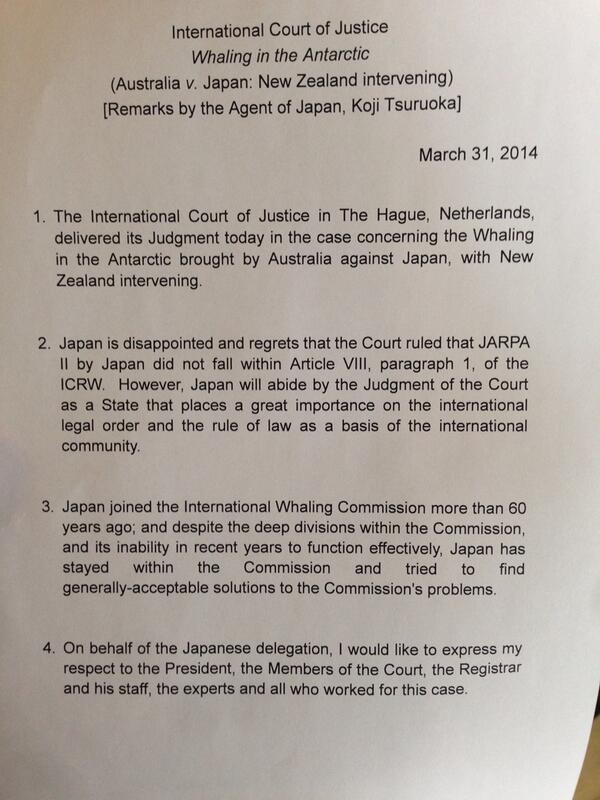
Will Japan comply with this ruling? They’ve officially said that they will comply with the ruling (see #2):
Does this mean that Japan won’t be able to kill any whales anywhere at this point? No. The ruling is restricted to the Antarctic whale sanctuary. Japan also has an ongoing “scientific whaling” program in the North Pacific, as well as commercial whaling in their territorial waters. This doesn’t count killing small cetaceans, such as the dolphin drive-hunt fishery depicted in “the Cove”.
Are any other nations still killing whales? Yes. Iceland and Norway kill minke whales commercially, and Iceland also kills fin whales commercially. There are also nations which practice “aboriginal” and “subsistence” whaling, including the United States. The IWC website has details on the numbers of whales killed by each nation.
How big of a victory is this? Blogger Amy Putnam believes that this is an important ruling because “it sort of officially calls out the fallacy of the scientific whaling program in an unavoidable way. It reduces Japan’s illusion of legitimacy on that count.” According to Angela Recalde Salas, a Ph.D. student at Curtin University, “ethically and politically, this victory is huge., this decision will hopefully lead to a change in the objectives and methodologies of Japan’s cetacean research institute.” Jake Levenson notes that this is the first time that Japan has been a respondent at the ICJ, and that this is the first time an international court has ruled some of Japan’s whaling operations to be illegal and in violation of the commercial whaling moratorium. Additionally, while whaling isn’t the biggest threat to whale populations, it is the most visible and well-known threat, so this represents a major PR victory for the marine conservation community. However,
“something that people need to be clear about though is that scientific whaling has not stopped ! ” emphasized Professor Parsons. “This court case is just related to the practice in Antarctica. In the 2012/13 season 103 minke whales whales were taken in Antarctica verses 321 northern minke, Bryde’s and sei whales in the North Pacific. It’s a victory for the conservation of whales around Antarctica certainly, but whales are still likely to be killed, perhaps even more than are being killed already, in the North Pacific.”
What is the next major issue in marine mammal conservation? Dr. Parsons said, “As the co-convenor of the Environmental Concerns Standing Working Group for the IWC (currently the largest IWC scientific sub-committee) I hope that this means that there will be more focus in the IWC scientific committee on pressing matters such as the impacts of climate change, pollution and noise on whales, as well depletion of populations by-catches and ship strikes. Scientific studies on the impacts of whalewatching is also another important area , and managing whalewatching so that its impacts are reduced to negligible levels, but maximizing its socioeconomic impacts to human communities is also very important.”
A note on the 3,600 figure for the number of whales killed. I am pretty sure that only includes minke whales killed in the Southern Ocean for the JARPA II programme (i.e. since the 2005/2006 whaling season). It doesn’t include other species of whales killed, whales killed in the North Pacific or whales killed in the Southern Ocean for JARPA (JARPA II’s predecessor that began in the 80’s). I’ve come to that understanding from my reading of the ICJ ruling, which states in paragraph 219: “In light of the fact
that JARPA II has been going on since 2005 and has involved the killing of about 3,600 minke whales, the scientific output to date appears limited.”