Skip to content

Southern Fried Science

Over 15 years of ocean science and conservation online

  • Home
  • About SFS
  • Authors
  • Support SFS

Fun Science FRIEDay – Cell Hijack!

Posted on December 12, 2014 By Kersey Sturdivant
Uncategorized

Happy Fun Science FRIEDay!!

This week we bring you work from researchers at the Massachusetts Institute of Technology (MIT), where they discovered a new method to “hijack” cells. Think about it, if we could make our own cells do our bidding, we could reprogram them to do all sorts of wonderful things for us, such as manufacture insulin, attack tumors, etc. But hijacking a cell is no easy venture. In nature viruses can be quite efficient at hijacking cells, and because of this current methods employed by researchers to hijack cells entails penetrating the cell’s wall with a virus. The biggest issue with this method is that it tends to inflict permanent damage on cell.

Image of a virus attacking a host cell. (Photo credit: dbscience3 @ https://dbscience3.wikispaces.com/Sienna)

In 2009 MIT chemical engineer Armon Sharei, and colleagues, discovered by accident another method to hijack cells. They were playing around with a new method of implanting cells with large molecules and nanomaterials using a microscopic water gun. Basically they were trying to insert particles inside of a cell that would alter the cell’s behavior but also not destroy the cell in the process. Sharei noticed that when the cells were shot with water some of them became momentarily misshapen, and while they were material was getting inside! What was occurring was that when pressure was exerted on the cells, small holes formed in the cell membrane allowing for the transmission of particles inside the cell.
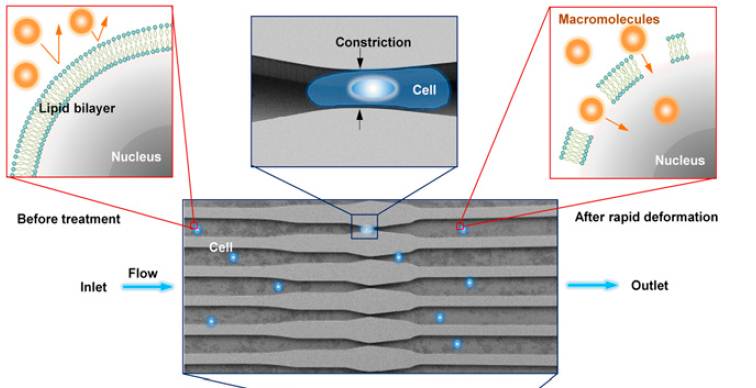
Illustration of delivery hypothesis whereby the rapid deformation of a cell, as it passes through a microfluidic constriction, generates transient membrane holes.  (Photo credit: Sharei et al. 2013, PNAS)
Illustration of delivery hypothesis whereby the rapid deformation of a cell, as it passes through a microfluidic constriction, generates transient membrane holes.
(Photo credit: Sharei et al. 2013, PNAS)

The water gun idea was a bit crude and Sharei worked with colleagues to refine the processes. In the end they developed a silicon-and-glass microchip etched with channels through which cells flow.  As the cells flow through, the channels gradually get narrower, until the gap tapers into a space slimmer than the cells themselves. As the squeezed cells force their way through, temporary holes form in the cell membrane. The tiny holes are wide enough to let in a variety of behavior-altering agents, and apparently this technique even works on stem and immune cells, which are normally too sensitive to be manipulated using previous methods.

Since this initial discovery Sharei and colleagues have produced 16 different chips with channel arrays designed to squeeze different cells. Their chip arrays can process 500,000 cells a second, and Sharei et al. has started a company to commercialize the technology called SQZ Biotech.

You can read the original article published in the Proceedings of the National Academy of Sciences or watch the informative video interactive publication at JOVE.

Happy FSF! 🙂

Share this:

  • Click to share on Bluesky (Opens in new window) Bluesky
  • Click to share on Facebook (Opens in new window) Facebook
  • Click to share on Reddit (Opens in new window) Reddit
  • Click to share on Threads (Opens in new window) Threads
  • Click to share on WhatsApp (Opens in new window) WhatsApp
  • Click to share on Mastodon (Opens in new window) Mastodon

Related

Tags: bioscience biotechnology cells stem-cells virus

Post navigation

❮ Previous Post: What Jaws Teaches Us About Scientists and the Future of Shark Bite Politics
Next Post: No Endangered Listing for Dusky Sharks (and That’s a Good Thing) ❯

You may also like

Uncategorized
Fun Science FRIEDay – Cure for HIV?
May 19, 2017
Blogging
Fun Science FRIEDay – Fasting Fights Cancer?
July 18, 2014
Uncategorized
First DNA-based computer virus jumps the cyborg hardware barrier.
January 16, 2016

Popular Posts

Shark scientists want their research to help save threatened species, but don’t know how. Our new paper can help.Shark scientists want their research to help save threatened species, but don’t know how. Our new paper can help.December 1, 2025David Shiffman
Norway and Cook Islands put their deep-sea mining plans on pause.Norway and Cook Islands put their deep-sea mining plans on pause.December 3, 2025Andrew Thaler
What Ocean Ramsey does is not shark science or conservation: some brief thoughts on "the Shark Whisperer" documentaryWhat Ocean Ramsey does is not shark science or conservation: some brief thoughts on "the Shark Whisperer" documentaryJuly 2, 2025David Shiffman
What we know we don't know: impacts of deep-sea mining on whales, dolphins, sharks, turtles, and other migratory species.What we know we don't know: impacts of deep-sea mining on whales, dolphins, sharks, turtles, and other migratory species.November 20, 2025Andrew Thaler
2025: My year in writing, public speaking, and media interviews2025: My year in writing, public speaking, and media interviewsDecember 3, 2025David Shiffman
The Trouble with Teacup PigsThe Trouble with Teacup PigsOctober 14, 2012Andrew Thaler
Urea and Shark OsmoregulationUrea and Shark OsmoregulationNovember 15, 2010David Shiffman
How tiny satellites are tracking marine wildlifeDecember 1, 2025Andrew Thaler
Shark of Darkness: Wrath of Submarine is a fake documentaryShark of Darkness: Wrath of Submarine is a fake documentaryAugust 10, 2014Michelle Jewell
Quick Tips for Graduate Student Life - Write a Book ReviewJanuary 23, 2014Andrew Thaler
Subscribe to our RSS Feed for updates whenever new articles are published.

We recommend Feedly for RSS management. It's like Google Reader, except it still exists.

Southern Fried Science

  • Home
  • About SFS
  • Authors
  • Support SFS


If you enjoy Southern Fried Science, consider contributing to our Patreon campaign.

Copyright © 2025 Southern Fried Science.

Theme: Oceanly Premium by ScriptsTown