Skip to content

Southern Fried Science

Over 15 years of ocean science and conservation online

  • Home
  • About SFS
  • Authors
  • Support SFS

Fun Science FRIEDay – Shark Daycare

Posted on September 2, 2016September 2, 2016 By Kersey Sturdivant 3 Comments on Fun Science FRIEDay – Shark Daycare
Conservation, Uncategorized

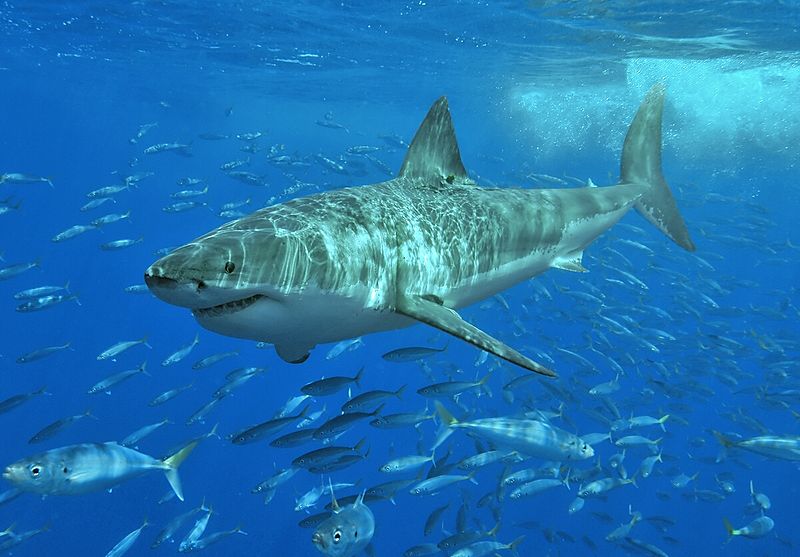
A great white shark nursery in the North Atlantic that was discovered in 1985 south of Cape Cod in the waters off Montauk, New York  has received renewed attention due to the increased activity of white sharks off cape cod in recent years. The nursery was first documented in 1985 by Casey and Pratt who deduced the presence of a nursery based on the number of juvenile sightings and landings in the area. This work was followed up recently  by OCEARCH (an organization dedicated to generating scientific data related to tracking/telemetry and biological studies of keystone marine species such as great white sharks), which tagged and tracked nine infant great whites to the nursery, located a few miles off Montauk.
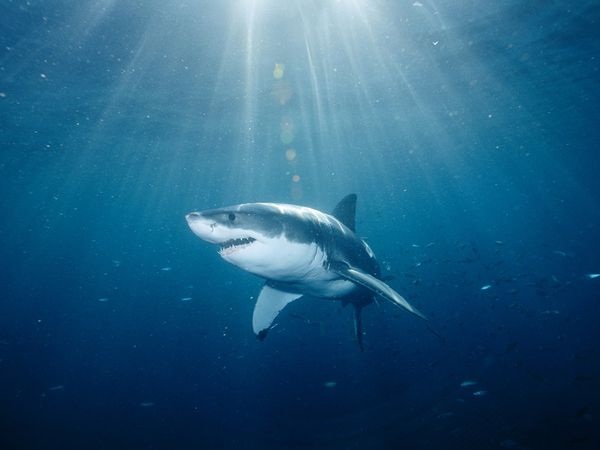
Great White Shark. Image courtesy animals.NationalGeographic.com
Photo of a great white shark in Mexico by Terry Goss, WikiMedia Commons. http://commons.wikimedia.org/wiki/File:White_shark.jpg


The white shark is rare throughout most of the western North Atlantic, but the sighting in and around the cape correlate with presence of the only known nursery in the North Atlantic:


Great whites can live up to 70 years old and they can grow up to 25 feet long and weigh 5,000 pounds.  Despite the fearsome reputation of these majestic creatures, shark attacks on humans are extremely rare — the odds are about one in 12 million. Most shark attack victims survive as bites on humans by sharks are normally exploratory or a case of mistaken identity. This discovery could lead to restrictions on human activity around the nursery in a conservation effort to protect the sharks. Globally 200,000 sharks are killed per day; by contrast, about 10 to 12 human lives are lost yearly as a result of shark attacks.

You can learn more about shark conservation and track shark movements in real-time at the OCEARCH website!


Happy FSF!

*Editors note*

Article was amended to take into account the discovery of this nursery in 1985.

Share this:

  • Click to share on Bluesky (Opens in new window) Bluesky
  • Click to share on Facebook (Opens in new window) Facebook
  • Click to share on Reddit (Opens in new window) Reddit
  • Click to share on Threads (Opens in new window) Threads
  • Click to share on WhatsApp (Opens in new window) WhatsApp
  • Click to share on Mastodon (Opens in new window) Mastodon

Related

Tags: cape cod great white sharks important shark conservation research nursery ground shark conservation

Post navigation

❮ Previous Post: Look at your sharks: how close observation leads to new scientific discoveries
Next Post: Fun Science FRIEDay – Drug Resistant Bacteria, The Movie ❯

You may also like

Conservation
37 things I learned about shark ecology and conservation for my dissertation
December 12, 2016
Conservation
Securing the Conservation of Sharks and Rays
October 10, 2011
Weekly Salvage
The Ocean Cleanup has an ocean of problems, whales, KISS, and more! Weekly Salvage: October 7, 2019
October 7, 2019
Conservation
Bigger than just conservation: The WWF Pacific Shark Heritage Program
September 17, 2014

3 thoughts on “Fun Science FRIEDay – Shark Daycare”

  1. Michael Domeier says:
    September 2, 2016 at 1:28 pm

    It’s disappointing that SFS would perpetuate the myth that Ocearch discovered this white shark nursery area. Doesn’t anyone read the literature anymore?? Perhaps you should read:

    CASEY, J.G. & PRATT, H.L. (1985) Distribution of the white shark Carcharodon carcharias in the Western North Atlantic. Memoirs of the Southern California Academy of Sciences, 9: 2-14

    …and right an article about the pioneers who really made this discovery.

  2. Kersey Sturdivant says:
    September 2, 2016 at 2:18 pm

    Michael, thanks your comment. The 1985 report was brought to my attention by a colleague immediately after publishing this article. By, “doesnt anyone read the literature anymore” statement, I think maybe you are assuming my field of science is sharks (or large pelagic fish). It is not. I study worms. As a result I am not abreast of literature about white sharks from 1985. But that is why as a collective community we are able to utilize the disparate knowledge of everyone to ensure that information is presented correctly. Again, thanks for your feedback.

  3. Michael Domeier says:
    September 2, 2016 at 2:53 pm

    Whether you are writing for an academic journal or a popular publication, there is a responsibility to be factually correct. That means doing the academic or journalistic homework yourself or having someone with the right expertise review the article prior to publication. “Cut and paste” journalism is becoming a big problem in the internet era. Nonetheless, I appreciate that you’ve corrected the mistake.

Comments are closed.

Popular Posts

Shark scientists want their research to help save threatened species, but don’t know how. Our new paper can help.Shark scientists want their research to help save threatened species, but don’t know how. Our new paper can help.December 1, 2025David Shiffman
Norway and Cook Islands put their deep-sea mining plans on pause.Norway and Cook Islands put their deep-sea mining plans on pause.December 3, 2025Andrew Thaler
What Ocean Ramsey does is not shark science or conservation: some brief thoughts on "the Shark Whisperer" documentaryWhat Ocean Ramsey does is not shark science or conservation: some brief thoughts on "the Shark Whisperer" documentaryJuly 2, 2025David Shiffman
The Trouble with Teacup PigsThe Trouble with Teacup PigsOctober 14, 2012Andrew Thaler
What we know we don't know: impacts of deep-sea mining on whales, dolphins, sharks, turtles, and other migratory species.What we know we don't know: impacts of deep-sea mining on whales, dolphins, sharks, turtles, and other migratory species.November 20, 2025Andrew Thaler
2025: My year in writing, public speaking, and media interviews2025: My year in writing, public speaking, and media interviewsDecember 3, 2025David Shiffman
Urea and Shark OsmoregulationUrea and Shark OsmoregulationNovember 15, 2010David Shiffman
Shark of Darkness: Wrath of Submarine is a fake documentaryShark of Darkness: Wrath of Submarine is a fake documentaryAugust 10, 2014Michelle Jewell
How tiny satellites are tracking marine wildlifeDecember 1, 2025Andrew Thaler
Build a dirt cheap, tough-as-nails field computer in a Pelican caseBuild a dirt cheap, tough-as-nails field computer in a Pelican caseJuly 21, 2015Andrew Thaler
Subscribe to our RSS Feed for updates whenever new articles are published.

We recommend Feedly for RSS management. It's like Google Reader, except it still exists.

Southern Fried Science

  • Home
  • About SFS
  • Authors
  • Support SFS


If you enjoy Southern Fried Science, consider contributing to our Patreon campaign.

Copyright © 2025 Southern Fried Science.

Theme: Oceanly Premium by ScriptsTown