Skip to content

Southern Fried Science

Over 15 years of ocean science and conservation online

  • Home
  • About SFS
  • Authors
  • Support SFS

Fun Science FRIEDay – The Break-up

Posted on July 20, 2018 By Kersey Sturdivant
Uncategorized

Our lives are a blip in the space time continuum. As a result, it can seem that the Earth is relatively static, with many of the large scale dynamic changes that shape our sphere largely unnoticeable to us occurring on geological time-scales. One such change is the movement of landmasses on earth, better known as plate tectonics.

Earth’s landmasses are not static but in constant flux. The Earth’s lithosphere (formed by the crust and the upper part of the mantle) is broken up into a number of tectonic plates that move relative to each other at varying speeds, “gliding” over a viscous asthenosphere. There is still ongoing debate about what force or forces causes this movement, but whatever the forces are they can also cause the plates to rupture, forming rifts, and potential leading to the development of new plate boundaries. When this happens landmasses break-up and new continents forms; this is currently happening in the East African Rift in southwestern Kenya.
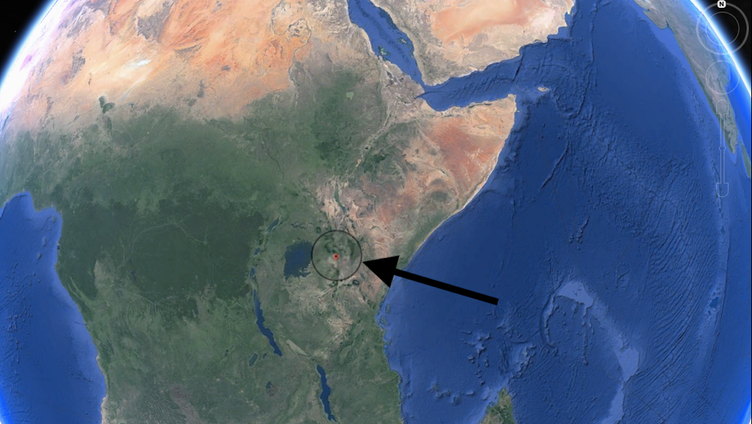
View of East African Rift in Kenya from space (Photo credit: Google Earth. Data SIO, NOAA, US Navy, NGA, GEBCO).

Rifts are the initial stages of continental break-up, and the current rift occurring in Kenya may be the beginning of the African continent splitting into two. It’s very likely this isn’t the first time the continent has split. Around 138 million years ago its been theorized this landmass split from what is now modern day South America.
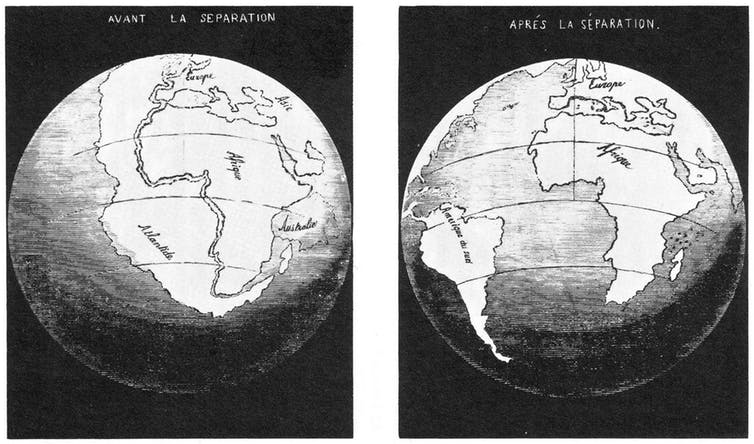
Maps showing the idea of how the American and African continents may once have fitted together. (Photo credit: Snider-Pellegrini)

The East African rift is unique because we can observe different stages of rifting along its length. To the south the rift is young and faulting occurs over a wide area. In the Afar region in Ethiopia, however, the lithosphere has thinned almost to the point of complete break up. When this happens (over a period of tens of millions of years), the ocean will flood into the rift, a new ocean will begin forming, and there will be a large island in the Indian Ocean composed of parts of Ethiopia and Somalia.

To read more about the East African Rift, check out this paper in Geophysical Research Letters, and this publication in the Geological Society of London.
Share this:

  • Click to share on Bluesky (Opens in new window) Bluesky
  • Click to share on Facebook (Opens in new window) Facebook
  • Click to share on Reddit (Opens in new window) Reddit
  • Click to share on Threads (Opens in new window) Threads
  • Click to share on WhatsApp (Opens in new window) WhatsApp
  • Click to share on Mastodon (Opens in new window) Mastodon

Related

Tags: Africa earthquakes east africa ethiopia geology Kenya plate tectonics rift

Post navigation

❮ Previous Post: Writing an Effective Ocean Advocacy Letter
Next Post: Gently jelly-nabbing bots, deep-coral under threat, albino stingrays, #JacquesWeek, and more! Monday Morning Salvage: July 23, 2018 ❯

You may also like

Blogging
Social media as a scientific research tool: Background info for my #scio14 session
February 6, 2014
Two logs, notched and joined, 500,000 years ago
Built to Last
A good joint is built to last: archaeologists uncover evidence for the earliest structural use of wood. 
January 8, 2024
Blogging
Fun Science FRIEDay – The Origin of HIV
November 14, 2014
Weekly Salvage
Eat hagfish, work at LUMCON, clone Vaquita, question floating trash collectors, and more! Monday Morning Mega-Salvage: August 13, 2018
August 13, 2018

Popular Posts

Shark scientists want their research to help save threatened species, but don’t know how. Our new paper can help.Shark scientists want their research to help save threatened species, but don’t know how. Our new paper can help.December 1, 2025David Shiffman
Norway and Cook Islands put their deep-sea mining plans on pause.Norway and Cook Islands put their deep-sea mining plans on pause.December 3, 2025Andrew Thaler
What Ocean Ramsey does is not shark science or conservation: some brief thoughts on "the Shark Whisperer" documentaryWhat Ocean Ramsey does is not shark science or conservation: some brief thoughts on "the Shark Whisperer" documentaryJuly 2, 2025David Shiffman
The Trouble with Teacup PigsThe Trouble with Teacup PigsOctober 14, 2012Andrew Thaler
2025: My year in writing, public speaking, and media interviews2025: My year in writing, public speaking, and media interviewsDecember 3, 2025David Shiffman
What we know we don't know: impacts of deep-sea mining on whales, dolphins, sharks, turtles, and other migratory species.What we know we don't know: impacts of deep-sea mining on whales, dolphins, sharks, turtles, and other migratory species.November 20, 2025Andrew Thaler
Urea and Shark OsmoregulationUrea and Shark OsmoregulationNovember 15, 2010David Shiffman
Shark of Darkness: Wrath of Submarine is a fake documentaryShark of Darkness: Wrath of Submarine is a fake documentaryAugust 10, 2014Michelle Jewell
How tiny satellites are tracking marine wildlifeDecember 1, 2025Andrew Thaler
Build a dirt cheap, tough-as-nails field computer in a Pelican caseBuild a dirt cheap, tough-as-nails field computer in a Pelican caseJuly 21, 2015Andrew Thaler
Subscribe to our RSS Feed for updates whenever new articles are published.

We recommend Feedly for RSS management. It's like Google Reader, except it still exists.

Southern Fried Science

  • Home
  • About SFS
  • Authors
  • Support SFS


If you enjoy Southern Fried Science, consider contributing to our Patreon campaign.

Copyright © 2025 Southern Fried Science.

Theme: Oceanly Premium by ScriptsTown