Skip to content

Southern Fried Science

Over 15 years of ocean science and conservation online

  • Home
  • About SFS
  • Authors
  • Support SFS

Fun Science FRIEDay – Underwater World of Pollination

Posted on October 14, 2016 By Kersey Sturdivant
Science

Pollination. I think most people understand why this is important (or maybe I should say, I hope). To put it simply, the process of pollination facilitates reproduction in plants by transferring pollen from one plant to another. In the terrestrial world, this can be mediated by physical forcing (e.g., wind) or by animals (e.g., insects) – and its why people are freaking out about the loss of bees due to pesticides (because they are a primary pollinator), but I digress. Until relatively recently, pollination by animals was not thought to occur in the ocean. Unlike on land, where most flowering plants rely on creatures to carry pollen, plant reproduction in an aquatic world was surmised to rely exclusively on currents and tides. However, a team of researchers led by marine biologist Brigitta van Tussenbroek revoked the long standing paradigm that pollen in the sea is transported only by water, discovering and documenting the process of zoobenthophilous pollination (a term they coined).
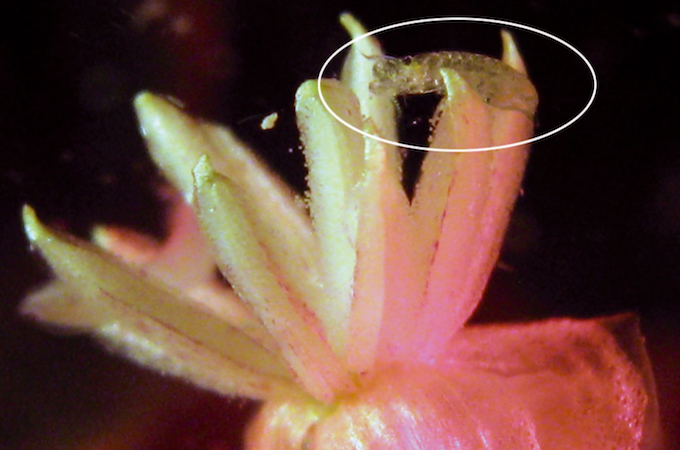
Gamarid amphipod feeding on pollen or mucilage of a male flower of the seagrass Thalassia testudinum at night. (Photo credit: Tussenbroek et al. 2012)
Gamarid amphipod feeding on pollen of a male
flower of the seagrass Thalassia testudinum at night. (Photo credit: Tussenbroek et al. 2012)

These researchers from the National Autonomous University of Mexico observed that tiny crustaceans visiting seagrass beds were covered in grains of pollens. It seemed to van Tussenbroek and her team as if these organisms were most certainly pollinators, but the researchers did not have any definitive proof. As good scientists do, they put their hypothesis to the test. They developed a series of mesocosm based experiments in aquaria, and determined that in the complete absence of current, seagrass flowered only when visited by by crustaceans, i.e., underwater animal pollination!
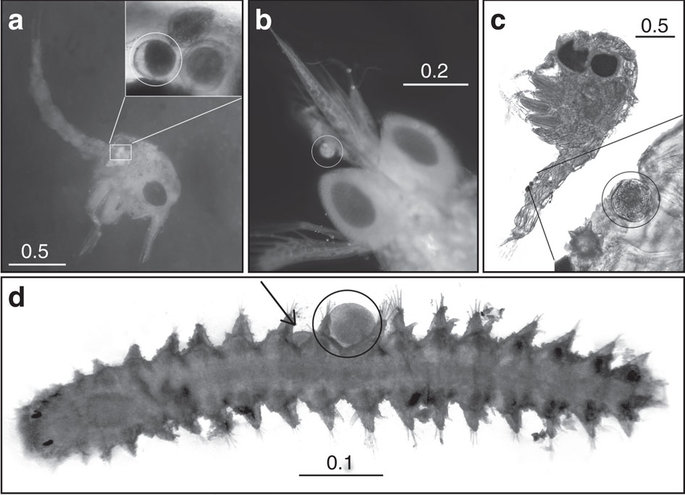
(a) Majid zoea larva (stage I) with a pollen grain in digestive tract (detail was obtained with different illumination). (b) Thallasinidea zoea (stage I) with a pollen grain near rostrum and antenna. (c) Brachyuran zoea (stage I) with a pollen grain attached to abdomen. (d) Young Syllid polychaete with two pollen grains attached to segments; the almost hidden second grain is indicated by arrow. The pollen grains are indicated by circles. The bars represent mm. (Photo credit: Tussenbroek et al. 2016)
(a) Majid zoea with a pollen grain in digestive tract. (b) Thallasinidea zoea with a pollen grain near rostrum and antenna. (c) Brachyuran zoea with a pollen grain attached to abdomen. (d) Young Syllid polychaete with two pollen grains attached to segments; the almost hidden second grain is indicated by arrow. The pollen grains are indicated by circles. The bars represent mm. (Photo credit: Tussenbroek et al. 2016)

There are a number of practical implications for their findings. Seagrass meadows are foundational to many coastal habitats and are amongst the world’s most productive ecosystems. Seagrass provides a number of ecosystem services such as improved water clarity, stabilization of the coastline, sequestration of carbon, and a facilitator of marine diversity. These findings by van Tussenbroek and her team demonstrate that despite how much we may know, there are still many more wonders and mysteries to elucidate about the natural world!

You can read more about this awesome study which was recently published in the journal Nature.


Share this:

  • Click to share on Bluesky (Opens in new window) Bluesky
  • Click to share on Facebook (Opens in new window) Facebook
  • Click to share on Reddit (Opens in new window) Reddit
  • Click to share on Threads (Opens in new window) Threads
  • Click to share on WhatsApp (Opens in new window) WhatsApp
  • Click to share on Mastodon (Opens in new window) Mastodon

Related

Tags: crustaceans invertebrates macrofauna pollen pollination pollinators seagrass zoobenthophilous

Post navigation

❮ Previous Post: Columbus doesn’t deserve a day ! (We should be giving credit to Cabot anyway)
Next Post: Disenfranchised Adjuncts Wanted: Flexible Morality a Plus ❯

You may also like

Weekly Salvage
Lessons from Puerto Rico, mutant starfish, pictures of ships, and more! Monday Morning Salvage: October 9, 2017.
October 9, 2017
Weekly Salvage
Deep-sea mining goes to court, a year in climate reporting, oyster-adorned singers, and more! The Monday Morning Salvage: December 11, 2017.
December 11, 2017
Uncategorized
Seagrass restoration, seabirds, and sea turducken! Thursday Afternoon Dredging: November 2, 2017
November 2, 2017
Conservation
Bottom trawling and the importance of plaice
July 27, 2010

Popular Posts

Shark scientists want their research to help save threatened species, but don’t know how. Our new paper can help.Shark scientists want their research to help save threatened species, but don’t know how. Our new paper can help.December 1, 2025David Shiffman
Norway and Cook Islands put their deep-sea mining plans on pause.Norway and Cook Islands put their deep-sea mining plans on pause.December 3, 2025Andrew Thaler
What Ocean Ramsey does is not shark science or conservation: some brief thoughts on "the Shark Whisperer" documentaryWhat Ocean Ramsey does is not shark science or conservation: some brief thoughts on "the Shark Whisperer" documentaryJuly 2, 2025David Shiffman
The Trouble with Teacup PigsThe Trouble with Teacup PigsOctober 14, 2012Andrew Thaler
What we know we don't know: impacts of deep-sea mining on whales, dolphins, sharks, turtles, and other migratory species.What we know we don't know: impacts of deep-sea mining on whales, dolphins, sharks, turtles, and other migratory species.November 20, 2025Andrew Thaler
2025: My year in writing, public speaking, and media interviews2025: My year in writing, public speaking, and media interviewsDecember 3, 2025David Shiffman
Urea and Shark OsmoregulationUrea and Shark OsmoregulationNovember 15, 2010David Shiffman
Shark of Darkness: Wrath of Submarine is a fake documentaryShark of Darkness: Wrath of Submarine is a fake documentaryAugust 10, 2014Michelle Jewell
How tiny satellites are tracking marine wildlifeDecember 1, 2025Andrew Thaler
Build a dirt cheap, tough-as-nails field computer in a Pelican caseBuild a dirt cheap, tough-as-nails field computer in a Pelican caseJuly 21, 2015Andrew Thaler
Subscribe to our RSS Feed for updates whenever new articles are published.

We recommend Feedly for RSS management. It's like Google Reader, except it still exists.

Southern Fried Science

  • Home
  • About SFS
  • Authors
  • Support SFS


If you enjoy Southern Fried Science, consider contributing to our Patreon campaign.

Copyright © 2025 Southern Fried Science.

Theme: Oceanly Premium by ScriptsTown