Skip to content

Southern Fried Science

Over 15 years of ocean science and conservation online

  • Home
  • About SFS
  • Authors
  • Support SFS

Grampa Hagfish: say hello to your greatest uncle

Posted on October 20, 2010October 20, 2010 By Andrew Thaler 6 Comments on Grampa Hagfish: say hello to your greatest uncle
Science

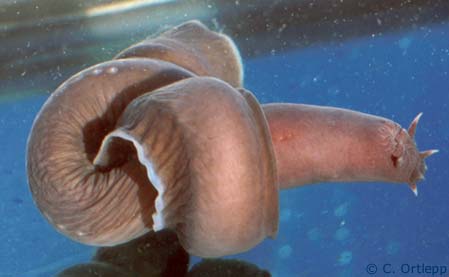
Image from http://www.zoology.ubc.ca/labs/biomaterials/slime.html

Today is Hagfish Day! Who knew?

What is a hagfish?

Hagfish are primitive eel-like chordates make famous for their relative unattractiveness*, profuse production of slime, and charismatic ability to tie themselves in knots. They are perhaps the only ‘fish’ that possesses a skull, but no vertebral column. But the question “What is a hagfish?” goes much deeper than that and it’s answer is fundamental to the evolution of vertebrates and, ultimately, us.

The National Academy of Sciences must have known today is Hagfish Day too, because yesterday afternoon they published online microRNAs reveal the interrelationships of hagfish, lampreys, and gnathostomes and the nature of the ancestral vertebrate. You see, hagfish have a problem, and it’s much bigger than too much slime blocking the gills. For most of their history, no one knew quite what to do with them.
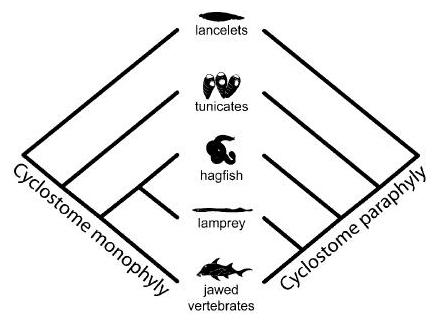
Two competing views of hagfish evolution (from Heimberg et al. 2010)

There are two opposing views of hagfish evolution. On one side, molecular evidence suggests that hagfish are most closely related to lampreys, a fair enough assumption and one that fits comfortably into our framework of vertebrate evolution. On the other side, morphology suggests that hagfish and lampreys were paraphyletic – that is, they aren’t most closely related to each other – and that lampreys and jawed vertebrates were BPF (best phylogenetic friends). The problem with the second option is that it would mean that the convergent evolution of hagfish and lampreys, or the subsequent degeneration of both groups into their current complementary forms would represent the single most exceptional event in all of evolution. We’d basically be talking about the transition from tunicate to vermiform ‘fish’ happening twice.

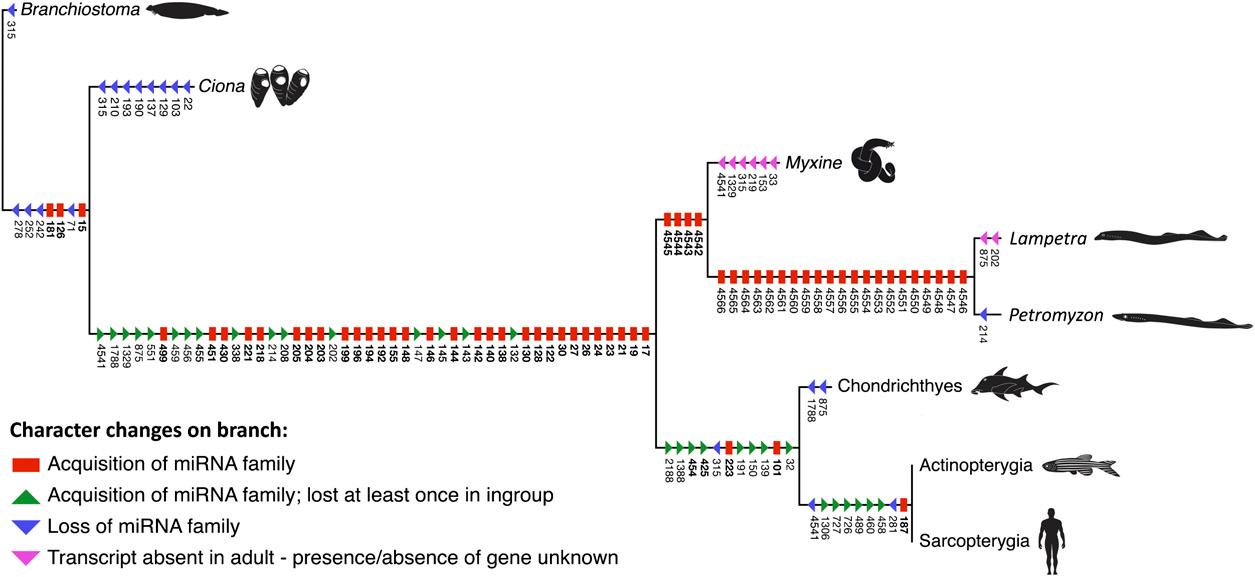
So Heimberg et al. set out to solve this puzzle using microRNA’s. microRNA’s are small bits of RNA that control gene expression in certain parts of an organism. They can essentially be treated much like morphological traits – the more microRNA’s two species have in common, the more closely related they are. By building the most parsimonious tree of microRNA acquisition and loss, they reconstructed a basic picture of early vertebrate evolution.

Not surprisingly this new analysis agreed with the morphology. Hagfish and lampreys are more closely related to each other than to anything else. This leaves us with a new problem though, because we still do not have a good picture of the common ancestor of all vertebrates, the lineage that unites hagfish, lampreys, and Homo sapiens into a single taxon. Somewhere between Tunicata and Cyclostomata we acquired huge numbers of regulatory genes and experienced a massive expansion of our genome. The mystery of cyclostome monophyly may be solved, but the transition to vertebrate body plan remains unresolved.

~Southern Fried Scientist

For a more, see Wired Science: Hagfish Analysis Opens Major Gaps in Tree of Life

*I think they’re beautiful

Update: Tree!

ResearchBlogging.org

Heimberg, A., Cowper-Sal{middle dot}lari, R., Semon, M., Donoghue, P., & Peterson, K. (2010). microRNAs reveal the interrelationships of hagfish, lampreys, and gnathostomes and the nature of the ancestral vertebrate Proceedings of the National Academy of Sciences DOI: 10.1073/pnas.1010350107

Share this:

  • Click to share on Bluesky (Opens in new window) Bluesky
  • Click to share on Facebook (Opens in new window) Facebook
  • Click to share on Reddit (Opens in new window) Reddit
  • Click to share on Threads (Opens in new window) Threads
  • Click to share on WhatsApp (Opens in new window) WhatsApp
  • Click to share on Mastodon (Opens in new window) Mastodon

Related

Tags: common ancestor hagfish lampreys phylogenetics tunicates vertebrates

Post navigation

❮ Previous Post: 365 days of Darwin: October 20, 2010
Next Post: Biodiversity Wednesday: How flesh-eating pitcher plants trap insects ❯

You may also like

Weekly Salvage
HAGFISH! Also deep-sea mining, climate change, The Ocean Cleanup, and more! Monday Morning Salvage: July 17, 2017
July 17, 2017
Weekly Salvage
Cinnamon-flavored hagfish, how to open a coconut, hunted by sperm whales, speaking up for the blue, and more! Monday Morning Salvage: June 11, 2018.
June 11, 2018
Weekly Salvage
Lost shipwrecks, weaponized hagfish, plastivorous worms, deep-sea mining, and more! Monday Morning Salvage: August 20, 2018.
August 20, 2018
Weekly Salvage
Saturation diving, destroying the world with Bitcoin mining, deep-sea mining, Arctic shrinkage, and more! Monday Morning Salvage: May 21, 2018
May 21, 2018

6 thoughts on “Grampa Hagfish: say hello to your greatest uncle”

  1. WhySharksMatter says:
    October 20, 2010 at 10:47 am

    Happy hagfish day!

  2. David Marjanović says:
    October 20, 2010 at 12:29 pm

    I haven’t been able to access the paper, but I heard a talk by Kevin Peterson about this and related topics a few days ago and got to talk to him afterwards…

    On one side, morphology suggests that hagfish are most closely related to lampreys, a fair enough assumption and one that fits comfortably into our framework of vertebrate evolution. On the other side, molecular evidence suggested that hagfish and lampreys were paraphyletic – that is, they aren’t most closely related to each other – and that lampreys and jawed vertebrates were BPF (best phylogenetic friends).

    The other way around: most of the morphological evidence suggests, if taken literally, that lampreys and jawed vertebrates are sister-groups (if we ignore all except the living), which means that “Cyclostomata” is paraphyletic (it contains a common ancestor and some but not all of its descendants). The molecular evidence, on the other hand, has consistently supported cyclostome monophyly.

    It may be that the vertebrate characteristics hagfish lack were secondarily lost as an adaptation to life on dark sea floors.

    The problem with the second option is that it would mean that the convergent evolution of hagfish and lampreys, or the subsequent degeneration of both groups into their current complementary forms would represent the single most exceptional event in all of evolution. We’d basically be talking about the transition from tunicate to vermiform ‘fish’ happening twice.

    Not at all. The tunicates are not our ancestors. They sit at the end of their own long branch, as your figure correctly shows. The question is whether 1) things like the round mouth with horny “teeth” in it are normal for vertebrates and secondarily lost by the jawed vertebrates, or 2) they are unique to Cyclostomata, and the hagfish lost things like vertebrae and eye lenses secondarily. Either way, the long, wormlike body shape is normal for vertebrates and was modified by the jawed vertebrates – as long as you kindly ignore all fossils, at least.

    the more microRNA’s two species have in common, the more closely related they are.

    Unless one of them has lost a lot of microRNAs. The authors say that this almost never happens, but I wonder if their method of analysis systematically underestimates how often it happens.

    Homo sapien

    Homo sapiens.

    Really. It’s not English. The -s is not a plural ending. (In fact, it’s the nominative singular ending. Latin is a bit weird that way. The plural would be sapientes, except that species names are singular-only.)

    a single taxa

    A single taxon. Two taxa. Greek. (Well, fake Greek, but never mind.)

    Somewhere between Tunicata and Cyclostomata we acquired huge numbers of regulatory genes and experienced a massive expansion of our genome.

    Somewhere between our last common ancestor with the tunicates and our last common ancestor with the cyclostomes a genome duplication happened, or two. This is also suggested by independent evidence from other regions of the genome, such as the number of Hox genes.

    hagfish monophyly

    This only means that the various hagfish species share a common ancestor that wasn’t also an ancestor of anything that’s not a hagfish. That’s uncontroversial. You probably mean “cyclostome monophyly”.

  3. Southern Fried Scientist says:
    October 20, 2010 at 2:06 pm

    Typos fixed, thanks! The dangers of writing at 2 in the morning.

    The other way around: most of the morphological evidence suggests, if taken literally, that lampreys and jawed vertebrates are sister-groups (if we ignore all except the living), which means that “Cyclostomata” is paraphyletic (it contains a common ancestor and some but not all of its descendants). The molecular evidence, on the other hand, has consistently supported cyclostome monophyly.

    Wow, yep, totally got that backwards. Thanks for catching that.

    It may be that the vertebrate characteristics hagfish lack were secondarily lost as an adaptation to life on dark sea floors.

    Absolutely.

    Not at all. The tunicates are not our ancestors. They sit at the end of their own long branch, as your figure correctly shows. The question is whether 1) things like the round mouth with horny “teeth” in it are normal for vertebrates and secondarily lost by the jawed vertebrates, or 2) they are unique to Cyclostomata, and the hagfish lost things like vertebrae and eye lenses secondarily. Either way, the long, wormlike body shape is normal for vertebrates and was modified by the jawed vertebrates – as long as you kindly ignore all fossils, at least.

    Sure, I could have been move precise in saying that the development of the vermiform body from the common ancestor of vertebrates and tunicates occurring twice would be exceptional. And it would be exceptional. From the article: “Alternatively, if the molecular phylogenies are correct, then it would indicate that the shared similarities of lampreys and gnathostomes are convergent or that these characters are absent through loss in the hagfish lineage. These would represent the most extraordinary examples of convergence or degeneracy, respectively, in vertebrate evolutionary history.”

    But you are right, Tunicates are highly derived in their own right and not representative of an ancestral chordate common ancestor.

    Unless one of them has lost a lot of microRNAs. The authors say that this almost never happens, but I wonder if their method of analysis systematically underestimates how often it happens.

    I’m not and expert by any means on microRNA’s, but even if loss happens, wouldn’t that be accounted for in a maximum parsimony analysis? If you look at the microRNA tree they’ve assembled (which I tacked on to the bottom of the post for you) you see many gains and some losses.

    Somewhere between our last common ancestor with the tunicates and our last common ancestor with the cyclostomes a genome duplication happened, or two. This is also suggested by independent evidence from other regions of the genome, such as the number of Hox genes.

    Semantically it would still be “between” Tunicates and Cyclostomes, it would just happen after Tunicates split from our last common and before Cyclostomes split. But yeah, I can see where someone might want more precision.

    The challenges of writing about systematics for a lay audience. Thanks for you comments.

Comments are closed.

Popular Posts

Florida angler catches (and likely kills) Endangered great hammerhead sharkFlorida angler catches (and likely kills) Endangered great hammerhead sharkFebruary 13, 2012David Shiffman
Shark of Darkness: Wrath of Submarine is a fake documentaryShark of Darkness: Wrath of Submarine is a fake documentaryAugust 10, 2014Michelle Jewell
Full video of injured shark shows numerous natural injuriesFull video of injured shark shows numerous natural injuriesMay 3, 2011David Shiffman
Severely injured great white shark found, are scientists responsible?Severely injured great white shark found, are scientists responsible?March 29, 2011David Shiffman
What Ocean Ramsey does is not shark science or conservation: some brief thoughts on "the Shark Whisperer" documentaryWhat Ocean Ramsey does is not shark science or conservation: some brief thoughts on "the Shark Whisperer" documentaryJuly 2, 2025David Shiffman
The Urgency Does Not Exist: My statement on Deep-sea Mining to the Subcommittee on Energy and Mineral ResourcesThe Urgency Does Not Exist: My statement on Deep-sea Mining to the Subcommittee on Energy and Mineral ResourcesJanuary 24, 2026Andrew Thaler
I'm getting married! Want to honor us? Here are some great charities you can donate to.I'm getting married! Want to honor us? Here are some great charities you can donate to.January 23, 2026David Shiffman
At least 74 practicing shark researchers: How a silly thing I said online raised thousands for conservationAt least 74 practicing shark researchers: How a silly thing I said online raised thousands for conservationFebruary 26, 2025David Shiffman
Bipartisan Concern Expressed Over Deep Sea Mining at Congressional HearingBipartisan Concern Expressed Over Deep Sea Mining at Congressional HearingJanuary 23, 2026Angelo Villagomez
10 Tips for grad students to make the most of a scientific conference10 Tips for grad students to make the most of a scientific conferenceAugust 21, 2013David Shiffman
Subscribe to our RSS Feed for updates whenever new articles are published.

We recommend Feedly for RSS management. It's like Google Reader, except it still exists.

Southern Fried Science

  • Home
  • About SFS
  • Authors
  • Support SFS


If you enjoy Southern Fried Science, consider contributing to our Patreon campaign.

Copyright © 2026 Southern Fried Science.

Theme: Oceanly Premium by ScriptsTown