The Important Shark and Ray Areas project is coming to North America! Colleagues, if you think your data suggests that you’ve identified an Important Shark and Ray Area in your study site, here’s how to submit your data and participate.
So what exactly is an Important Shark and Ray Area?
In short, an Important Shark and Ray Area is a place, which might be large or small, that is especially critical for the life history and survival of some species of sharks and their relatives. The process is based on criteria used in the past for Key Biodiversity Areas and Important Marine Mammal Areas, modified for the biology and ecology and conservation needs of sharks and their relatives.
“These are areas where they carry out key parts of their life cycle, such as giving birth, growing as juveniles, feeding, resting, migrating, or gathering in large numbers,” Dr. Rima Jabado, the ISRA project lead and chair of the IUCN Species Survival Commission Shark Specialist Group, told me. “These are areas where they carry out key parts of their life cycle, such as giving birth, growing as juveniles, feeding, resting, migrating, or gathering in large numbers. Some ISRAs are also places where species with very small geographic ranges occur in high numbers or where many different species overlap.”
Additionally, “their importance lies in the fact that they are identified through standardized scientific criteria that can be applied to all aquatic habitats these species occupy, which means that their importance is relative to other habitats occupied by these species,” Emiliano García Rodríguez, a spatial analyst with the Shark Specialist Group, told me. “ISRAs are also important because they provide a science-based guidance on where to put management and conservation actions that can protect these species.”
Why is it important to identify ISRAs?
“ISRAs are identified using a globally standardised, science-based approach, and they are deliberately independent of politics, boundaries, or existing management measures,” Dr. Jabado told me. “ISRAs do not create protection or impose rules — they simply make critical habitat visible. This matters because many decisions about ocean use are spatial, where fishing happens, where infrastructure is placed, or where protection is considered. ISRAs give governments, managers, and communities a credible, evidence-based starting point for making those decisions in a way that reflects the needs of these species.”
In other words, ISRAs are a standardized process for turning scientific data and evidence about shark habitat use into a priority list for future spatial conservation measures. Instead of different research labs and different jurisdictions each using their own processes and criteria, the ISRA project standardizes it all.
What counts as an Important Shark and Ray Area, and what kind of evidence can be used to support the identification of an ISRA?
The ISRA project has developed a set of standardized crtieria:
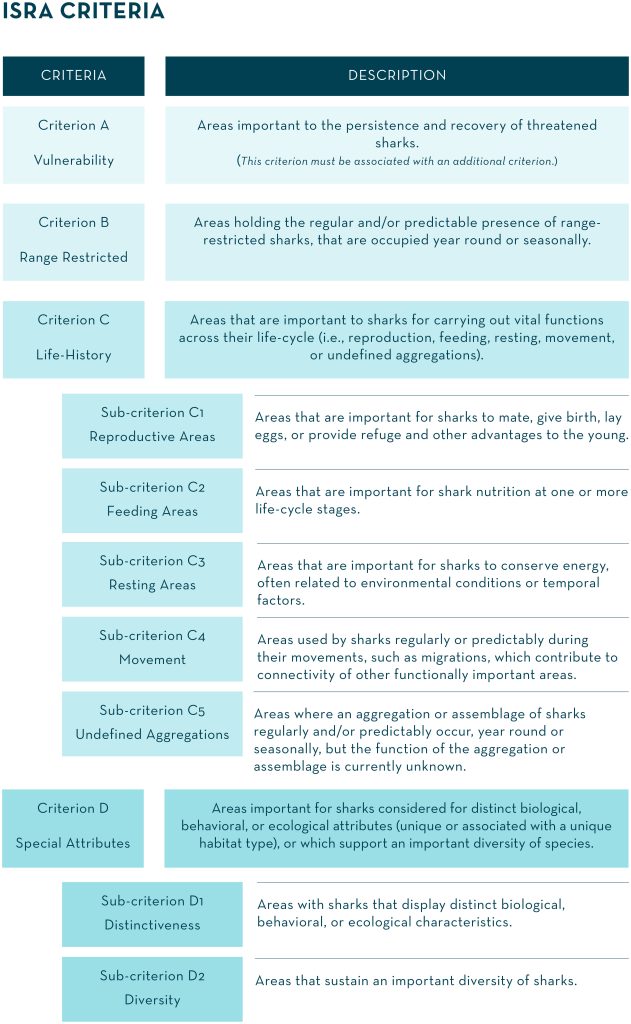
To qualify, “the data must show that these important habitats are used regularly over time, and that the area is more important than other nearby areas, and the data also needs to be recent” Dr. Marta Palacios from the Shark Specialist Group told me. “Relevant data is used to support one or several ISRA criteria. An area can have different criteria for different species.”
Different criteria and subcriteria have different requirements for data, which is all explained in great detail in the ISRA guidance document.
But generally, the team is looking at areas that are important to threatened or range-restricted species, especially those that include at least one of the following:
–Reproductive areas “where newborns or young-of-year, pregnant females, egg cases, individuals with fresh mating scars, or sharks exhibiting mating or courtship behavior are seen in the same area over several years,” Dr. Palacios said. García Rodríguez stresses that areas already confirmed as nursery areas in the literature make for easy ISRAs to identify.
–Feeding areas where sharks and rays travel to feed, either due to a temporary/seasonal high availability of food or year round availablity of food. Dr. Palacios stresses that “this information can come from direct observations, stable istope studies, or fecal contents, and include how many individuals had specific prey in their stomachs, how often feeding was directly observed, and how important the area is for feeding compared to nearby locations.”
–Resting areas “where sharks and rays regularly gather to rest, save energy, or control their body cycle, which can be influnced by tides, currents, habitat type, and type of day,” Dr. Palacios said. Evidence here can include accelerometers, cameras, or direct observation showing many individuals resting together.
–Movement areas, which are assessed separately because migratory corridors tend to be large and need to be managed separately. Data for these include telemetry tags.
–Areas with diversity or other distinctiveness, which are “Areas that consistently support high numbers of shark and ray species compared to nearby areas,” and “areas that support rare or unusual behaviors, life history traits, and ecological functions not known from elsewhere,” Dr. Jabado told me. There are also undefined aggregations, in which aggregations are well-known but the ecological or biological reason for them is not known.
Who can submit candidate ISRAs and how do you do that?
“The process is open to whoever wants to contribute,” García Rodríguez told me. “Submissions mostly come from scientists, but it’s not restricted to them. We have received proposals from dive operators, and have used data from social media, dive logbooks, recreational anglers, and traditional knowledge to identify ISRAs.”
“One of the strengths of ISRAs is that they deliberately bridge scientific research and lived experience, as many critical habitats are known by locals long before they appear in journals,” Dr. Jabado said. “The process is designed to capture both. Anyone with credible, well-documented information can contribute.”
If you think you have data and evidence supporting the identification of an ISRA, please double check in the ISRA guidance document. After you’ve done so, please contact the team at info @ sharkrayareas DOT org, and they will send you the form and explain the next steps. You’ll then submit a “preliminary area of interest,” which will be reviewed by the team at the upcoming workshop. Please note that only a limited number of people will be invited to participate in the workshop in person, but anyone contributing to the process can attend virtually.
If you want to see what the workshops look like, the team prepared a series of videos from past workshops, viewable here.
What happens next?
After the workshop, an independent expert peer review panel evaluates all submissions and makes sure that they support the deliniation of an Important Shark and Ray Area. If accepted, the ISRA will be shown on the ISRA interactive e-atlas and included in a future regional compendium report.
The ISRA team stressed to me once again that an identified Important Shark and Ray Area does not have any inherent legal protections, the goal is to provide standardized scientific evidence that others can use to support creating new protected areas and conservation regulations. “At a time when pressure on the ocean is intensifying, knowing where action matters most is essential,” Dr. Jabado told me. “ISRAs help provide that clarity for sharks, rays, and chimaeras, while also creating a space for regional communities to connect, share knowledge, and support the informed use of these tools in management and planning.”
The deadline to submit proposals is February 6, and the workshop will be held in March.