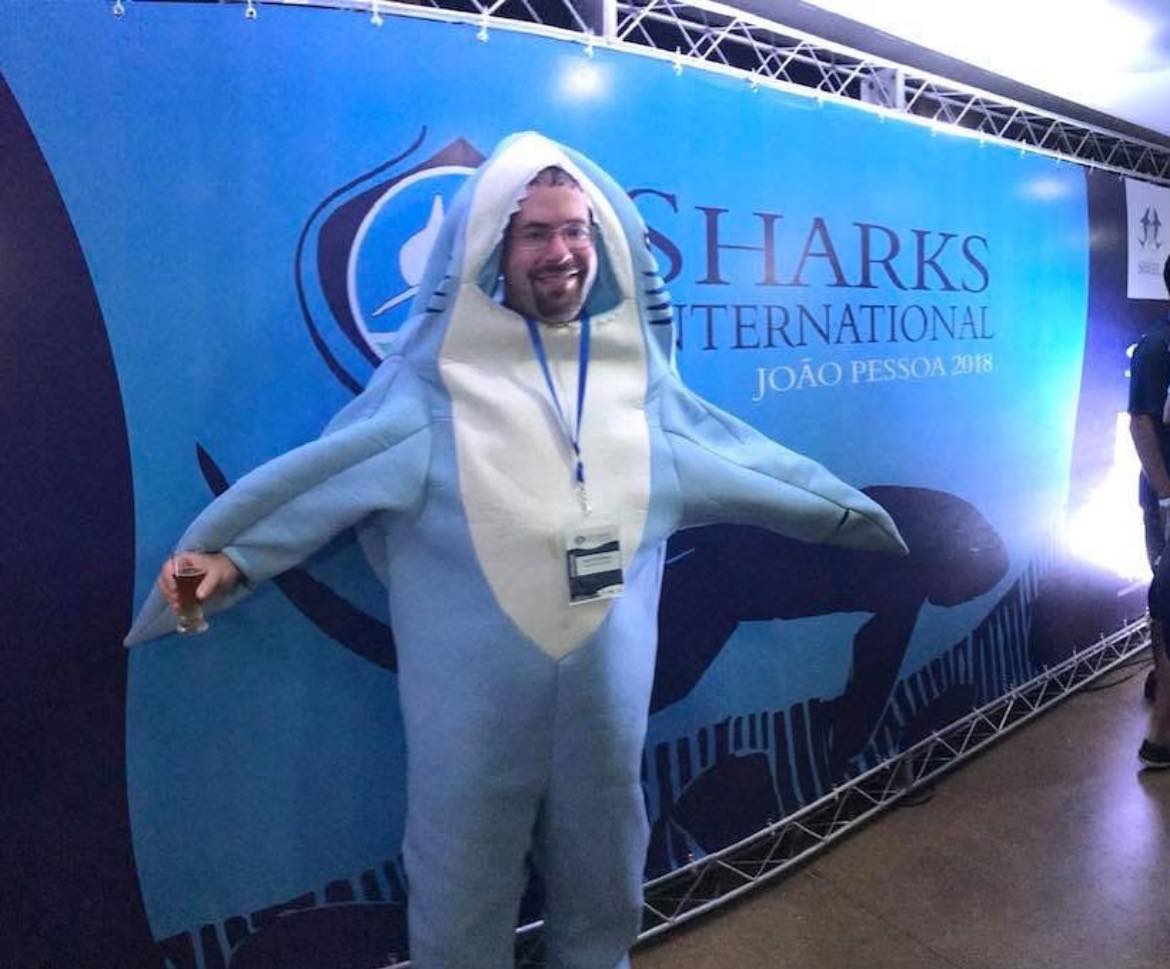
I am excited to be attending the upcoming Sharks International conference in Colombo, Sri Lanka! If you’re attending, I’d love to chat with you about your work. Here’s how to find me.
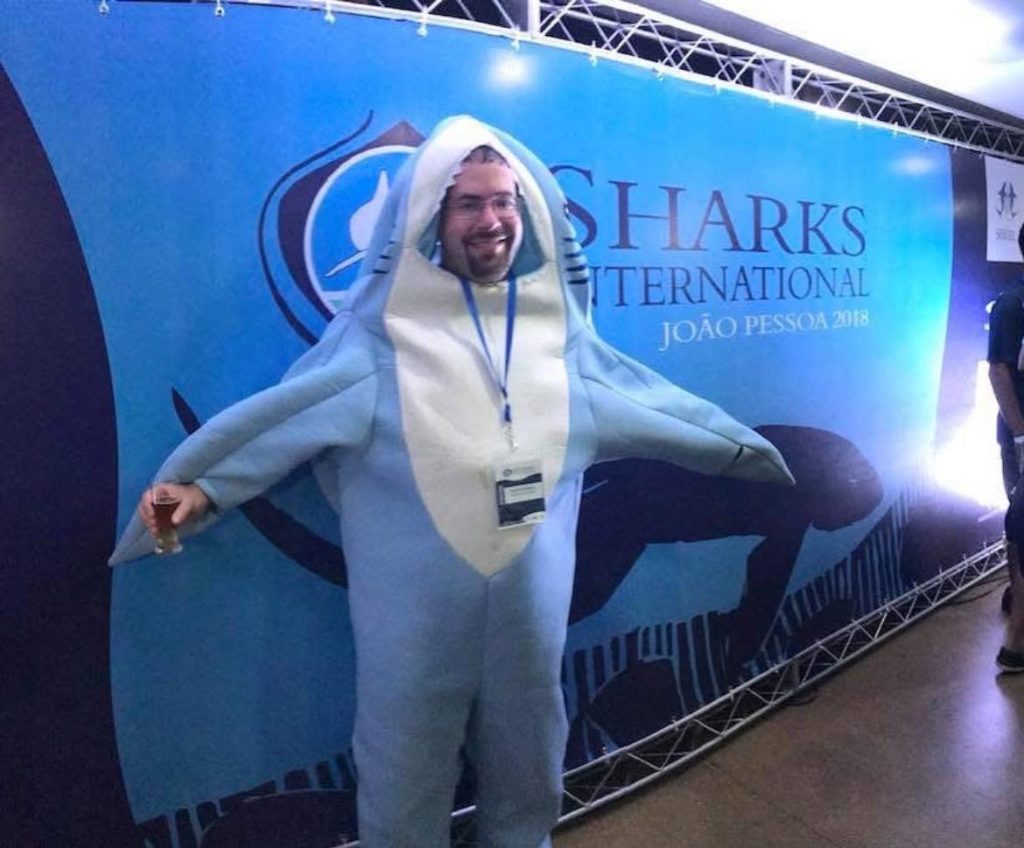
This photo of me at Sharks International 2018 in Brazil is now my official Amazon author photo.
(I donated that costume to a Brazilian non-profit on the condition that they wash it before they have their volunteers use it, but fear not, I have a new one that’s coming with me to Sri Lanka).
Sharks International is a global gathering of shark research, conservation, and education professionals held every four years in rotating locations. I’m one of a lucky few people who has been to all of them and I’m looking forward to this one!
I will be giving a presentation and leading a workshop, and I’ll be attending the rest of the meeting. I am excited to catch up wtih friends and colleagues. And if we haven’t met yet, please come say hello, I’d love to hear about what you’re working on!
My presentation, “the causes and consequences of public misunderstanding of shark conservation,” will be on May 8th at 11:55 a.m. in Hall A. I will be presenting a summary of the last decade of my interdisciplinary shark conservation research, work that has been published in Integrative and Comparative Biology here. (It also summarizes this paper, this paper, and this paper).
Here is the abstract:
“Saving sharks requires scientific data, and public support for data-driven conservation policy. Many members of the public are aware of and concerned by shark conservation issues in general, but there is widespread public misunderstanding of key details, including the biggest threats to sharks and the most effective policy solutions to resolve those threats. Many concerned members of the public wrongly believe that shark finning is the largest, or only significant, threat to sharks, ignoring the meat trade, habitat loss, and bycatch from industrial fisheries. Many concerned members of the public wrongly believe that banning the shark fin trade is the only possible solution to save sharks, and most are unaware of sustainable fisheries management solutions that are widely supported by experts. And many of these concerned members of the public have learned of these issues from environmental extremists, rather than from conservation professionals. These misunderstandings make it harder for scientists to help use our data in evidence-based conservation policymaking, and can result in suboptimal policy outcomes, or even conflict between stakeholder groups who should be working together. This presentation will summarize conclusions from a decade of interdisciplinary research trying to understand the causes and conflicts of public misunderstanding of shark conservation issues, highlighting key references, results, and paths forward throughout.”
My workshop will be the morning of May 9th at the Courtyard Marriot Colombo. It is part of the “Communicating Science with a Broader Audience” workshop, which I will be co-running with Sally Snow. My part is “How to use social media to communicate shark science, and why you should.” It’s a 90-minute crash course in using social media tools for public science engagement with case studies of successful strategies used by shark research and conservation organizations. There will be an extended discussion on today’s changing social media landscape (i.e., the decline in utility of Twitter, which was once the gold standard for online science communication) and what to do about it, and plenty of time for questions. To prep for the meeting, follow all these amazing shark science and conservation professionals on Bluesky!
In addition to just learning as much as possible and meeting some amazing new colleagues, here are my goals for Sharks International:
The workshop I’m teaching at Sharks International is one that I’ve taught all over the world to universities, environmental non-profits, and government natural resources management agency staff. I also have versions of it that focus on media training (i.e., speaking about your research or conservation initiative to journalists) and writing for the public (i.e., op-eds and issue briefs). I’d love to work with you to teach it at your institution, which I can do virtually or in person.
I work as a freelance science journalist, and I’m always looking for story tips! If your research or conservation initiative would make a good news story, let’s chat about how I can write it up and promote the important work you’re doing!
I’m also available to help your team write op-eds, issue briefs, or strategic social media communications plans. Here’s an op-ed I wrote last year for the Wildlife Conservation Society in support of some CITES listings.
Additionally, my consulting firm specializes in research prioritization via expert solicitation. Here’s one we did for threatened shark species in US waters. If you want to generate a list of outstanding research priorities for your discipline, study species, or region, let’s chat about how I can help you.
I’ll be around every day, and with the wardrobe of ridiculous shark shirts I’ll be wearing, I’ll be easy to find. But also you can e-mail me (WhySharksMatter at Gmail) or reach out on Instagram or Bluesky.
See everyone soon!