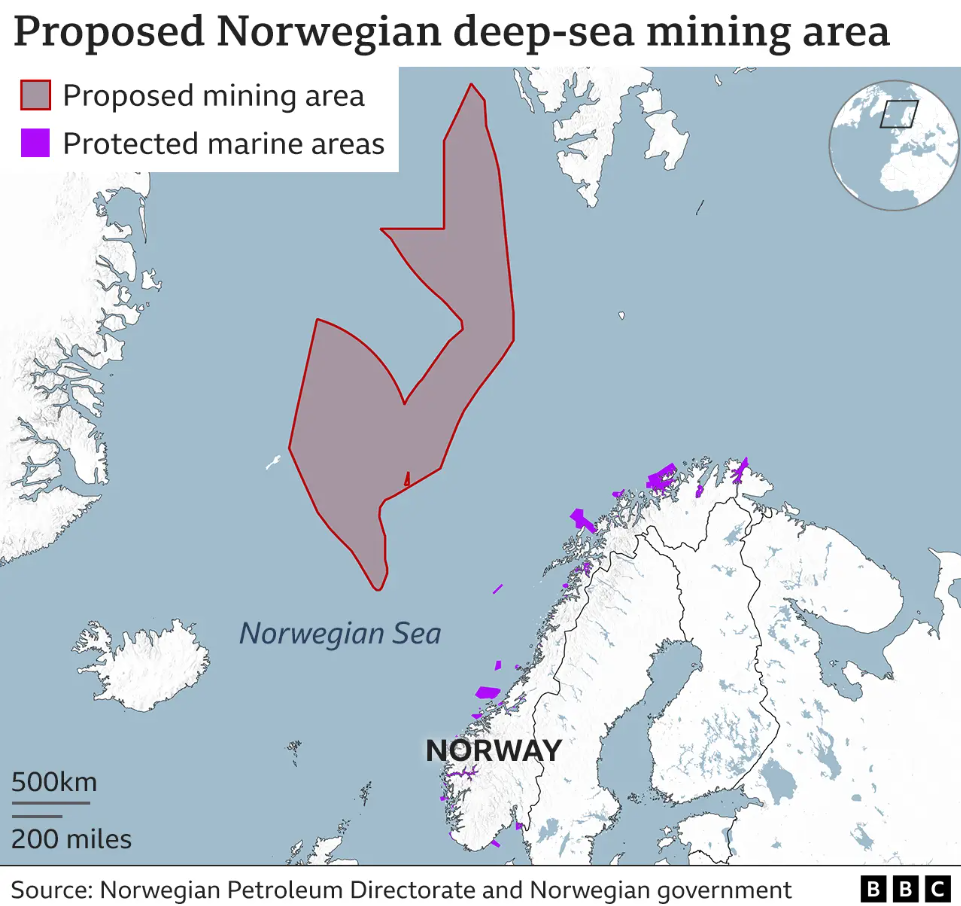
This morning, the Norwegian parliament approved a bill that moves the country one step closer to commercial deep-sea mining in Norway’s waters. This bill opens up nearly 300,000 square kilometers for mining companies to to explore for lithium, scandium, cobalt, and other critical minerals. Importantly, this does not mean that Norway is about to strip mine its oceans nor does it even mean that deep-sea mining is inevitable.
Two important fact checks that have been misrepresented throughout this process:
- Norway is not the first country to have advanced this far toward allowing deep-sea mining in its own waters. Both Papua New Guinea and the Cook Islands have made similar steps.
- Norway has not given any company permission to mine. They have begun a process that may eventually lead to companies gaining permission to mine Norway’s seabed resources, but that is neither guarantied nor inevitable.
While other major countries who had previously been engaged in deep-sea mining–including the UK, France, and Brazil–have now come out in favor of a moratorium, Norway has taken the opposite approach. Even so, representatives of the Norwegian government, have argued that they are, in fact, taking a precautionary approach. How the exploration phase of this process plays out will ultimately reveal whether or not that is true.
Deep-sea mining is an industry that always feels as though it is on the cusp of being fully realized, but Norway, in particular is a long way away from commercialization. Exploration precedes exploitation. What happened today was the creation of a framework which allows prospective mining companies to identify resources and conduct the necessary environmental impact assessments which allow them to apply for permission to mine.
The initiation of the exploration phase is not necessarily bad news for environmental groups and ocean advocates. The exploration phase is the most precarious moment for a deep-sea mining company, where any novel discovery (and the deep ocean is absolutely crawling with novel discoveries) could derail their plans. Because of just how difficult and expensive it is to access the deep sea, a mining company’s exploration phase inevitably results in an upwelling of scientific discovery, so long as there is at least some political will to enforce transparency.
It’s also a moment of heightened attention. Entering the exploration phase brings enhanced focus on the industry and allows for much more targeted messaging campaigns. On the international stage, the International Seabed Authority is still in the process of entering the exploitation phase, and, with decades of data from deep-sea mining exploration, opposition to commercializing the seabed has never been stronger.
Notably, Papua New Guinea approved mining exploration licenses for Nautilus Minerals in the early 2000s, which kicked off a decade long process of environmental studies and ocean campaigning. Despite ultimately being granted a mining exploitation license and given permission to begin mining at Solwara I, Nautilus Minerals never managed to begin operations. The company went bankrupt and Papua New Guinea eventually joined an alliance of Pacific nations opposed to deep-sea mining in their territorial waters. The rise and fall of Nautilus Minerals was a complex confluence of bad luck, poor business decisions, resistance from environmental and stakeholder groups, and even more bad luck.
Whether or not some form of deep-sea mining is necessary for a renewable energy future remains to be seen. Many of the prospective mining sites within this new exploration zone will prove to be far too ecologically important to mine. The industry itself faces greater resistance than at any point in its development. Norwegian deep-sea mining contractors have a ton of obstacles to overcome to prove their stake on the seafloor.
Don’t let the headlines get you down.
Southern Fried Science is free and ad-free. Southern Fried Science and the OpenCTD project are supported by funding from our Patreon Subscribers. If you value these resources, please consider contributing a few dollars to help keep the servers running and the coffee flowing. We have stickers.
Featured Image: Map of Norway’s new mining exploration area, Norwegian Petroleum Directorate via BBC.