That ambassador is Bathynomus giganteus, the giant, deep-sea isopod.
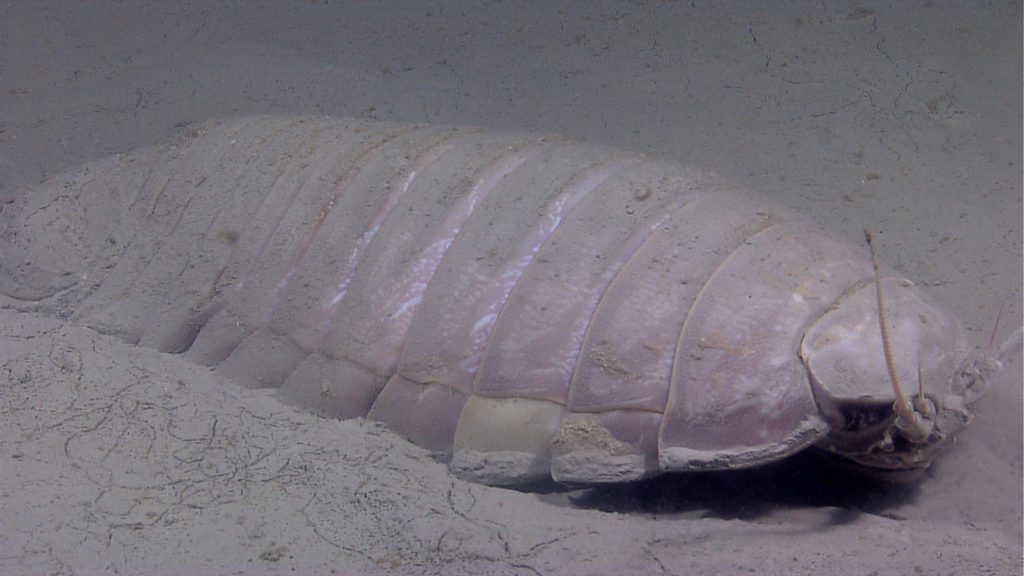
Conservation has long had the concept of Flagship Species—popular, charismatic species that serve as rallying points for conservation awareness and action. Formalized within the framework of conservation marketing, flagship species are focused around particular goals and audiences. Think of the WWF’s Giant Panda, Polar Bears and a thousand different arctic or climate change campaigns, or even the American Bald Eagle, whose decline galvanized the country into action. These animals are iconic. They connect people to species and ecosystems in crisis. They are Flagship Species.
The Giant Deep-sea Isopod is not a flagship species. The Giant Deep-sea Isopod addresses a much more fundamental issue: despite being the largest, most diverse ecosystem on the planet, most people have no direct connection, no frame of reference, for the deep sea.
Most people in the United States have some idea of what a rainforest is. We have some conception of the arctic. We can picture a coral reef. We *get* Yosemite. And while these are often idealized, maybe even wildly inaccurate views of natural land- and seascapes, they provide a frame of reference upon which we can build.
The deep sea doesn’t have that. At best, people are aware of structures like hydrothermal vents, maybe even methane seeps. Science and natural history buffs may have some understanding of whalefalls. But these are rare ecosystems that lightly blanket the broader, wider, weirder world of the vast abyssal plain, an ecosystem so understudied and undervalued that even among deep-sea ecologists, we often refer to it as the “background”.
When I ask grade-school students what they think this “background” looks like, I am met with blank stares, or descriptions of sprawling fields of mud devoid of interest.
We can’t even begin to talk about protecting an ecosystem if there is almost no public understanding of what that ecosystem is and why it has value. We have to start from the beginning. We aren’t even ready to pick a deep-sea Flagship Species, the audience for a conservation campaign barely exists. First we need an Ambassador. We need an iconic species of exception charisma, cultural value, and curiosity that can help lift the veil and get people thinking about what life is like in the largest and least understood ecosystem on the planet.
The Giant Deep-sea Isopod is an Ambassador for the Deep Sea.

Sign the Petition!
What makes the giant deep-sea isopod the perfect ambassador for the deep waters of the United States? For one, Bathynomus giganteus, the giantest of the giant isopods, is an animal that calls the US its home. Though its range extends into the Caribbean and down to South America, the vast majority of its territory falls within American waters. Of all the charismatic creatures of the deep, few have such a strong, regional claim.
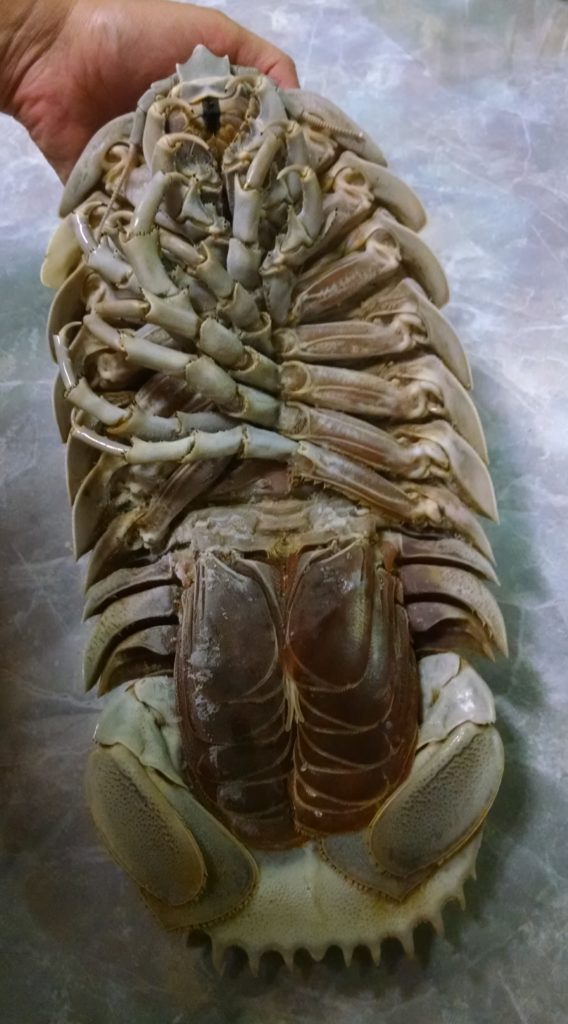
Bathynomus giganteus is charismatic. For over a decade, I’ve taught students about the wonders of the deep sea, and nothing inspires the sheer shock and delight as much as a carefully preserved specimen of a particularly large giant isopod. A giant squid is still distinctively squidy. Angler fish are strange, but not quite shocking. Even giant tubeworms, though magnificent, just don’t have the same draw. Giant deep-sea isopods are weird and wonderful.
Part of what makes them so compelling is that there is a common, terrestrial species that we can compare them to. Whether you call them pill bugs, wood louses, roly polies, or doodle bugs, terrestrial isopods are common critters across the country (though, ecologists make note, most terrestrial isopods in the United States are invaders from Europe). For an audience with nearly no exposure to the deep sea, having a common terrestrial analog can help ground them, providing a level of context that makes it that much easier to connect with this totally bizarre creatures.
They’re alien, but they’re not *that* alien.
That’s the true power of the giant deep-sea isopod. It is a cultural touchstone that commands a level of curiosity that can be honed and tempered through its terrestrial connection. It has the potential to make the deep sea as seemingly accessible as the rocks we turn over in our back yard. It grounds its audience by introducing something so very weird with something so completely mundane.
How do you talk about giant isopods?
“Imagine a roly poly as big as a cat…”
Sign the Petition!
Further Reading:
Bowen-Jones and Entwistle (2002) Identifying appropriate flagship species: the importance of culture and local contexts. Oryx 36: 189-195.
Verissimo and friends (2010) Toward a systematic approach for identifying conservation flagships. Conservation Letters. 4: 1-8.
McClain and friends (2015) Sizing ocean giants: patterns of intraspecific size variation in marine megafauna. PeerJ. 3:e715.