Skip to content

Southern Fried Science

Over 15 years of ocean science and conservation online

  • Home
  • About SFS
  • Authors
  • Support SFS

Dive the Wreck of the Steamship Tahoe with OpenROV!

Posted on June 6, 2016 By Andrew Thaler
Education, Oceanography for Everyone

OpenROVOne-hundred-fifty meters hardly seems like anything at all.

Standing in the parking lot of OpenROV, I pace out 150 meters. The small sign, hanging against the wall of the battered warehouse, pointing visitors towards the entrance, is clear.

One-hundred fifty meters is less than half a lap around a standard running track. It’s the height of Old St. Paul’s Cathedral, the tallest building in the world, 700 years ago. The fastest man in the world could cover 150 meters in 14 seconds.

On land, 150 meters is barely noteworthy. Plunge into the sea and 150 meters is the wine dark deep. It is the edge of the photic zone, a world of eternal twilight. It is three times deeper than most SCUBA divers will ever venture. At 150 meters, the water pushes down with the weight of 16 atmospheres.

And, if you climb high into the Sierra Mountains and descend into the frigid alpine waters of Lake Tahoe, just off the coast of Glenbrook, Nevada, lying on a steep glacial slope at 150 meters depth is the wreck of the Steamship Tahoe.

Launched on June 24, 1896, Tahoe sailed across the eponymous lake for four decades, carrying passengers, cargo, and mail, until the expanding US highway system rendered her obsolete. Tahoe was scuttled in 1940. She landed on a slope and slid down into the depths of Lake Tahoe, lost for 60 years. SS Tahoe laid on the bottom undisturbed until 2002, when the first divers surveyed the wreck. They returned in 2009 and 2010.

And then, in 2012, the OpenROV team made the trek up to Lake Tahoe, to explore the wreck not with divers, but with small, open-source underwater robots. It was my first adventure with OpenROV, but would be far from my last.

Whether through shipwrecks, sunken relics, or evolutionary biology, the future of underwater exploration has always been linked, inextricably to our past. There’s something important and profound about maintaining the connection to history as we push every forward into the ocean future.

OpenROV may be a young company, but it already has a history of it’s own. The back wall of headquarters proudly displays the evolution of the robot, from a rough high school PVC beast named Mr. Pinchy to the sleek, powerful Trident.
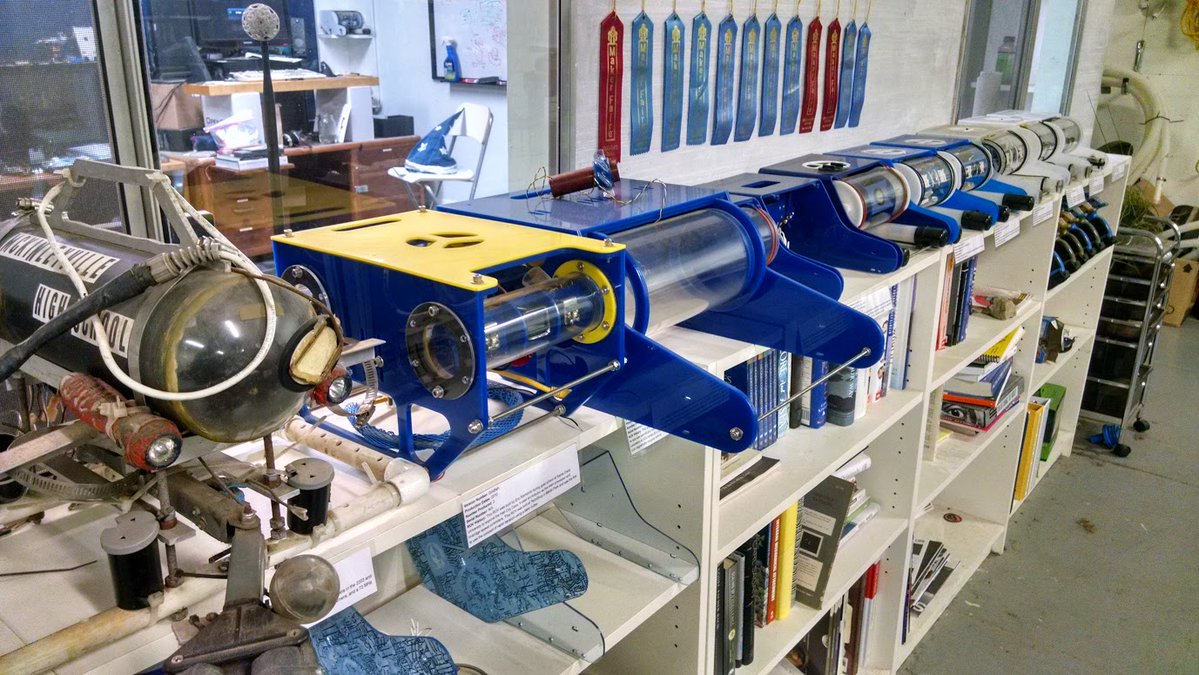
OpenROV history wall.

This week, we return to Lake Tahoe and the wreck of her largest steamship to once again push the limits of open exploration. The OpenROV team, led by Eric Stackpole and David Lang, will spend the next few days diving on the wreck, in coordination with NOAA and local preservation groups, to survey the condition of this historic site. Along the way, we’ll be testing the next generation of OpenROV equipment, including the much anticipated OpenROV Trident. Trident will join a host of experimental platforms, including specially modified deep-diving ROVs, a dropcam observation system, and Stackpole’s research-vessel-in-a-minivan system, complete with USBL tracking and dynamic positioning.

A few dozen members of the OpenROV community will gather on the shores of Lake Tahoe for the next great adventure. As with past OpenROV expeditions, you’re invited to come along. Updates will flow freely from the Return to the SS Tahoe OpenExplorer page, assorted social medias, and the OpenROV twitch stream.


Share this:

  • Click to share on Bluesky (Opens in new window) Bluesky
  • Click to share on Facebook (Opens in new window) Facebook
  • Click to share on Reddit (Opens in new window) Reddit
  • Click to share on Threads (Opens in new window) Threads
  • Click to share on WhatsApp (Opens in new window) WhatsApp
  • Click to share on Mastodon (Opens in new window) Mastodon

Related

Tags: open source OpenROV Tahoe

Post navigation

❮ Previous Post: The Importance of Scientific Discovery and Communication for a General Science Audience
Next Post: Trading blue collars for scarlet robes, my working-class experience of academic life ❯

You may also like

Weekly Salvage
“We’re in the midst of a sea change in who has access to the core tools of marine scientific research,” Weekly Salvage: November 11, 2019
November 11, 2019
Weekly Salvage
#IAmSeaGrant, Octopus Beats Dolphins, Deep-sea Mining, and more! Monday Morning Salvage: May 29, 2017
May 29, 2017
The Open CTD Project
Arduino Project Log: Building the Sea Leveler Part 1 – Hardware
April 13, 2013
Science
Building robots in Papua New Guinea: update from #ROV2PNG
October 24, 2014

Popular Posts

Shark scientists want their research to help save threatened species, but don’t know how. Our new paper can help.Shark scientists want their research to help save threatened species, but don’t know how. Our new paper can help.December 1, 2025David Shiffman
Norway and Cook Islands put their deep-sea mining plans on pause.Norway and Cook Islands put their deep-sea mining plans on pause.December 3, 2025Andrew Thaler
What Ocean Ramsey does is not shark science or conservation: some brief thoughts on "the Shark Whisperer" documentaryWhat Ocean Ramsey does is not shark science or conservation: some brief thoughts on "the Shark Whisperer" documentaryJuly 2, 2025David Shiffman
What we know we don't know: impacts of deep-sea mining on whales, dolphins, sharks, turtles, and other migratory species.What we know we don't know: impacts of deep-sea mining on whales, dolphins, sharks, turtles, and other migratory species.November 20, 2025Andrew Thaler
2025: My year in writing, public speaking, and media interviews2025: My year in writing, public speaking, and media interviewsDecember 3, 2025David Shiffman
The Trouble with Teacup PigsThe Trouble with Teacup PigsOctober 14, 2012Andrew Thaler
Urea and Shark OsmoregulationUrea and Shark OsmoregulationNovember 15, 2010David Shiffman
How tiny satellites are tracking marine wildlifeDecember 1, 2025Andrew Thaler
Shark of Darkness: Wrath of Submarine is a fake documentaryShark of Darkness: Wrath of Submarine is a fake documentaryAugust 10, 2014Michelle Jewell
Build a dirt cheap, tough-as-nails field computer in a Pelican caseBuild a dirt cheap, tough-as-nails field computer in a Pelican caseJuly 21, 2015Andrew Thaler
Subscribe to our RSS Feed for updates whenever new articles are published.

We recommend Feedly for RSS management. It's like Google Reader, except it still exists.

Southern Fried Science

  • Home
  • About SFS
  • Authors
  • Support SFS


If you enjoy Southern Fried Science, consider contributing to our Patreon campaign.

Copyright © 2025 Southern Fried Science.

Theme: Oceanly Premium by ScriptsTown