Skip to content

Southern Fried Science

Over 15 years of ocean science and conservation online

  • Home
  • About SFS
  • Authors
  • Support SFS

Pushing back against technological puritanism in ocean conservation.

Posted on February 22, 2016February 22, 2016 By Andrew Thaler
Conservation

By now, you’ve almost certainly seen this photograph, making the viral rounds, of a Franciscana dolphin in South America, attached to headlines like the following: Endangered baby dolphin dies after swimmers pass it around for selfies, A Baby Dolphin Died Because Tourists Wanted Selfies With Her, A selfie mob in Argentina may have killed a dolphin.
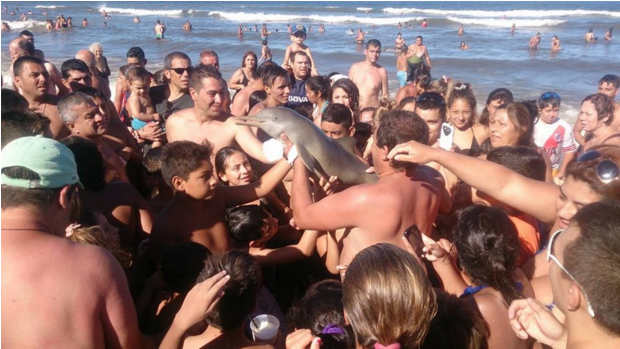
seflie

I hate these news stories, but not for the reasons you might think.

These stories represent a kind of technological puritanism in ocean outreach, where we draw weirdly unfounded conclusions about the way humans relate to their tools to somehow absolve us of social responsibility. It’s not people mistreating a dolphin, it’s a selfie-crazed mob. We chuckle and move on, because we don’t take aggressive selfies. We’re better than that.

This is not correct.

I know  it’s not correct because, admit it, you shared one of those articles. You jumped into a social media mob to pass around this image as if it were some kind of statement about how horrible selfies are. Yes, even you. And if you didn’t, I bet you’re feeling pretty smug about not jumping in on that one. Catch-22.

As an aside, because I am the saltiest of salty ocean bloggers, I would be remiss if I didn’t ask: where is the selfie? I see two cameras among this crowd of a couple dozen people, plus the camera taking this picture. None of them appear to be taking selfies.

Here’s what I know: We need to do a better job educating people about handling marine animals, these kinds of things happen a lot, and they happen whether or not someone is there to take pictures. We need to train lifeguards or beach staff to handle marine animal standings. We need to post more signs. And we need to spend more time thinking about how to use incidents like this to broaden people’s understanding of marine life. After all, that crowd is comprised mostly of children who are simply curious, rather than cruel.  

People don’t participate in exceptionally cruel acts because they have a camera. People participate, often unknowingly, in exceptionally cruel acts and, because everyone has a camera, these acts are documented. Pretending it’s technology that drives crowds to drag an ailing dolphin out of the surf and pass it around like a trophy, fundamentally misses something important about human behavior and refocuses conservation conversations on trivialities like cracking wise about selfie-sticks rather than addressing clear and critical knowledge gaps. We need to be fostering both an appreciation for and understanding of the ocean, and yes, absolutely that involves connecting people to the ocean through photography, even *gasp* selfies.

If nothing else, this kind of technological puritanism misses the most important message in this moment. We only know it happened, we are only now able to discuss it, because someone took a picture.

Share this:

  • Click to share on Bluesky (Opens in new window) Bluesky
  • Click to share on Facebook (Opens in new window) Facebook
  • Click to share on Reddit (Opens in new window) Reddit
  • Click to share on Threads (Opens in new window) Threads
  • Click to share on WhatsApp (Opens in new window) WhatsApp
  • Click to share on Mastodon (Opens in new window) Mastodon

Related

Tags: dolphin selfie

Post navigation

❮ Previous Post: New book by Doc Gruber raises money for shark research
Next Post: Shark MOOC: There’s a big shark party, and you’re invited! ❯

You may also like

Science
10 reasons why marine mammals aren’t as cute as you think they are
April 8, 2010
Weekly Salvage
Burning driftwood, new protections for Canada’s oceans, dolphin errant, and more! Monday Morning Salvage: May 13, 2019
May 13, 2019
Weekly Salvage
A new disaster in Ocean Policy, follow the International Marine Conservation Congress at #IMCC5, shallow vents, deep mining, cotton candy lobsters, and more! Monday Morning Salvage: June 25, 2018
June 25, 2018
Weekly Salvage
The real deep reefs of South Carolina, dolphin chatter, autonomous starfish killing robots, an exciting submarine discovery, and more! Monday Morning Salvage: September 3, 2018
September 3, 2018

Popular Posts

Shark scientists want their research to help save threatened species, but don’t know how. Our new paper can help.Shark scientists want their research to help save threatened species, but don’t know how. Our new paper can help.December 1, 2025David Shiffman
Norway and Cook Islands put their deep-sea mining plans on pause.Norway and Cook Islands put their deep-sea mining plans on pause.December 3, 2025Andrew Thaler
What Ocean Ramsey does is not shark science or conservation: some brief thoughts on "the Shark Whisperer" documentaryWhat Ocean Ramsey does is not shark science or conservation: some brief thoughts on "the Shark Whisperer" documentaryJuly 2, 2025David Shiffman
The Trouble with Teacup PigsThe Trouble with Teacup PigsOctober 14, 2012Andrew Thaler
What we know we don't know: impacts of deep-sea mining on whales, dolphins, sharks, turtles, and other migratory species.What we know we don't know: impacts of deep-sea mining on whales, dolphins, sharks, turtles, and other migratory species.November 20, 2025Andrew Thaler
2025: My year in writing, public speaking, and media interviews2025: My year in writing, public speaking, and media interviewsDecember 3, 2025David Shiffman
Urea and Shark OsmoregulationUrea and Shark OsmoregulationNovember 15, 2010David Shiffman
Shark of Darkness: Wrath of Submarine is a fake documentaryShark of Darkness: Wrath of Submarine is a fake documentaryAugust 10, 2014Michelle Jewell
How tiny satellites are tracking marine wildlifeDecember 1, 2025Andrew Thaler
Build a dirt cheap, tough-as-nails field computer in a Pelican caseBuild a dirt cheap, tough-as-nails field computer in a Pelican caseJuly 21, 2015Andrew Thaler
Subscribe to our RSS Feed for updates whenever new articles are published.

We recommend Feedly for RSS management. It's like Google Reader, except it still exists.

Southern Fried Science

  • Home
  • About SFS
  • Authors
  • Support SFS


If you enjoy Southern Fried Science, consider contributing to our Patreon campaign.

Copyright © 2025 Southern Fried Science.

Theme: Oceanly Premium by ScriptsTown