
Like most marine biology geeks, I’m a huge fan of Disney/Pixar’s “Finding Nemo”. In addition to a heartwarming story of a father trying to bring his son home to their aneme…anemeneme… amenememe… anemone, the film showcases an enormous variety of beautiful real-life coral reef species. According to research published today in Conservation Letters, however, we may soon only be able to see some of these animals in the movies. The paper, titled “Extinction Risk and Bottlenecks in the Conservation of Charismatic Marine Species”, concluded that many of the stars of Finding Nemo are in deep trouble.
Regular readers know that sharks (like Anchor, Bruce, and Chum) and sea turtles (like Squirt and Crush) are threatened globally due to overharvest. Other characters in the film are threatened as well. 40% of all known seahorses (like Sheldon) are threatened with extinction, earning seahorses the unfortunate honor of being the most threatened group of bony fishes that appear in Finding Nemo. Brown pelicans (like Nigel) and their relatives are also in bad shape.
This new research summarized the conservation status of over 1,500 marine species which either appear in Finding Nemo or are in the same family as those who do, and the trends are scary. One in six of these species are threatened with extinction. When broken down by family, the trends are even worse for many groups. 100% of sea turtles, 80% of lamnid sharks (a group which includes makos and great whites), and 50% of myliobatid rays (Eagle rays like the cleverly-named Mr. Ray) are listed as threatened. Marlin was right when he told Nemo that the ocean is not a safe place for fish.
“Putting Nemo in office aquariums, making soup out of Anchor the shark’s fins and selling Sheldon the seahorse as curios has taken a toll,” says Loren McClenachan, the study’s lead author and NSF International Postdoctoral Fellow at Simon Fraser University. “Our research highlights how very little we know about many of these animals. It’s unthinkable that the characters in Finding Nemo could become extinct, but this is the reality unless we pay more attention to the diversity of marine life.”
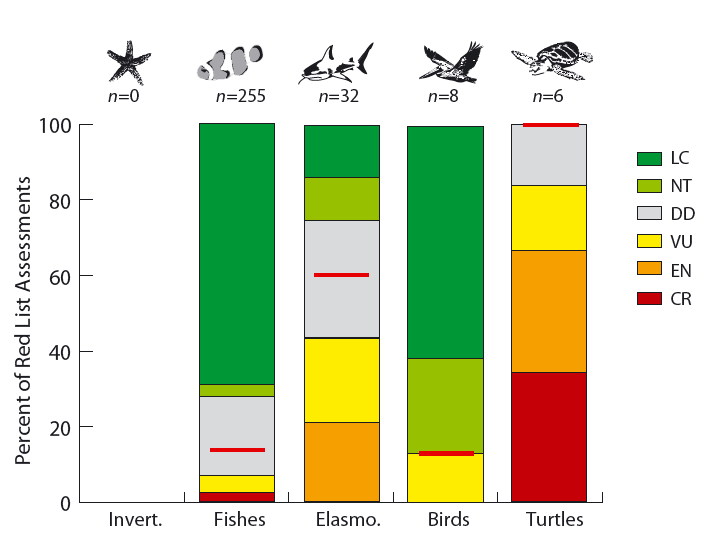
An alarmingly high number of animals are considered “Data Deficient”, which means we don’t know enough about their populations to make an informed judgment on how endangered they are. In my experience, not knowing enough about a species’ population trends typically means that the species in question isn’t doing great. Marine invertebrates like Jaques the cleaner shrimp and Peach the sea star are particularly poorly studied. You don’t need to be able to speak whale to know that’s a big problem.
Perhaps most troubling, this new paper concluded that legal protection for many of the threatened animals identified by this study is severely lacking. Only 8% of the threatened shark species (and only 39% of all the threatened species) in this analysis are protected by CITES. Yikes- with friends like these, who needs anemones? The picture is particularly bleak for sharks and rays.
“Our study found that threatened sharks and rays lacked needed protection against international trade, compared to all other groups. Fewer than one in ten species of threatened sharks and rays considered in the study were protected by the CITES (Convention on International Trade of Endangered Species),” says co-author Nicholas Dulvy, co-chair of the IUCN Shark Specialist Group and Associate Professor of Biology at Simon Fraser University.
If we want these amazing creatures to be able to “just keep swimming”, we’re going to need to act before it’s too late. The good news is that thanks to movies like Finding Nemo, people care about many of these animals. I fully expect this paper to make a huge media splash, and I hope that it’s dire conclusions will inspire improved marine conservation all over the world. After all- fish are friends, not food.

Loren McClenachan,, Andrew Cooper,, Kent Carpenter, & Nick Dulvy (2011). Extinction Risk and Bottlenecks in the Conservation of Charismatic Marine Species Conservation Letters
I remember the moral of the movie was that the fish were better off in the ocean than in people’s aquaria – then after they saw the movie, lots of people felt they had to have a clown fish in their home aquarium. Talk about a message backfiring!!
Wish that in movies like these there would be some kind of message or statement in the front of the movies of warning on how precious our animal and wild life really is and that we need to take every step to protect their homes and habitats for their generations to come.
I’ll be happy to read the next article: 5 out of 6 species that appear in Finding Nemo not to be threatened with extinction, according to the CRs 🙂