 Every once in a while, with predictable regularity, I will encounter a call to be more interdisciplinary in order to fully understand the many aspects of a given issue. The world forgot to compartmentalize its problems for ease of solution. Solutions require scientists to think big and basic at the same time – recent estimates that 7 billion people will roam the planet by the end of this year – and that creates a big demand for resources such as food, water, fuel, and fiber. Ecologists clearly have something to say on the matter and designated 2011’s meeting theme “Earth Stewardship”, meant as a way to kick off new thinking on research process and connecting research to problem solving.
The Earth Stewardship initiative might remind you of ESA’s Sustainable Biosphere Initiative, which was directly aimed at ecologists in the form of an “ecological research agenda”. You’d have to ask the very busy Jane Lubchenco and Pam Matson to be sure, but the initiative is largely credited with creation of sustainability science. Since 1991, however, those words have become politicized, generalized, and often leave modern readers with more questions than answers. I’ve heard people claim sustainability science is fundamentally a social science – despite deep foundational roots in ecology.
A recent study in PNAS aims to empirically track what’s happened to sustainability science since its birth. The study frames the transition in the challenge sustainability science embodies:
“A science of sustainability necessarily requires collaboration between perspectives in developed and developing human societies, among theoretical and applied scientific disciplines, and must bridge the gap between theory, practice, and policy. There is arguably no example in the history of science of a field that from its beginnings could span such distinct dimensions and achieve at once ambitious and urgent goals of transdisciplinary scientific rigor and tangible socioeconomic impact.”
So perhaps sustainability science in its original incarnation needed some help before tackling such ambitious goals. In fact, these challenges require reexamination of the very way we structure scientific inquiry.
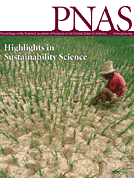 Every discipline has a culture. The problem is that many of the relevant disciplines to sustainability problems have very different cultures – from style of writing to collaboration facilitation. The rumors about the social sciences dominating sustainability science are somewhat true – 1/3 of all publications – but that influence is decreasing and engineering and biology each have a large and rising contribution.
Perhaps more interestingly, the culture melding extends beyond academic fencelines to countries and institutions. Sustainability science has more global representation than any of its contributing disciplines, likely due to historic connection to the international development community. Authors are also more likely to come from smaller universities, think-tanks, nonprofits, and government.
So what does sustainability science look like today? Can we see where it’s going? The number of authors ascribing themselves to the field is exponentially growing and according to this particular investigation, the field unified itself in 2000. The main hallmark of the field seems to be wide collaborations and new approaches to synthesis of concepts and methods. So the future may hold better public understanding of what sustainability science is and tangible results of scientific collaborations credited to the new discipline.
Reference:
Bettencourt, L., & Kaur, J. (2011). From the Cover: Evolution and structure of sustainability science Proceedings of the National Academy of Sciences, 108 (49), 19540-19545 DOI: 10.1073/pnas.1102712108


See also Sustainability: Science, Practice, & Policy (SSPP) http://sspp.proquest.com — peer-reviewed, open-access journal that provides a platform for the dissemination of new practices and for dialogue emerging out of the field of sustainability.