Skip to content

Southern Fried Science

Over 15 years of ocean science and conservation online

  • Home
  • About SFS
  • Authors
  • Support SFS

Tag: deep-sea mining

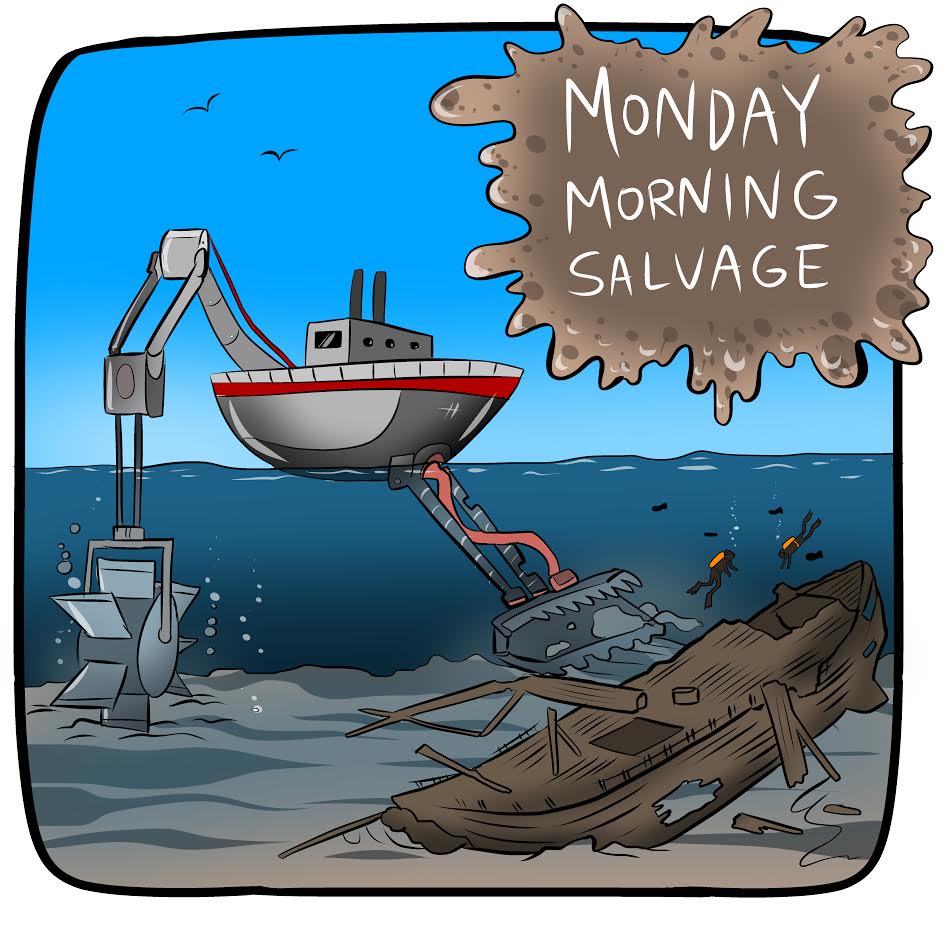
Titanic tourists, nodule mining, right whales, and more! The Monday Morning Salvage: April 17, 2017

Posted on April 17, 2017April 16, 2017 By Andrew Thaler
Weekly Salvage

Fog Horn (A Call to Action)

  • The EPA is seeking public input on the new administrations approach to environmental regulations. They are required to seek public input. They are required to respond to public input. Go tell them how you feel. Public comments close May 15. Here’s the docket with instructions on how to comment: Evaluation of Existing Regulations.

Flotsam (what we’re obsessed with right now)

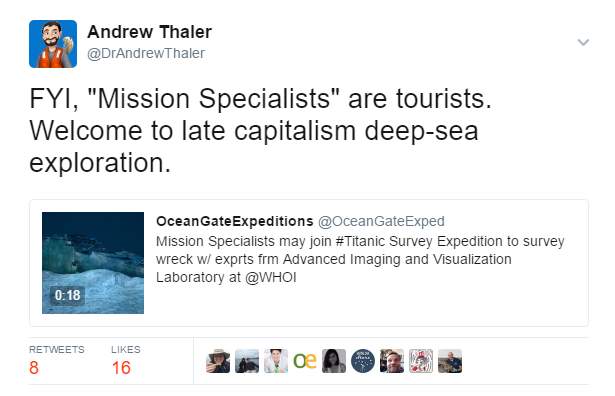
  • Titanic Tourism. Like this article: To Visit Titanic Firsthand, New York Banker Dives Deep Into Wallet. I have thoughts. Oh so many thoughts.

Jetsam (what we’re enjoying from around the web)

  • Deep-sea mining meets alternative energy: Renewables’ deep-sea mining conundrum. I once calculated that all the copper in Solwara 1 could make 800 1-megawatt wind turbines [note: I am not good at math].
  • Two really cool expeditions coming out of Louisiana this year: Exploring Changes on the Gulf Coast and Ecology of Shallow Wood Falls.  Neat!
  • Begun, the crab wars have. Svalbard’s Snow Crabs: a Pincered Proxy for Arctic Oil.
  • A wonderful piece on field notes and what they mean to past a future fisheries biologists from our friends at the Fisheries Blog.
  • A tiny Iowa paper just won a Pulitzer Prize for tackling farm pollution. This mouse roars.
  • Farm-raised superbugs find their way into kids’ noses somehow. This is fine. Every thing is fine.

Read More “Titanic tourists, nodule mining, right whales, and more! The Monday Morning Salvage: April 17, 2017” »

Octopus Genes, Decolonization, and a mega-dose of Citizen Science! Monday Morning Salvage: April 10, 2017

Posted on April 10, 2017April 10, 2017 By Andrew Thaler
Weekly Salvage

Flotsam (what we’re obsessed with right now)

  • Octopuses are weird. Really, really weird. Ed Yong covers yet another weird octopus thing in the Atlantic: Octopuses Do Something Really Strange to Their Genes. And check out the original paper, below.

Jetsam (what we’re enjoying from around the web)

  • This interview with Shay Akil McLean is one of the best introductions to the concept of decolonizing science: Hood Biologist Explains How to Decolonize All The Science. See also: We Need Decolonial Scientists.
  • Free Radicals is one of the best new(ish) science blogs on the net: Zapatistas Reimagine Science as Tool of Resistance.
  • Incidentally, the March for Science does not have a diversity problem.

Instead, I believe that this march needs to be completely apolitical and nonpartisan. I think that we should protest the current administration, which wants to repeal laws guaranteeing clean air and water, claim that climate change is a hoax, and remove scientists’ access to quality healthcare, but in a way that doesn’t alienate members of the current administration. We should demand change, but vaguely, and from no one in particular.

Source.

  • If you love geophysical fluid dynamics, then you will love these foamy streaks in a lagoon. Deep Sea News, natch.
  • With the legendary Erika Bergman at the helm, the Aquatica Submarine crew put eyes on a new glass sponge bioherm off the coast of Vancouver.

https://www.youtube.com/watch?v=V6stLjJ5lAo

  • Another article about the GOSH meeting where I rep-ed OpenROV and Oceanography for Everyone: Santiago de Chile, capital of the Global network for Open Science Hardware.
  • As a card-carrying population geneticist, I second this piece: Getting your genetic disease risks from 23andme is probably a terrible idea.

Read More “Octopus Genes, Decolonization, and a mega-dose of Citizen Science! Monday Morning Salvage: April 10, 2017” »

Meteor hunters, deep divers, and ocean action! Monday Morning Salvage: April 3, 2017

Posted on April 3, 2017 By Andrew Thaler
Weekly Salvage

Flotsam (what we’re obsessed with right now)

  • Have you ever wanted to hunt for meteorites in the Great Lakes using underwater robots? Yes? Well, guess what? Now you can! Join along with the ROV Meteorite Hunt on OpenExplorer!
  • If the Great Lakes are a little too chilly for you, maybe consider joining SFS Super Fan Joey Meier and his students at Polk State on their journey to Guadalupe!

Jetsam (what we’re enjoying from around the web)

Read More “Meteor hunters, deep divers, and ocean action! Monday Morning Salvage: April 3, 2017” »

“When we left the beach…” Monday Morning Salvage: March 20, 2017

Posted on March 20, 2017 By Andrew Thaler
Weekly Salvage


Flotsam (what we’re obsessed with right now)

  • The poetry of Derek Walcott.
Walcott, from the Trinidad Guardian.
  • Nobel laureate, poet, and perhaps the finest English-language writer of any generation, died this weekend. His poetry, particularly the epic poem Omeros, which draws upon the themes of Homer’s Iliad and Odyssey to tell the story of colonization, imperialism, slavery, and humanity’;s relationship to the sea over more than 8000 lines.
  • If you’re new to the poetry of Derek Walcott, The Sea is History is a great place to start and the New York Times published a short selection of his poetry: The Pages of the Sea.

Read More ““When we left the beach…” Monday Morning Salvage: March 20, 2017″ »

Monday Morning Salvage: February 20, 2017

Posted on February 20, 2017 By Andrew Thaler 1 Comment on Monday Morning Salvage: February 20, 2017
Weekly Salvage

For all our US-based Readers: Happy President’s Day! For everyone else, this is the reason none of you USian colleagues are answering e-mails. Unless they are, in which case, *grumble grumble grumble* *something about work-life balance*

Flotsam (what we’re obsessed with right now)

  • The ocean is full of garbage and even the deepest trenches aren’t safe. Here’s an interview I did with KSPN Saipan where I talked about the garbage the precedes us everywhere we go.
  • Also: Banned chemicals persist in deep ocean. This seems important.

Read More “Monday Morning Salvage: February 20, 2017” »

Monday Morning Salvage: February 6, 2017

Posted on February 6, 2017 By Andrew Thaler
Uncategorized

Bringing you the best of marine science and conservation from the last week.

Flotsam (what we’re obsessed with right now)

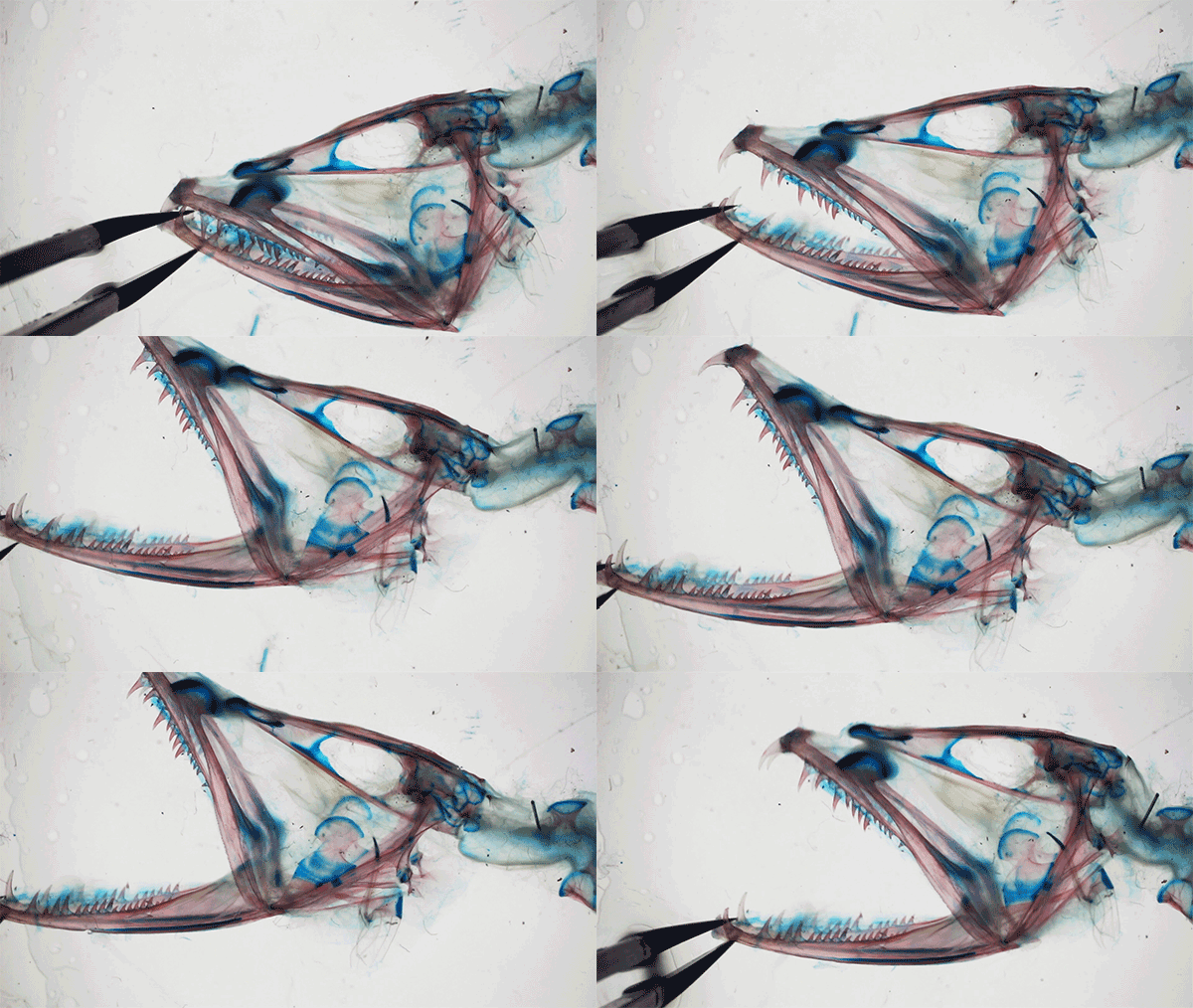
  • The ridiculous, extensible jaw and neck joint of a Barbeled Dragonfish.

  • Deep-Sea Fishes That Are Built to Eat Big.

Jetsam (what we’re enjoying from around the web)

Read More “Monday Morning Salvage: February 6, 2017” »

Monday Morning Salvage: January 2, 2017

Posted on January 2, 2017January 1, 2017 By Andrew Thaler
Weekly Salvage

Welcome to 2017 and the ninth year of marine science and conservation at Southern Fried Science!

Flotsam (what we’re obsessed with right now)

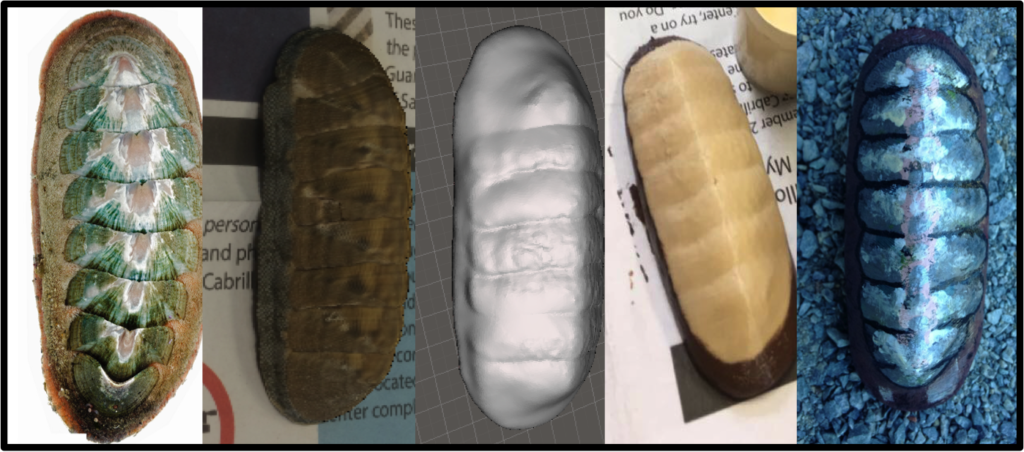
  • Alex Warneke knows exactly how to push all of my ocean outreach buttons: Low-cost teaching tools? Check! Hands on student engagement? Check! Open-source materials and datasets? Check! 3D Printing? Check! Meet 3D Cabrillo:
Courtesy A. Warneke, DSN.
  • Learn more about this awesome project from the National Park Service: How to Build a Better Biomodel.

Jetsam (what we’re enjoying from around the web)

Read More “Monday Morning Salvage: January 2, 2017” »

The environmental impact of biomining the deep sea.

Posted on January 20, 2016January 19, 2016 By Andrew Thaler
Uncategorized

On January 1, 2016, the Southern Fried Science central server began uploading blog posts apparently circa 2041. Due to a related corruption of the contemporary database, we are, at this time, unable to remove these Field Notes from the Future or prevent the uploading of additional posts. Please enjoy this glimpse into the ocean future while we attempt to rectify the situation.


Diversity is resilience.

Or so deep-sea mining newcomer Aronnax Environmental wants you to believe. Arronax will be the first new novel-compound biomining operation to make the dive in almost a decade. The high cost of entry and the onerous permitting process has made competition in the high seas practically non-existent for the big six.

Aronnax enters the game as the “sustainable alternative to destructive biomining”. They claim that their proprietary process is kinder to the seafloor and allows recruitment and recovery following each pass of the mining tool–which they call a swath. The machine itself is a sifter, rather than a dozer, which allows for the collection of environmental DNA while minimizing disturbance to the seafloor. Sifter technology is, in theory, designed to maximize biotic retention, protecting local biodiversity while still achieving 95% comprehensive sampling.

At least, that’s what Aronnax hopes. 

Read More “The environmental impact of biomining the deep sea.” »

Whatever happened to deep-sea mining?

Posted on January 19, 2016January 10, 2016 By Andrew Thaler
Uncategorized

On January 1, 2016, the Southern Fried Science central server began uploading blog posts apparently circa 2041. Due to a related corruption of the contemporary database, we are, at this time, unable to remove these Field Notes from the Future or prevent the uploading of additional posts. Please enjoy this glimpse into the ocean future while we attempt to rectify the situation.


“In the depths of the ocean, there are mines of zinc, iron, silver and gold that would be quite easy to exploit”

Jules Verne, 20,000 Leagues Under the Sea

There really should be a rule about starting any more deep-sea mining articles with that Jules Verne quote. Something like 50% of my own articles on the topic begin with that aging line from 20,000 Leagues Under the Sea. There are mines of gold in the deep sea, but, as it turns out, they are not quite so easy to exploit.

Three decades ago, the deep-sea mining industry coalesced around a hydrothermal vent prospect in Papua New Guinea. At the time one of the largest known seafloor massive sulfides, its proximity to shore, as well as its location within the territorial seas of a single nation, made it the ideal spot to launch the first deep-sea mining operation. A decade later the first mining tools touched down on the seafloor.

This is not that story. The rise and fall and fall and rise and fall and rise of deep-sea mining is a tale almost a century old (and one which we have blogged about quite a bit). Like the tide itself, the industry is entirely dependent on the ebb and flow of commodities prices. When copper and gold are down, exploiting the seafloor is prohibitively expensive. When the price eventually rises, the upfront cost and long tail of mobilization means that initial profit projections are woefully obsolete by the time production begins. The Persistent Technology movement managed to handily tank the commodities market for most of the 20’s. 

Of course, while the underlying resource proved to be too risky in a volatile commodities market, the technology developed for those first mines went on to be enormously profitable in other sub-sea ventures. Biomining and Rare-Earth Element Shunting wouldn’t exist if it weren’t for these early pioneers. Nor, for that matter, would some non-exploitive industries, like deep aquaculture and thermogradient energy production.

Read More “Whatever happened to deep-sea mining?” »

What happens when we punch a hole in the seafloor?

Posted on April 23, 2015April 24, 2015 By Andrew Thaler 1 Comment on What happens when we punch a hole in the seafloor?
Science
Fig 3. Temporal sequence of landscape at/around Hole D/E. From Nakajima et al. 2015.

A longtime submariner I know tells the story of a most unusual dive. On this particular plunge, they went down into the briny deep to place what can best be described as a giant manhole cover on the seafloor. There was a hole, and, by all accounts, the sea was draining in to it.

For more than half-a-century, we’ve been drilling holes in the bottom of the sea. Some reveal the buried history of the evolution of our oceans. Others uncover vast wells of crude oil. Science, exploration, and exploitation have all benefited from ocean drilling programs. But what happens to the seafloor when you punch a hole in the ocean? In my friend’s case, the drilling program opened a sub-sea cavern, resulting in changes to local current regimes, potentially disturbing the surrounding benthic community. The most practical solution was to simply plug the hole.

We’ve punched a lot of holes in the seafloor, but despite a few anecdotes and scant research, we know precious little about how these holes actually alter the marine environment. This is particularly worrying, as deep-sea mining at hydrothermal vents, manganese nodule fields, and oceanic crusts are slowly creeping out of the realm of science fiction and into our oceans. Ocean drilling in the deep sea is perhaps the closest analog to industrial-scale deep-sea mining. Understanding the potential impacts is critical to designing management and mitigation regimes that protect the delicate deep seafloor.

Read More “What happens when we punch a hole in the seafloor?” »

Posts pagination

Previous 1 … 14 15 16 Next

Popular Posts

Shark scientists want their research to help save threatened species, but don’t know how. Our new paper can help.Shark scientists want their research to help save threatened species, but don’t know how. Our new paper can help.December 1, 2025David Shiffman
Norway and Cook Islands put their deep-sea mining plans on pause.Norway and Cook Islands put their deep-sea mining plans on pause.December 3, 2025Andrew Thaler
What Ocean Ramsey does is not shark science or conservation: some brief thoughts on "the Shark Whisperer" documentaryWhat Ocean Ramsey does is not shark science or conservation: some brief thoughts on "the Shark Whisperer" documentaryJuly 2, 2025David Shiffman
What we know we don't know: impacts of deep-sea mining on whales, dolphins, sharks, turtles, and other migratory species.What we know we don't know: impacts of deep-sea mining on whales, dolphins, sharks, turtles, and other migratory species.November 20, 2025Andrew Thaler
2025: My year in writing, public speaking, and media interviews2025: My year in writing, public speaking, and media interviewsDecember 3, 2025David Shiffman
The Trouble with Teacup PigsThe Trouble with Teacup PigsOctober 14, 2012Andrew Thaler
Urea and Shark OsmoregulationUrea and Shark OsmoregulationNovember 15, 2010David Shiffman
How tiny satellites are tracking marine wildlifeDecember 1, 2025Andrew Thaler
Shark of Darkness: Wrath of Submarine is a fake documentaryShark of Darkness: Wrath of Submarine is a fake documentaryAugust 10, 2014Michelle Jewell
Build a dirt cheap, tough-as-nails field computer in a Pelican caseBuild a dirt cheap, tough-as-nails field computer in a Pelican caseJuly 21, 2015Andrew Thaler
Subscribe to our RSS Feed for updates whenever new articles are published.

We recommend Feedly for RSS management. It's like Google Reader, except it still exists.

Southern Fried Science

  • Home
  • About SFS
  • Authors
  • Support SFS


If you enjoy Southern Fried Science, consider contributing to our Patreon campaign.

Copyright © 2025 Southern Fried Science.

Theme: Oceanly Premium by ScriptsTown