Skip to content

Southern Fried Science

Over 15 years of ocean science and conservation online

  • Home
  • About SFS
  • Authors
  • Support SFS

Tag: deep-sea mining

Monday Morning Salvage: January 2, 2017

Posted on January 2, 2017January 1, 2017 By Andrew Thaler
Weekly Salvage

Welcome to 2017 and the ninth year of marine science and conservation at Southern Fried Science!

Flotsam (what we’re obsessed with right now)

  • Alex Warneke knows exactly how to push all of my ocean outreach buttons: Low-cost teaching tools? Check! Hands on student engagement? Check! Open-source materials and datasets? Check! 3D Printing? Check! Meet 3D Cabrillo:
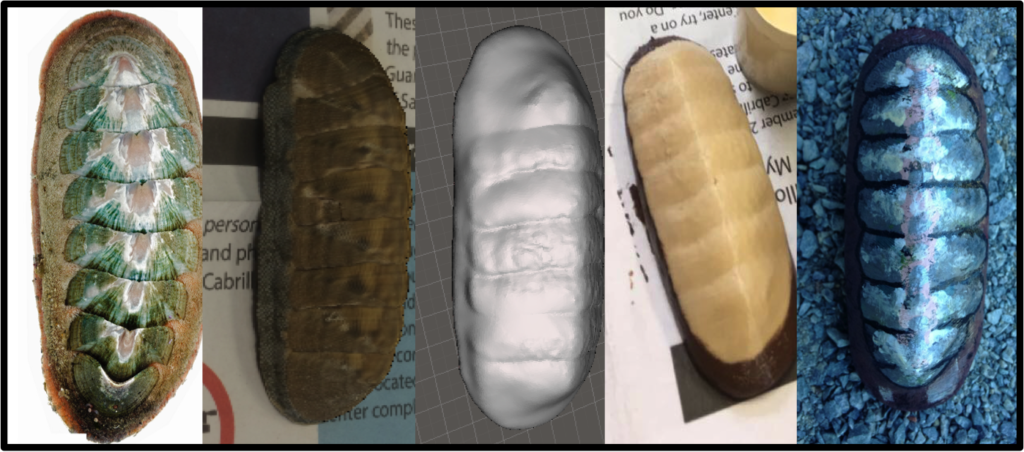
Courtesy A. Warneke, DSN.
  • Learn more about this awesome project from the National Park Service: How to Build a Better Biomodel.

Jetsam (what we’re enjoying from around the web)
Read More “Monday Morning Salvage: January 2, 2017” »

The environmental impact of biomining the deep sea.

Posted on January 20, 2016January 19, 2016 By Andrew Thaler
Uncategorized

On January 1, 2016, the Southern Fried Science central server began uploading blog posts apparently circa 2041. Due to a related corruption of the contemporary database, we are, at this time, unable to remove these Field Notes from the Future or prevent the uploading of additional posts. Please enjoy this glimpse into the ocean future while we attempt to rectify the situation.


Diversity is resilience.

Or so deep-sea mining newcomer Aronnax Environmental wants you to believe. Arronax will be the first new novel-compound biomining operation to make the dive in almost a decade. The high cost of entry and the onerous permitting process has made competition in the high seas practically non-existent for the big six.

Aronnax enters the game as the “sustainable alternative to destructive biomining”. They claim that their proprietary process is kinder to the seafloor and allows recruitment and recovery following each pass of the mining tool–which they call a swath. The machine itself is a sifter, rather than a dozer, which allows for the collection of environmental DNA while minimizing disturbance to the seafloor. Sifter technology is, in theory, designed to maximize biotic retention, protecting local biodiversity while still achieving 95% comprehensive sampling.

At least, that’s what Aronnax hopes. 

Read More “The environmental impact of biomining the deep sea.” »

Whatever happened to deep-sea mining?

Posted on January 19, 2016January 10, 2016 By Andrew Thaler
Uncategorized

On January 1, 2016, the Southern Fried Science central server began uploading blog posts apparently circa 2041. Due to a related corruption of the contemporary database, we are, at this time, unable to remove these Field Notes from the Future or prevent the uploading of additional posts. Please enjoy this glimpse into the ocean future while we attempt to rectify the situation.


“In the depths of the ocean, there are mines of zinc, iron, silver and gold that would be quite easy to exploit”

Jules Verne, 20,000 Leagues Under the Sea

There really should be a rule about starting any more deep-sea mining articles with that Jules Verne quote. Something like 50% of my own articles on the topic begin with that aging line from 20,000 Leagues Under the Sea. There are mines of gold in the deep sea, but, as it turns out, they are not quite so easy to exploit.

Three decades ago, the deep-sea mining industry coalesced around a hydrothermal vent prospect in Papua New Guinea. At the time one of the largest known seafloor massive sulfides, its proximity to shore, as well as its location within the territorial seas of a single nation, made it the ideal spot to launch the first deep-sea mining operation. A decade later the first mining tools touched down on the seafloor.

This is not that story. The rise and fall and fall and rise and fall and rise of deep-sea mining is a tale almost a century old (and one which we have blogged about quite a bit). Like the tide itself, the industry is entirely dependent on the ebb and flow of commodities prices. When copper and gold are down, exploiting the seafloor is prohibitively expensive. When the price eventually rises, the upfront cost and long tail of mobilization means that initial profit projections are woefully obsolete by the time production begins. The Persistent Technology movement managed to handily tank the commodities market for most of the 20’s. 

Of course, while the underlying resource proved to be too risky in a volatile commodities market, the technology developed for those first mines went on to be enormously profitable in other sub-sea ventures. Biomining and Rare-Earth Element Shunting wouldn’t exist if it weren’t for these early pioneers. Nor, for that matter, would some non-exploitive industries, like deep aquaculture and thermogradient energy production.

Read More “Whatever happened to deep-sea mining?” »

What happens when we punch a hole in the seafloor?

Posted on April 23, 2015April 24, 2015 By Andrew Thaler 1 Comment on What happens when we punch a hole in the seafloor?
Science
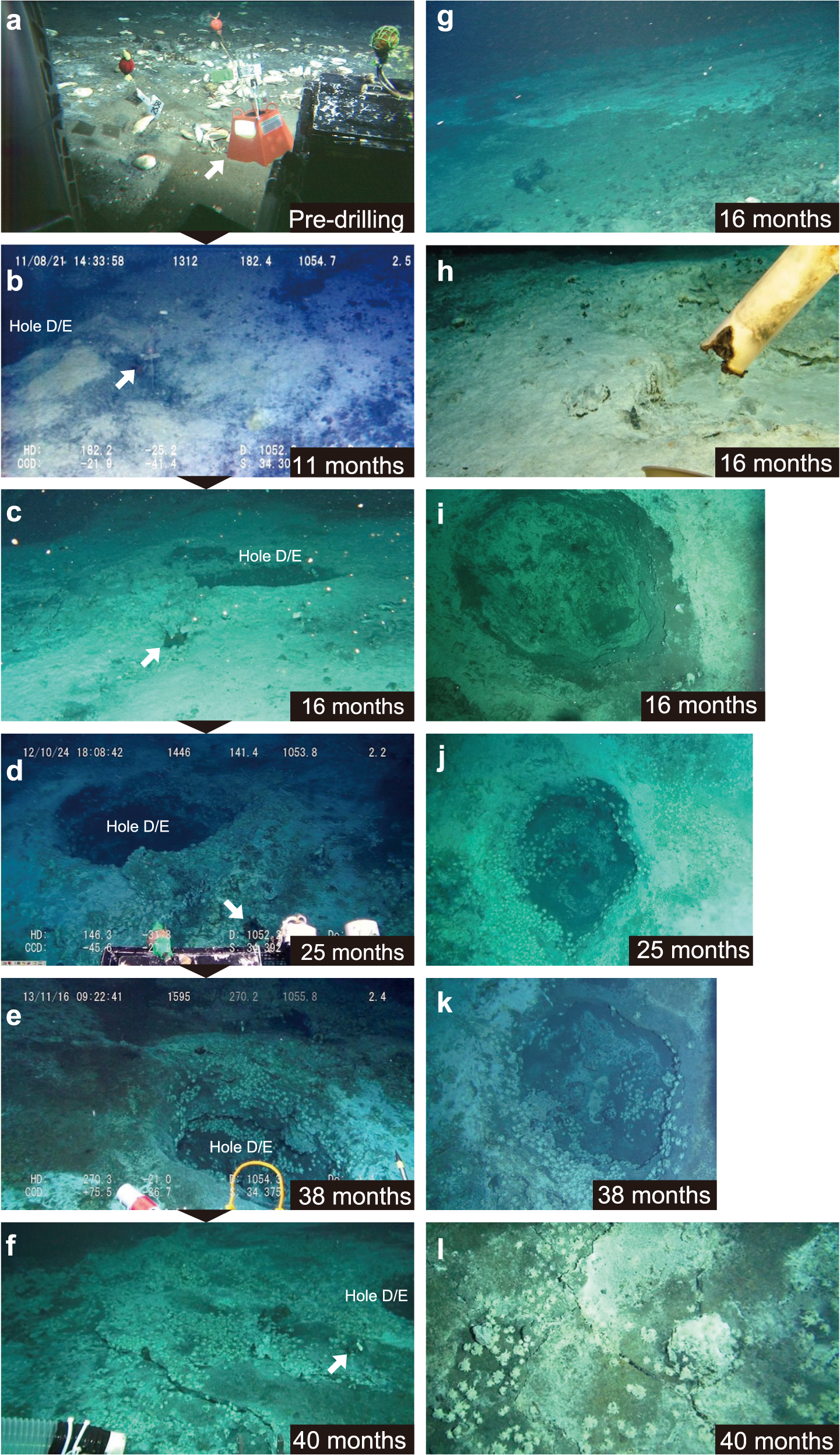
Fig 3. Temporal sequence of landscape at/around Hole D/E. From Nakajima et al. 2015.

A longtime submariner I know tells the story of a most unusual dive. On this particular plunge, they went down into the briny deep to place what can best be described as a giant manhole cover on the seafloor. There was a hole, and, by all accounts, the sea was draining in to it.

For more than half-a-century, we’ve been drilling holes in the bottom of the sea. Some reveal the buried history of the evolution of our oceans. Others uncover vast wells of crude oil. Science, exploration, and exploitation have all benefited from ocean drilling programs. But what happens to the seafloor when you punch a hole in the ocean? In my friend’s case, the drilling program opened a sub-sea cavern, resulting in changes to local current regimes, potentially disturbing the surrounding benthic community. The most practical solution was to simply plug the hole.

We’ve punched a lot of holes in the seafloor, but despite a few anecdotes and scant research, we know precious little about how these holes actually alter the marine environment. This is particularly worrying, as deep-sea mining at hydrothermal vents, manganese nodule fields, and oceanic crusts are slowly creeping out of the realm of science fiction and into our oceans. Ocean drilling in the deep sea is perhaps the closest analog to industrial-scale deep-sea mining. Understanding the potential impacts is critical to designing management and mitigation regimes that protect the delicate deep seafloor.

Read More “What happens when we punch a hole in the seafloor?” »

Beyond the Edge of the Plume: understanding environmental impacts of deep-sea mining

Posted on July 21, 2014July 21, 2014 By Andrew Thaler 1 Comment on Beyond the Edge of the Plume: understanding environmental impacts of deep-sea mining
Conservation, Science
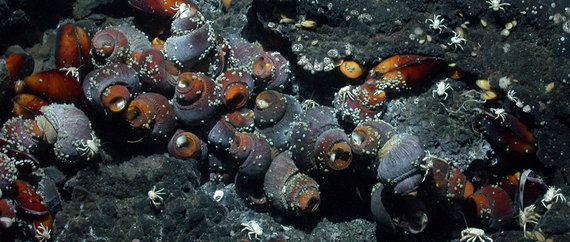
Ifremeria nautilei from the Manus Basin. Source: MARUM

The mining of deep-sea hydrothermal vents for gold, copper, and other precious metals, is imminent. Over the last seven years I’ve worked with industry, academia, and international regulatory agencies to help craft guidelines for conducting environmental impact studies and assess the connectivity and resilience of deep-sea ecosystems. Deep-sea mining, particularly at hydrothermal vents, is a complicated endeavor. As an ecologist and environmentalist, I’d like to see all deep-sea ecosystems receive extraordinary levels of protection. As a pragmatist and someone who recognizes that access to technology is a human right, I realize that demand for essential resources like copper, cobalt, and rare earth elements is only going to increase.

Mining a deep-sea hydrothermal vent presents a conundrum. Across the world, vents vary in their longevity and proximity to each other. A fast spreading center like those found in western Pacific back-arc basins, can have numerous, densely packed vents that persist for tens of years. In contrast, ultra-slow spreading centers, like the central Indian Ridge, may have a few, sparsely distributed vents that remain active for centuries. The sustainability of deep-sea mining is completely dependent on the type of vents being mined. Vents in slow spreading centers may never recover from any anthropogenic impact, while those in fast spreading centers could be extremely resilient to the disturbance caused by mining.

Read More “Beyond the Edge of the Plume: understanding environmental impacts of deep-sea mining” »

Posts pagination

Previous 1 … 15 16

Popular Posts

What Ocean Ramsey does is not shark science or conservation: some brief thoughts on "the Shark Whisperer" documentaryWhat Ocean Ramsey does is not shark science or conservation: some brief thoughts on "the Shark Whisperer" documentaryJuly 2, 2025David Shiffman
That's not a blobfish: Deep Sea Social Media is Flooded by AI SlopThat's not a blobfish: Deep Sea Social Media is Flooded by AI SlopDecember 19, 2025Andrew Thaler
Tangier, an Island out of Time.Tangier, an Island out of Time.July 3, 2017Andrew Thaler
Shark of Darkness: Wrath of Submarine is a fake documentaryShark of Darkness: Wrath of Submarine is a fake documentaryAugust 10, 2014Michelle Jewell
Join Me at Upwell: A Wave of Ocean Justice — Our Fourth Year!Join Me at Upwell: A Wave of Ocean Justice — Our Fourth Year!March 24, 2026Angelo Villagomez
Urea and Shark OsmoregulationUrea and Shark OsmoregulationNovember 15, 2010David Shiffman
What is a Sand Shark?What is a Sand Shark?November 12, 2017Chuck Bangley
I turned my woodshop into a personal solar farm.I turned my woodshop into a personal solar farm.June 21, 2021Andrew Thaler
Alberta, Canada is the proud owner of the largest man-made pyramid on the planetAlberta, Canada is the proud owner of the largest man-made pyramid on the planetOctober 16, 2012Andrew Thaler
How many nuclear weapons are at the bottom of the sea. An (almost certainly incomplete) census of broken arrows over water.How many nuclear weapons are at the bottom of the sea. An (almost certainly incomplete) census of broken arrows over water.July 26, 2018Andrew Thaler
Subscribe to our RSS Feed for updates whenever new articles are published.

We recommend Feedly for RSS management. It's like Google Reader, except it still exists.

Southern Fried Science

  • Home
  • About SFS
  • Authors
  • Support SFS


If you enjoy Southern Fried Science, consider contributing to our Patreon campaign.

Copyright © 2026 Southern Fried Science.

Theme: Oceanly Premium by ScriptsTown