Skip to content

Southern Fried Science

Over 15 years of ocean science and conservation online

  • Home
  • About SFS
  • Authors
  • Support SFS

Tag: deep-sea mining

A brutal slog through some of the worst ocean and climate news of the summer. Also, fish cannons. [Tuesday] Morning Salvage: August 13, 2019.

Posted on August 13, 2019August 13, 2019 By Andrew Thaler
Weekly Salvage

Foghorn (A Call to Action!)

  • Trump Administration Guts Endangered Species Act, setting back conservation efforts by decades, dooming thousands of charismatic species to extinction, and sealing his legacy as the racist president that is unambiguously worse than Nixon. Look, at this point, if you aren’t calling your representatives on the regular to demand impeachment, I don’t know what to tell you.

Flotsam (what we’re obsessed with right now)

  • This Satellite Image Shows Everything Wrong With Greenland Right Now.
Image: Pierre Markuse (Flickr)
  • Ballard announces new plan to search for Amelia Earhart’s plane. Cool.
    • Side Note: Ballard’s search for the Titanic has now been revealed as a front to search for two lost US nuclear submarines. Many defense experts also believe Earhart’s flight was used to provide cover as the Navy populated the Pacific with airfields. So perhaps something else is happening here, too.
  • Whooshh! Salmon Cannons Are A Thing.
https://twitter.com/i/status/1159610222148669440

Read More “A brutal slog through some of the worst ocean and climate news of the summer. Also, fish cannons. [Tuesday] Morning Salvage: August 13, 2019.” »

A global assessment of biodiversity and research effort at active Seafloor Massive Sulphides: Transcript from my talk at the International Seabed Authority.

Posted on August 6, 2019August 6, 2019 By Andrew Thaler
Conservation, Science

[The following is a transcript from a talk I gave at a side event during Part II of the 25th Session of the International Seabed Authority in July, 2019. It has been lightly edited for clarity.]

I want to change gears this afternoon and talk about a very different kind of mining. For the last two years, Diva and I have been engaged in a data mining project to discover what we can learn and what we still need to learn about biodiversity at hydrothermal vents from the 40-year history of ocean exploration in the deep sea.

Read More “A global assessment of biodiversity and research effort at active Seafloor Massive Sulphides: Transcript from my talk at the International Seabed Authority.” »

What we’ve missed in the Abyss: Mining 40 years of cruise reports for biodiversity and research effort data from deep-sea hydrothermal vents.

Posted on August 6, 2019August 6, 2019 By Andrew Thaler
Science

“When the RV Knorr set sail for the Galapagos Rift in 1977, the geologists aboard eagerly anticipated observing a deep-sea hydrothermal vent field for the first time. What they did not expect to find was life—abundant and unlike anything ever seen before. A series of dives aboard the HOV Alvin during that expedition revealed not only deep-sea hydrothermal vents but fields of clams and the towering, bright red tubeworms that would become icons of the deep sea. So unexpected was the discovery of these vibrant ecosystems that the ship carried no biological preservatives. The first specimens from the vent field that would soon be named “Garden of Eden” were fixed in vodka from the scientists’ private reserves.”

Thaler and Amon 2019

In the forty years since that first discovery, hundreds of research expedition ventured into the deep oceans to study and understand the ecology of deep-sea hydrothermal vents. In doing so, they discovered thousands of new species, unraveled the secrets of chemosynthesis, and fundamentally altered our understanding of what it means to be alive on this planet. Now, as deep-sea mining crawls slowly towards production, we must transform those discoveries into conservation and management principles to safeguard the diversity and resilience of life in the deep sea.

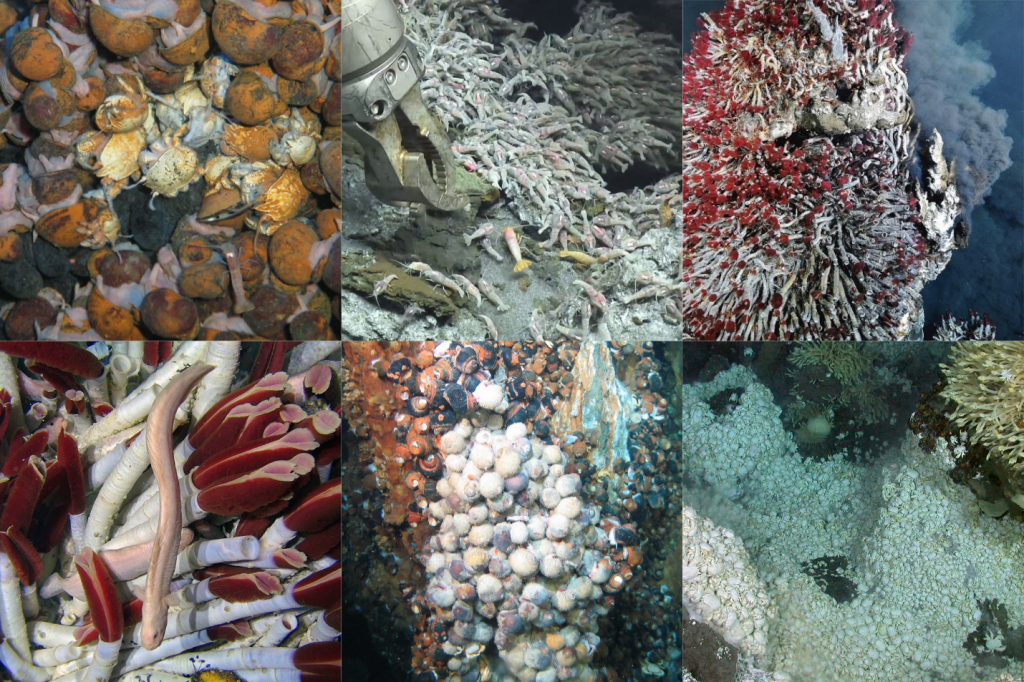
Biodiversity of hydrothermal vents from around the world. Top: Indian Ocean, Mid-Atlantic Ridge, Juan de Fuca Ridge. Bottom: East Pacific Rise, Southwest Pacific, Southern Ocean. Photo credits (top left to bottom right): University of Southampton; Woods Hole Oceanographic Institute; Ocean Networks Canada; Woods Hole Oceanographic Institute; Nautilus Minerals; University of Southampton.

Though research at hydrothermal vents looms large in the disciplines of deep-sea science, relative to almost any terrestrial system, they are practically unexplored. Over the last 2 years, Drs. Andrew Thaler and Diva Amon have poured through every available cruise report that made a biological observation at the deep-sea hydrothermal vent to assess how disproportionate research effort shapes or perception of hydrothermal vent ecosystems and impacts how we make management decisions in the wake of a new form of anthropogenic disturbance.

Read More “What we’ve missed in the Abyss: Mining 40 years of cruise reports for biodiversity and research effort data from deep-sea hydrothermal vents.” »

A big-hearted iron snail is the first deep-sea species to be declared endangered due to seabed mining.

Posted on July 22, 2019July 22, 2019 By Andrew Thaler
Conservation, Science

[Note: this article originally appeared on the Deep-sea Mining Observer. It is republished here with permission.]

In 2001, on an expedition to hydrothermal vent fields in the Indian Ocean, researchers made a bizarre discovery. Clustered in small aggregations around the base of a black smoker was an unusual snail, seemingly clad in a suit of armor. Rather than a single, hard, calcareous structure, the snail’s operculum was covered in a series of tough plates. On recovery to the surface, those plates, as well as the snail’s heavy shell, began to rust. This was an Iron Snail.

Individuals from the three known populations of C. squamiferum: Kairei, Longqi, Solitaire (left to right). Chong Chen.

Read More “A big-hearted iron snail is the first deep-sea species to be declared endangered due to seabed mining.” »

After mining a seabed is forever changed, divers do good and bad, eating plastic, a Musk mystery sub, and more! Monday Morning Salvage: June 17, 2019

Posted on June 17, 2019June 17, 2019 By Andrew Thaler
Weekly Salvage

Flotsam (what we’re obsessed with right now)
  • What Makes Things Slimy? Now, I’m just a humble country deep-sea ecologist, but I reckon it’s probably the slime.
  • I’m not not considering this: I Live Alone in an Island Paradise.
  • Hong Kong diver, 66, wages marine war against ocean’s silent killers – ghost nets.
Mr Harry Chan (in blue t-shirt) with divers who have joined his cause from Today Online.

Read More “After mining a seabed is forever changed, divers do good and bad, eating plastic, a Musk mystery sub, and more! Monday Morning Salvage: June 17, 2019” »

Deep-sea gator bait, a mining company’s continued decline, why are there so many Garfield phones on French beaches, and more! Monday Morning Salvage: April 1, 2019.

Posted on April 1, 2019April 1, 2019 By Andrew Thaler
Weekly Salvage

Foghorn (A Call to Action!)

  • Shameless plug for my Patreon! This month, subscribers who sign up for the Ocean Pun Sticker reward will get this glorious squat lobster in high quality vinyl. Suitable for dive gear, laptops, field equipment, or anywhere luxuriously goofy stickers are displayed.

Flotsam (what we’re obsessed with right now)
  • Gator falls!
    • Scientists Dropped Dead Gators to the Seafloor to See What Bites.
    • Why A Scientist Dropped Dead Alligators In The Gulf Of Mexico.
Each giant isopod is around the size of a football. LOUISIANA UNIVERSITIES MARINE CONSORTIUM
  • Researchers beginning to uncover the mystery of hagfish’s zombie hearts.

Read More “Deep-sea gator bait, a mining company’s continued decline, why are there so many Garfield phones on French beaches, and more! Monday Morning Salvage: April 1, 2019.” »

Blending smartphones for science, understanding the environmental hazards of 3D printing, flooding the midwest, and ocean news, too! Monday Morning Salvage: March 25, 2019

Posted on March 25, 2019March 25, 2019 By Andrew Thaler
Weekly Salvage

Foghorn (A Call to Action!)

  • Your regular reminder that the currently proposed 2020 US budget is a crime against the American People. Call your representatives, especially if you live in MD, LA, or NC.
    • U.S. Interior Official Suggests Trump’s Drilling Proposal Will Include Parts of Atlantic.

Flotsam (what we’re obsessed with right now)

  • The destruction of Beira is a catastrophe on a nearly unimaginable scale. ‘Almost Everything Is Destroyed’: Cyclone Idai Leaves Mozambique’s Fourth-Largest City in Ruins.
  • It’s Official, This Is the Oldest Known Mariner’s Astrolabe in the World.
The oldest mariner’s astrolabe ever found, decorated with the Portuguese coat of arms. COURTESY DAVID MEARNS
  • After Two Decades, a Fishy Genetic Mystery Has Been Solved.
  • A scientist faced down the ultimate cold case: How did two groups of fish separately evolve genes for making antifreeze?

Read More “Blending smartphones for science, understanding the environmental hazards of 3D printing, flooding the midwest, and ocean news, too! Monday Morning Salvage: March 25, 2019” »

The fate of the deep sea is being decided behind closed doors, plastic in the deepest trench, memories of whales, and more! Monday Morning Salvage: March 4, 2019

Posted on March 4, 2019March 4, 2019 By Andrew Thaler
Weekly Salvage

Foghorn (A Call to Action!)

  • Last week was a huge week for deep-sea mining and there’s still more coming. Catch up on the latest!
    • Species threatened by deep-sea mining.
    • The future of deep seabed mining.
    • Deep seabed mining: key questions.

Flotsam (what we’re obsessed with right now)

  • Legendary submarine pilot Erika Bergman, a couple dudes, and a group of scientists make exciting discovery inside Great Blue Hole and What Erika Bergman, Richard Branson, Fabien Cousteau, and Aquatica Submarines Found In Belize’s Great Blue Hole.
The voyage meant scientists could construct a 3D map of the hole. Picture: Thomas Bodhi Wade/Aquatica Submarines

Read More “The fate of the deep sea is being decided behind closed doors, plastic in the deepest trench, memories of whales, and more! Monday Morning Salvage: March 4, 2019” »

The ongoing wonder of hagfish, deep-sea mining’s race to the bottom, saving whales with lineless lobster traps, and more! Monday Morning Salvage: January 21, 2019

Posted on January 21, 2019January 22, 2019 By Andrew Thaler
Weekly Salvage
Logo for Monday Morning Salvage.

Foghorn (A Call to Action!)

It’s month two of the longest shutdown in US history and there’s only one party who won’t allow a vote to reopen the government proceed. Have you called you senator today?

  • The Shutdown Is Making the U.S. Less Prepared for Hurricane Season

And while I have your attention, FYI:

  • Thousands of Scientists Endorse Study Proclaiming Trump’s Border Wall a Disaster for Wildlife

Flotsam (what we’re obsessed with right now)3-D Printing the Ulitmate Deep-Sea Christmas Tree

  • Oceans Warming Faster Than Predicted, Scientists Say and Ocean Warming Is Accelerating Faster Than Thought, New Research Finds.
  • Ministry hints Putin’s Arctic ambitions are not realistic. There is unease in several Russian government ministries as officials start to understand that the President’s objectives for the Northern Sea Route can not be reached. The only way to please the president might be to expand the sea route itself.
  • Hagfish are so good. We don’t deserve hagfish.
    • How hagfish launch slime missiles that swell 10,000 times in size.
    • How hagfish can make enough slime to clog a shark’s jaws in seconds

Read More “The ongoing wonder of hagfish, deep-sea mining’s race to the bottom, saving whales with lineless lobster traps, and more! Monday Morning Salvage: January 21, 2019” »

A lost continent, rich in cobalt crusts, could create a challenging precedent for mineral extraction in the high seas.

Posted on January 18, 2019January 18, 2019 By Andrew Thaler
A lost continent, rich in cobalt crusts, could create a challenging precedent for mineral extraction in the high seas.
Science

[This article originally appeared yesterday in the Deep-sea Mining Observer. ~Ed.]

The Rio Grande Rise is an almost completely unstudied, geologically intriguing, ecologically mysterious, potential lost continent in the deep south Atlantic. And it also hosts dense cobalt-rich crusts.

The Rio Grande Rise is a region of deep-ocean seamounts roughly the area of Iceland in the southwestern Atlantic. It lies west of the Mid-Atlantic Ridge off the coast of South America and near Brazil’s island territories. As the largest oceanic feature on the South American plate, it straddles two microplates. And yet, like much of the southern Atlantic deep sea, it is relatively under sampled.

Almost nothing is known about the ecology or biodiversity of the Rio Grande Rise.

Read More “A lost continent, rich in cobalt crusts, could create a challenging precedent for mineral extraction in the high seas.” »

Posts pagination

Previous 1 … 7 8 9 … 16 Next

Popular Posts

Shark scientists want their research to help save threatened species, but don’t know how. Our new paper can help.Shark scientists want their research to help save threatened species, but don’t know how. Our new paper can help.December 1, 2025David Shiffman
What Ocean Ramsey does is not shark science or conservation: some brief thoughts on "the Shark Whisperer" documentaryWhat Ocean Ramsey does is not shark science or conservation: some brief thoughts on "the Shark Whisperer" documentaryJuly 2, 2025David Shiffman
Norway and Cook Islands put their deep-sea mining plans on pause.Norway and Cook Islands put their deep-sea mining plans on pause.December 3, 2025Andrew Thaler
What can the funniest shark memes on the internetz teach us about ocean science and conservation?What can the funniest shark memes on the internetz teach us about ocean science and conservation?November 8, 2013David Shiffman
What is a Sand Shark?What is a Sand Shark?November 12, 2017Chuck Bangley
Mermaids: The New Evidence is a Fake DocumentaryMermaids: The New Evidence is a Fake DocumentaryMay 28, 2013Andrew Thaler
Build a dirt cheap, tough-as-nails field computer in a Pelican caseBuild a dirt cheap, tough-as-nails field computer in a Pelican caseJuly 21, 2015Andrew Thaler
Breaking News! "Most Comprehensive Estimate of Mortality": Between 63 and 273 Million Sharks Killed Each YearBreaking News! "Most Comprehensive Estimate of Mortality": Between 63 and 273 Million Sharks Killed Each YearMarch 1, 2013David Shiffman
About Southern Fried ScienceOctober 27, 2013Administrator
I spent 50 days working out in Virtual Reality and everything went better than expected.I spent 50 days working out in Virtual Reality and everything went better than expected.May 16, 2019Andrew Thaler
Subscribe to our RSS Feed for updates whenever new articles are published.

We recommend Feedly for RSS management. It's like Google Reader, except it still exists.

Southern Fried Science

  • Home
  • About SFS
  • Authors
  • Support SFS


If you enjoy Southern Fried Science, consider contributing to our Patreon campaign.

Copyright © 2025 Southern Fried Science.

Theme: Oceanly Premium by ScriptsTown