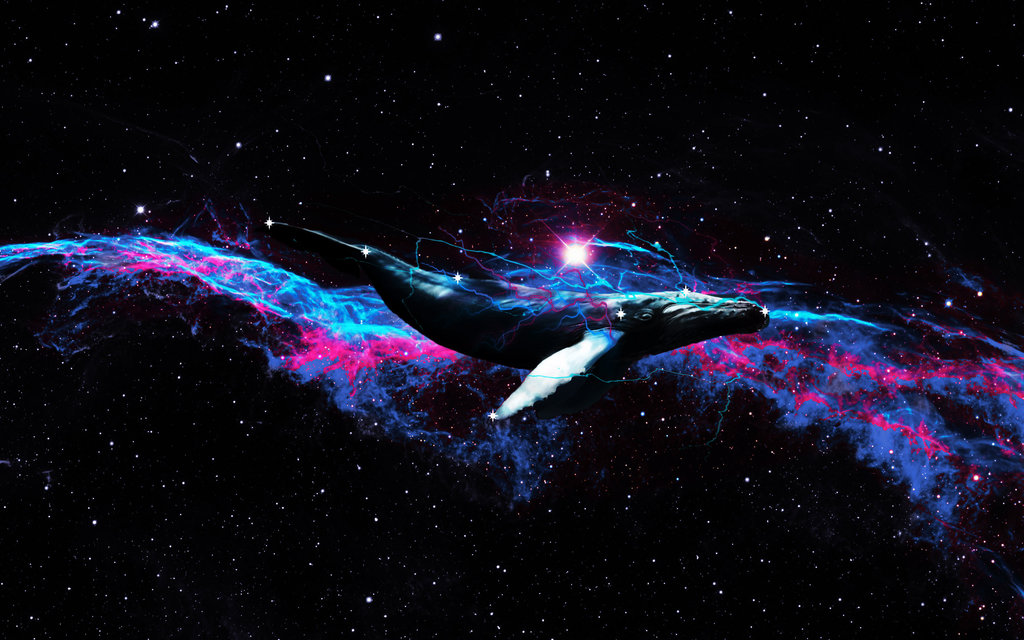
Whales, those magnificent leviathans of the deep, have an uncanny knack for ending up in space. Science fiction is flooded with stories of starwhales–sometimes entirely new creatures that happen to resemble terran cetaceans in either behavior or appearance, sometimes evolved leviathans from our own world, and occasionally hapless, confused, ordinary whales. This is no fluke. Space is big, whales are big, so why shouldn’t there be whales in space?
Science fiction loves its tropes, and particularly loves comparing space to the golden age of maritime exploration, to the point where starships sometimes have sails. And then, of course, there’s The Narrative. You know, the one where a captain is consumed by obsession and revenge to hunt some semi-mythical mcguffin. If you’re going to do Moby-Dick-in-Space, you better have a starwhale. SciFi loves the Moby Schtick.
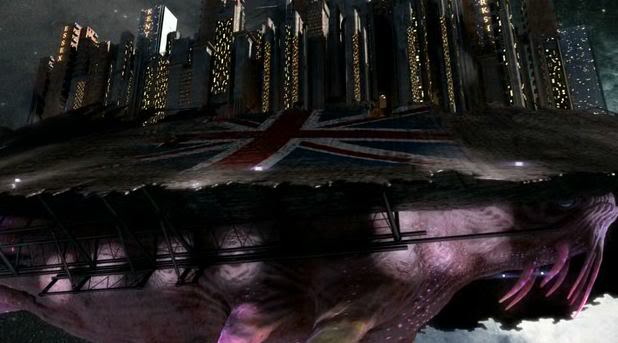
So what is a starwhale, and why is it different from other giant space creatures like the exogorth of Empire Strikes Back? Like terran whales, star whales are intelligent creatures that often exhibit some form of emotion. Unlike other space monsters, they often act with a purpose that goes beyond “eat space people, wreck ship”. Nowhere is this more clearly highlighted than in the Doctor Who episode The Beast Below, in which the Doctor encounters the last living starwhale, now supporting the remnants of the British Empire on its back. In the story, the whale endures tremendous suffering in order to protect ‘the children’, and chooses to stay even after being freed from its captors.
Giant whales providing the backbone for mysterious islands traces its roots back to the ancient Greeks, at least in the Western canon. Aspidochelon was a sea monster said to resemble either a turtle or a whale, with a craggy back the carried sandy beaches and sometimes even trees and jungles. Sailors who wandered ashore would find their ships crushed as they were pulled down into the deep. Later incarnations of the whale-as-island made explicit its connection to Satan, the ultimate deceiver. And, of course, Herman Melville makes explicit the modern civilization rests on the back, or, more accurately, the oil, of the whale.
Interestingly, starwhales are, at worst chaotic neutral, but more often lawful good. Their connection to the devil abandoned back on Earth.
The Star Trek universe is resplendent with starwhales, from numerous Enterprises have encountered numerous starwhales, from benign travelers passing through to confused infants looking to the ship for survival, to aggressive bulls threatened by incursion into their territory. Bull sperm whales were documented by early Earth whalers as solitary, especially aggressive male whales, some of which had tasted the bite of many harpoons and continued to charge. It was a bull sperm whale the sunk the Essex, the inspiration for Moby Dick.