Skip to content

Southern Fried Science

Over 15 years of ocean science and conservation online

  • Home
  • About SFS
  • Authors
  • Support SFS

Tag: thresher shark

Jumping the shark: New study reviews the breaching behavior of sharks and rays

Posted on September 19, 2024September 20, 2024 By David Shiffman
Jumping the shark: New study reviews the breaching behavior of sharks and rays
Featured, Science

One of the most iconic images of shark behavior is a great white shark hitting its prey so hard from below that the whole shark flies out of the water. This behavior, called “breaching,” has been documented in many species, and is useful for a variety of ecological functions, not just hunting. I spoke to … Read More “Jumping the shark: New study reviews the breaching behavior of sharks and rays” »

Here’s how thresher sharks whip their tails back and forth

Posted on February 19, 2024 By David Shiffman 1 Comment on Here’s how thresher sharks whip their tails back and forth
Here’s how thresher sharks whip their tails back and forth
Science

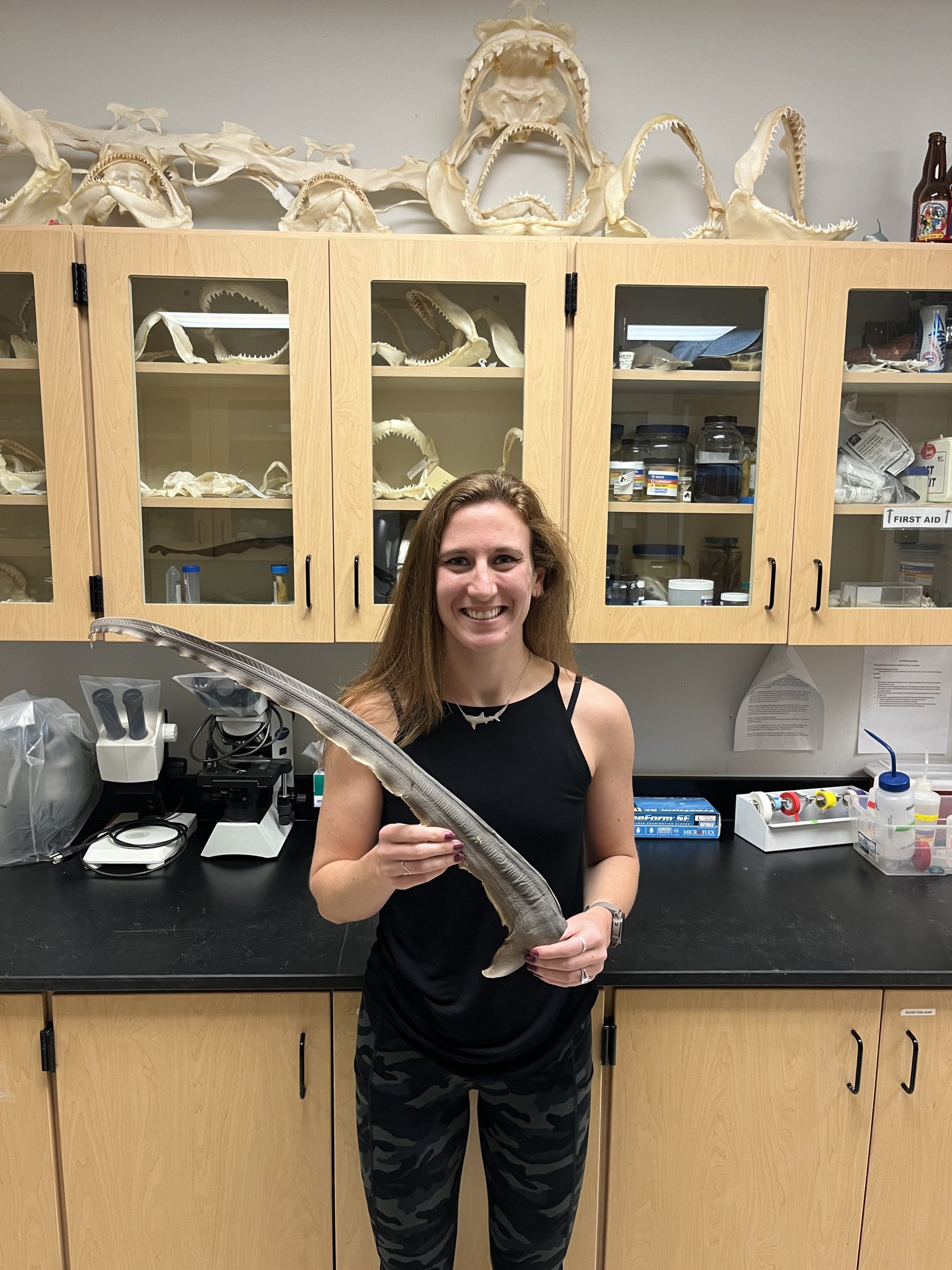
A new study breaks down the biomechanics of one of the marine world’s most unusual hunting behaviors. Thresher sharks have one of the strangest body plans of any fish, with almost half their body comprised of a scythe-like tail. It had long been suspected that that they use this tail is a whip to stun … Read More “Here’s how thresher sharks whip their tails back and forth” »

Thursday Afternoon Dredging: December 15th, 2016

Posted on December 15, 2016December 14, 2016 By David Shiffman
Uncategorized

Cuttings (short and sweet):

  • How thresher sharks use their tails, from this paper by Oliver and friends.
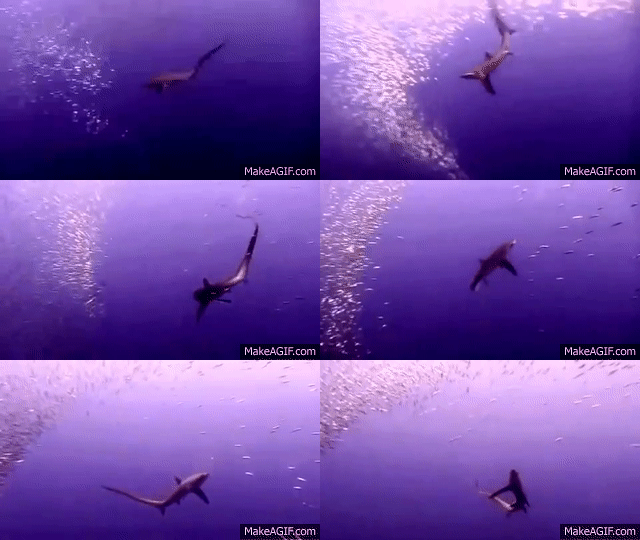
Thresher shark tail whip, from Oliver and friends 2013, "Thresher Sharks Use Tail-Slaps as a Hunting Strategy," PLoS ONE
Thresher shark tail whip, from Oliver and friends 2013, “Thresher Sharks Use Tail-Slaps as a Hunting Strategy,” PLoS ONE
  • Follow Brit Finucci @BritFinucci on twitter! Follow her for awesome photos of her research with deep sea sharks.
  • I love this commerical and I’m pretty sure that you will too.

Read More “Thursday Afternoon Dredging: December 15th, 2016” »

13 amazing things scientists discovered about sharks in 2013

Posted on December 28, 2013December 30, 2013 By David Shiffman 5 Comments on 13 amazing things scientists discovered about sharks in 2013
Conservation, Science

Other than a certain week in August whose name we shall not speak here, 2013 was a great year for both shark science and the communication of that shark science. There were many important and fascinating discoveries, and many of the world’s top media outlets covered them. Presented here is a list of 13 amazing scientific discoveries made in 2013, in no particular ranking order. To make the list, research must have been published in a peer-reviewed scientific journal in 2013, and someone else other than me must have also thought it was awesome (i.e. it received mainstream media or blog coverage). In the interest of objectivity, I did not include any papers that I or my lab were directly involved with. Whenever possible, I’ve linked to an accessible version of the paper.


1) A two-headed bull shark!

From Wagner et al. 2013


Citation: Wagner, CM, Rice, PH, and Pease, AP 2013. First record of dicephalia in a bull shark Carcharhinus leucas foetus from the Gulf of Mexico. Journal of Fish Biology 82: 1419-1422.

Brief description: Researchers presented the first case of a bull shark embryo with 2 heads (the mother was caught by a Florida fishermen). In response to the most common question I received about this study, no, this animal would not have survived to adulthood.  While this is a cool discovery, the broader significance is somewhat minimal. As I told science writer Douglas Main in an interview about a similar study, “There have been a number of reports of deformed shark and ray embryos in recent years— two heads, one eye, etc. There’s no evidence to suggest these defects represent a new phenomenon or that they are harmful to shark populations as a whole.”

Media coverage highlights: A figure from this study was named one of the coolest science photos of the year by the International Science Times. It was also covered by National Geographic, the Guardian, and TIME magazine.

Read More “13 amazing things scientists discovered about sharks in 2013” »

A photo of people eating a shark is upsetting activists for some silly reason

Posted on September 26, 2013September 30, 2013 By David Shiffman 42 Comments on A photo of people eating a shark is upsetting activists for some silly reason
Conservation, Science

davesquare

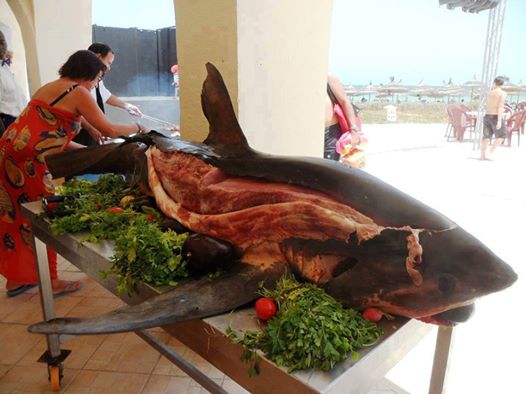
Photo via activist Andy Gray on Facebook, original photographer unknown

A photo of a single thresher shark being served for dinner at a resort is making the rounds among shark conservation activists. The photo, shown on the right, has been shared more than 12,000 times. A petition written in response to the image  (in French) has over 1,000 signatures. The story has even made it into the mainstream media. The original caption refers to this scene as “shameful and disgraceful”, while follow-up comments refer to it as “shocking,” “sickening,” “disgusting,” “beyond words,” “shameful,” and “barbaric.”  12,000 shares and a 1,000 signature petition is significantly more outrage than I’ve ever seen for any issue involving a single individual shark. Why, exactly, are activists so upset about it?

It can’t simply be reaction to the death of a single shark. If you believe that no sharks should be eaten ever (or that no animals should be eaten ever), that’s a perfectly valid belief system. You should be (and likely are) aware, however, that the overwhelming majority of the world, including almost all governments, the majority of the scientific community, and many NGOs, completely disagree with you. People have encountered photos of individual sharks being killed before, or pictures of sharks on a menu or for sale in grocery stores, and not reacted this strongly.

It likely isn’t the species of shark in question, either. This shark is either a pelagic thresher or a common thresher, and while both are considered Vulnerable to extinction by the IUCN Red List, they’re common components of shark fisheries. Thresher fisheries in U.S. waters are considered well managed (and that population is only “Near-Threatened”). Some of the comments say that “sharks are an endangered species,” which is nonsense, as there are over 500 species of sharks and most are not even Threatened. Regardless, a single individual animal doesn’t impact the population in any significant way.

Read More “A photo of people eating a shark is upsetting activists for some silly reason” »

Good intentions and negative transfer effects: The California swordfish fishery

Posted on March 13, 2012October 27, 2013 By Guest Writer 25 Comments on Good intentions and negative transfer effects: The California swordfish fishery
Conservation, Science
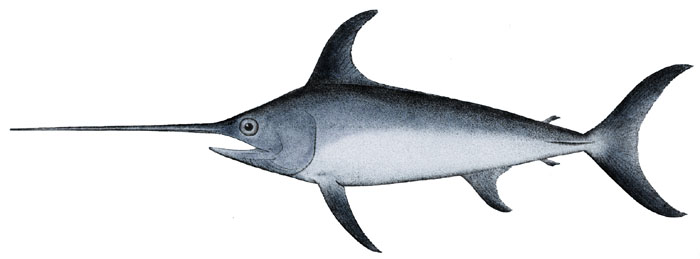
Image courtesy Wikimedia Commons, via the National Marine Fisheries Service historic collection

A press release circulating on Twitter, which claims that a “deadly expansion” of a California fishery will negatively affect critically endangered leatherback sea turtles, has been making waves in the marine conservation and fisheries communities, inspiring a series of interesting discussions. Is it better to buy US-caught seafood with some bycatch than foreign-caught seafood from fleets with less strict environmental regulations? Is the current “Pacific leatherback conservation area”, a large region of the ocean where no fishing is allowed, too much of a restriction on U.S. fisheries? Can there be a balance between fisheries and conservation? I invited Jonathan Gonzalez, a California graphic designer with a strong interest in marine conservation issues, to write a guest post about the swordfish fishery in question. You can follow him on Twitter here, and he’s happy to answer your questions about this issue in the comments section of this post. In addition to his graphic design work, Jonathan has served as the assistant director of the Santa Barbara Marine Mammal center, and has worked with the California Shark Coalition to gather support from fishermen for the state’s recent ban on shark fins. 

by Jonathan Gonzalez

Fisheries are complicated and often misunderstood. We often see conflicting information about what fish we should or should not eat and we see general statements about certain gear types that over simplify an extremely complex issue. But don’t be discouraged, learning about fisheries can be very fun and can lead to eating seafood with confidence, free of any guilt or confusion. One particular fishery I want to talk about that is not only complicated, but in my opinion it is California’s most misunderstood fishery. I’m talking about the drift gillnet (DGN) fishery for swordfish and common thresher sharks (CTS). Swordfish, CTS and mako sharks caught in Hawaiian set longlines are also landed in California, but I am not going to talk about that here.  I am going to focus on the DGN fishery because this fishery has been in the headlines a bit lately because of recent motions that were voted on at a Pacific Fisheries Management Council (PFMC) meeting. Here is a press release you may have seen that in my opinion is full of factual errors and a few downright slanderous statements. I’m not going to point them all out and I’m not going to try to tell you what to do. Instead I am going to give you some background about the fishery and provide you with information that will hopefully help you to make an informed decision for yourself.

Read More “Good intentions and negative transfer effects: The California swordfish fishery” »

Were 18 foot long thresher sharks responsible for closing a New York beach?

Posted on June 3, 2011June 9, 2011 By David Shiffman 10 Comments on Were 18 foot long thresher sharks responsible for closing a New York beach?
Popular Culture, Science

Earlier this week, several New York state beaches were closed due to shark sightings. Fox News’ Rick Leventhal, speaking as part of Bill Hemmer’s “America’s Newsroom” show, reported on this story, claiming that “some onlookers ID’ed them as thresher sharks, they’re estimated to be about  18 feet long”. A half-eaten seal also washed up on shore nearby.


To his credit, Mr. Leventhal  attempted to play down fears about these animals, saying that “Let’s not forget that sharks live in the ocean…as long as there’s food, they’re likely to keep hanging around”. However, I was immediately skeptical of the claim that a group of 18 foot long thresher sharks were swimming slowly just a few yards offshore. A cursory review of the known biology and ecology of thresher sharks will explain my skepticism.

Read More “Were 18 foot long thresher sharks responsible for closing a New York beach?” »

Shark conservation news: Fisheries closures, fish and chips, and a new shark sanctuary

Posted on March 12, 2010 By David Shiffman
Conservation, Science

It has been an exciting week for shark conservation! We can only hope that this provides some momentum for CITES, which begins tomorrow. And now, for this week’s shark conservation news: The Indian Ocean Tuna Commission declared a ban on commercial landings of all thresher sharks (each of the three thresher shark species is considered … Read More “Shark conservation news: Fisheries closures, fish and chips, and a new shark sanctuary” »

Popular Posts

Shark scientists want their research to help save threatened species, but don’t know how. Our new paper can help.Shark scientists want their research to help save threatened species, but don’t know how. Our new paper can help.December 1, 2025David Shiffman
Norway and Cook Islands put their deep-sea mining plans on pause.Norway and Cook Islands put their deep-sea mining plans on pause.December 3, 2025Andrew Thaler
What Ocean Ramsey does is not shark science or conservation: some brief thoughts on "the Shark Whisperer" documentaryWhat Ocean Ramsey does is not shark science or conservation: some brief thoughts on "the Shark Whisperer" documentaryJuly 2, 2025David Shiffman
The Trouble with Teacup PigsThe Trouble with Teacup PigsOctober 14, 2012Andrew Thaler
What we know we don't know: impacts of deep-sea mining on whales, dolphins, sharks, turtles, and other migratory species.What we know we don't know: impacts of deep-sea mining on whales, dolphins, sharks, turtles, and other migratory species.November 20, 2025Andrew Thaler
2025: My year in writing, public speaking, and media interviews2025: My year in writing, public speaking, and media interviewsDecember 3, 2025David Shiffman
Urea and Shark OsmoregulationUrea and Shark OsmoregulationNovember 15, 2010David Shiffman
Shark of Darkness: Wrath of Submarine is a fake documentaryShark of Darkness: Wrath of Submarine is a fake documentaryAugust 10, 2014Michelle Jewell
How tiny satellites are tracking marine wildlifeDecember 1, 2025Andrew Thaler
Build a dirt cheap, tough-as-nails field computer in a Pelican caseBuild a dirt cheap, tough-as-nails field computer in a Pelican caseJuly 21, 2015Andrew Thaler
Subscribe to our RSS Feed for updates whenever new articles are published.

We recommend Feedly for RSS management. It's like Google Reader, except it still exists.

Southern Fried Science

  • Home
  • About SFS
  • Authors
  • Support SFS


If you enjoy Southern Fried Science, consider contributing to our Patreon campaign.

Copyright © 2025 Southern Fried Science.

Theme: Oceanly Premium by ScriptsTown