Skip to content

Southern Fried Science

Over 15 years of ocean science and conservation online

  • Home
  • About SFS
  • Authors
  • Support SFS

Tag: twitter

For science communication, hashtag games are a scientist’s secret weapon.

Posted on December 15, 2015 By Andrew Thaler
Uncategorized

#ExplainAFilmPlotBadly, #StupidCommonNames, #LOTRyourResearch.

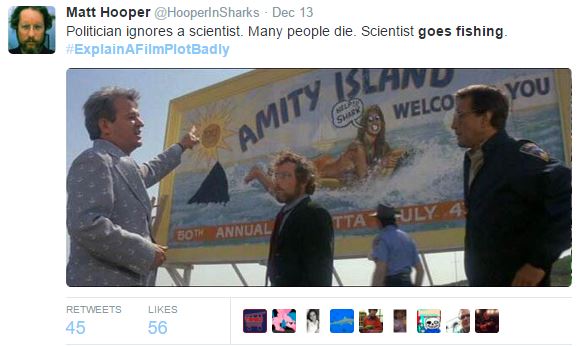
Hashtag games. A few times a week, these weird, funny, quirky wordplay challenges explode across twitter, driving the most serious, and sometimes even super-serious, tweeters to pause for a moment of levity and let you know what they think Jaws is really about.
jaws

Goofy, whimsical, and extremely silly, one might wonder why scientists and science communicators would want to jump into these games, potentially compromising the reputation they’ve built up as a Serious Scientist (TM), unswayed by such foolishness.

The answer is simple: Playing hashtag games makes you a better communicator of science.

Read More “For science communication, hashtag games are a scientist’s secret weapon.” »

Combating fake science in popular media – six months later

Posted on September 28, 2015October 6, 2015 By Andrew Thaler
Uncategorized

As noted earlier, David and my paper on twitter, social media, Shark Week, and fake documentaries came out last week. Since scientific publishing has a “long tail” — the time between when we actually wrote the paper and when it was published, in this case, was almost 9 months — we thought it might be … Read More “Combating fake science in popular media – six months later” »

If you could only follow five people on Twitter, who would they be?

Posted on May 27, 2015 By Andrew Thaler
Blogging

Every few years, I published a Field Guide to Ocean Science and Conservation on Twitter. Rather than a comprehensive list of the best ocean twitter accounts (a list that would stretch out over more than 500 accounts as of last count), these guides are designed to point readers towards central nodes in the online conversation, from which they could then build upon by following and engaging in conversation. Instead of being a “best of”, the field guides are all about connectivity and how to build it.

I was just beginning to prepare this year’s guide a few weeks ago, when David Lang at OpenROV caught me with an even more challenging question: If you could only follow 5 people on twitter, who would they be? Again, not the “best”, or the funniest, or whatever metric you use to decide who to follow but the five that, if I were absolutely forced to cut my following list down to, would capture the widest breadth depth of the twitter conversations I care about: the most effective community builders, the central-est nodes, the people whose insight is most valuable and who curate and disseminate the most important content. After talking for a while about who the list would include, I was surprised to discover that the majority were people who I followed, but only ever interacted with rarely, if at all.

Read More “If you could only follow five people on Twitter, who would they be?” »

A field guide to ocean science and conservation on Twitter, volume 2

Posted on March 14, 2014 By Andrew Thaler
Conservation, Science

Almost 2 years ago, we published our first field guide to ocean science and conservation on twitter. While the advice is still sound (and you should definitely read it), the recommended people to follow is now painfully dated. Here’s two updated lists of core people to follow on twitter to get yourself plugged in to the ocean science and conservation community.

New to the online ocean community? This list will help you get connected to the conversation by following key members of the community. Rather than a comprehensive collection of all ocean science and conservation broadcasters, this short list will help you follow along without becoming overwhelmed.

Read More “A field guide to ocean science and conservation on Twitter, volume 2” »

Social media as a scientific research tool: Background info for my #scio14 session

Posted on February 6, 2014February 6, 2014 By David Shiffman 1 Comment on Social media as a scientific research tool: Background info for my #scio14 session
Blogging, Science

ScionlineAt the 2014 ScienceOnlineTogether conference, I will be moderating a session focusing on how to use social media as a scientific research tool (2:30 P.M. on Friday, February 28th in room 3).  The hashtag is #ScioResearch , so be sure to follow along, and I’ll make a Storify afterwards. This post is primarily intended to be a source of background information for participants in my session, though feel free to read, share and ask questions in the comments if you are not planning on participating in my session.

ScienceOnline community members understand the value of social media for collaborating with colleagues and communicating science to the public, but few think of the incredible resource that these tools are for scientific research. Hundreds of millions of people all over the world are constantly sharing their experiences and opinions in a format that is public, archived, searchable, and accessible, giving researchers access to this enormous dataset without the expense or logisitical difficulties involved in organizing a large-scale survey or series of focus groups. To use a technical term, for many types of scientific research, social media and “big data” is what is called “a freakin’ gold mine.”

Onion

Below are a few examples of how social media can be used for scientific research.

Read More “Social media as a scientific research tool: Background info for my #scio14 session” »

A Guide to Tweeting at Scientific Meetings for Social Media Veterans

Posted on December 13, 2013December 13, 2013 By Andrew Thaler
Blogging, Science

A year ago, David Shiffman published How to live-tweet a conference: A guide for conference organizers and twitter users, an informative and exhaustive guide to using twitter to help promote scientific conferences. Since then, I’m certain you’ve internalized his lessons and become a veteran of the science twitterverse. Now that you’re among the top twitter users in your field, it’s time to address how that changes the way you use twitter to interact with your peers.

How do you know if you’re a twitter veteran? There’s no real, concrete rule but, being that this is a guide for scientists, let’s say that a veteran twitter has significantly more followers than the average twitter user attending the conference. If you sampled the number of followers that each conference attendee on twitter had, you would fall outside of the 95% confidence interval. For a huge tech conference, this might mean you have hundreds of thousands, even millions of followers. For a small, regional conference in a relatively narrow field, this could be a couple of hundred followers.

Read More “A Guide to Tweeting at Scientific Meetings for Social Media Veterans” »

Housekeeping note regarding weird torrent files

Posted on September 23, 2013October 27, 2013 By Andrew Thaler
Blogging

Several users have e-mailed me about a weird .torrent file that automatically started downloading when thy loaded the mainpage. According to Business Insider, this is the result of a bug/exploit in twitter’s share buttons. For the moment, we have disabled all twitter sharing buttons on the site. Please contact me here if you continue to … Read More “Housekeeping note regarding weird torrent files” »

Was CITES COP16 a game-changer for online outreach at wildlife management meetings?

Posted on March 18, 2013 By David Shiffman 5 Comments on Was CITES COP16 a game-changer for online outreach at wildlife management meetings?
Conservation, Science

davesquareCITES logo

As 16th Conference of the Parties of the Convention of International Trade in Endangered Species (CITES COP16, pronounced sight-eze) comes to a close, I’d like to reflect on something that made this meeting unlike almost any other wildlife conservation and management meeting in history. Yes, history was made as delegates voted to list commercially exploited shark species for the first time, and history was made when manta rays became the first shark or ray species  to be listed under CITES the first time they were proposed, and that’s all fantastic news. However, what I believe made CITES COP16 a game-changer for wildlife conservation and management was the large-scale inclusion of online outreach by both attendees and organizers. For the first time ever, interested members of the public from all over the world could follow along (and to some degree, participate) in real time.

Read More “Was CITES COP16 a game-changer for online outreach at wildlife management meetings?” »

Return from the Cayman Abyss: cruise post-mortem and some thoughts on media coverage

Posted on March 1, 2013 By Andrew Thaler 3 Comments on Return from the Cayman Abyss: cruise post-mortem and some thoughts on media coverage
Science

AndrewThumbAt 7 AM EST on Monday, February 25, the ROV Isis rose from the depths of the Cayman Abyss, bringing to a close the 82nd cruise of the RRS James Cook. During JC82, we explored two recently discovered hydrothermal vents fields in the Cayman Trough: Von Damm, named for the late marine geochemist Karen Von Damm, and Beebe, named for the 20th century explorer William Beebe. By any measure, JC82 was a massive success. The samples and videos we’ll bring back will provide ecologists, geologists, and chemists with new insights into fundamental ocean systems for years. The images alone, some beautiful, some heart-breaking, have already inspired.

bacteriamatssmall
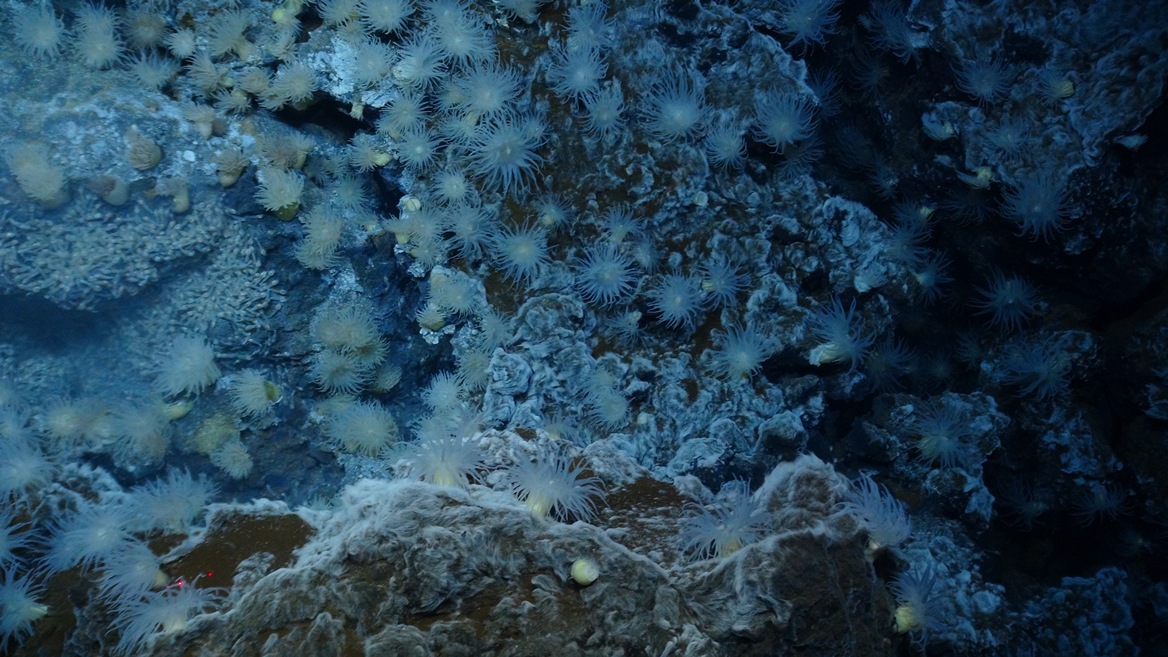
Eyeless shrimp, dancing anemones, and a garden of filamentous bacteria. I’m a pretty good writer, and I can’t even begin to describe how beautiful this is. Photo Credit: NERC

Since I last updated the blog on our adventures exploring the Cayman Trough, we’ve had a steady stream media coverage, most of which has been excellent, some of which has been… strange. It’s been fascinating watching the articles come out, seeing what different media outlets consider the story, and, most important to me, getting a chance to share our adventure with a wide audience. Now that the #DeepestVents cruise is officially over (and we’re in transit to yet another, equally exciting bolt on cruise to investigate submerged lava flows off the island of Montserrat), I thought it would be a good opportunity to reflect on the cruise, the story, and how the media shaped it.

Read More “Return from the Cayman Abyss: cruise post-mortem and some thoughts on media coverage” »

A field guide to ocean science and conservation on twitter

Posted on June 30, 2012June 30, 2012 By Andrew Thaler 2 Comments on A field guide to ocean science and conservation on twitter
Popular Culture

A few of my colleagues recently came to me looking for advice on how to get started on twitter. Even for seasoned marine scientists who grew up during the internet revolution, establishing a twitter presence can be a daunting task. When used well, it provides a steady stream of news, commentary, and discussion that can provide broad insight into the current state of marine science and conservation. When used poorly, twitter can become a continuous, unrelenting torrent of irrelevant nonsense, punditry, and manufactured controversy. I put this guide together to provide a foundation for those interested in using twitter to engage with the Ocean Community.

There are several great basic guides on how to get started on twitter, so, rather than reinventing the wheel, here are a few of my favorite resources:

  • What is Twitter and Why Scientists Need To Use It
  • Twitter: What’s All the Chirping About? 
  • How to live-tweet a conference: A guide for conference organizers and twitter users
  • Your 5-minute, 5-day orientation to twitter

All of these guides have some good advice, but really, the best thing you can to get a feel for twitter is to create a personal account and play around for a week or two. Always start with a personal account. You’re going to make mistakes, faux pas, or perhaps accidentally tweet something that you’d wish you hadn’t. You don’t learn to ride a bike on a Pinarello Dogma 60.1 and you shouldn’t learn to use a new social media tool on an account that will be permenently linked to your online reputation.

Read More “A field guide to ocean science and conservation on twitter” »

Posts pagination

Previous 1 2 3 Next

Popular Posts

Shark scientists want their research to help save threatened species, but don’t know how. Our new paper can help.Shark scientists want their research to help save threatened species, but don’t know how. Our new paper can help.December 1, 2025David Shiffman
Norway and Cook Islands put their deep-sea mining plans on pause.Norway and Cook Islands put their deep-sea mining plans on pause.December 3, 2025Andrew Thaler
What Ocean Ramsey does is not shark science or conservation: some brief thoughts on "the Shark Whisperer" documentaryWhat Ocean Ramsey does is not shark science or conservation: some brief thoughts on "the Shark Whisperer" documentaryJuly 2, 2025David Shiffman
The Trouble with Teacup PigsThe Trouble with Teacup PigsOctober 14, 2012Andrew Thaler
What we know we don't know: impacts of deep-sea mining on whales, dolphins, sharks, turtles, and other migratory species.What we know we don't know: impacts of deep-sea mining on whales, dolphins, sharks, turtles, and other migratory species.November 20, 2025Andrew Thaler
2025: My year in writing, public speaking, and media interviews2025: My year in writing, public speaking, and media interviewsDecember 3, 2025David Shiffman
Urea and Shark OsmoregulationUrea and Shark OsmoregulationNovember 15, 2010David Shiffman
Shark of Darkness: Wrath of Submarine is a fake documentaryShark of Darkness: Wrath of Submarine is a fake documentaryAugust 10, 2014Michelle Jewell
How tiny satellites are tracking marine wildlifeDecember 1, 2025Andrew Thaler
Build a dirt cheap, tough-as-nails field computer in a Pelican caseBuild a dirt cheap, tough-as-nails field computer in a Pelican caseJuly 21, 2015Andrew Thaler
Subscribe to our RSS Feed for updates whenever new articles are published.

We recommend Feedly for RSS management. It's like Google Reader, except it still exists.

Southern Fried Science

  • Home
  • About SFS
  • Authors
  • Support SFS


If you enjoy Southern Fried Science, consider contributing to our Patreon campaign.

Copyright © 2025 Southern Fried Science.

Theme: Oceanly Premium by ScriptsTown