Andrew is a post-doctoral researcher in North Carolina focused on population and conservation genetics in hydrothermal vent communities.


David is a graduate student in Florida. He studies the ecology and conservation of sharks.


Amy is a graduate student in North Carolina studying local ecological knowledge within small scale fisheries.


Chuck is a graduate student in North Carolina focusing on apex predators and how they interact with fisheries.


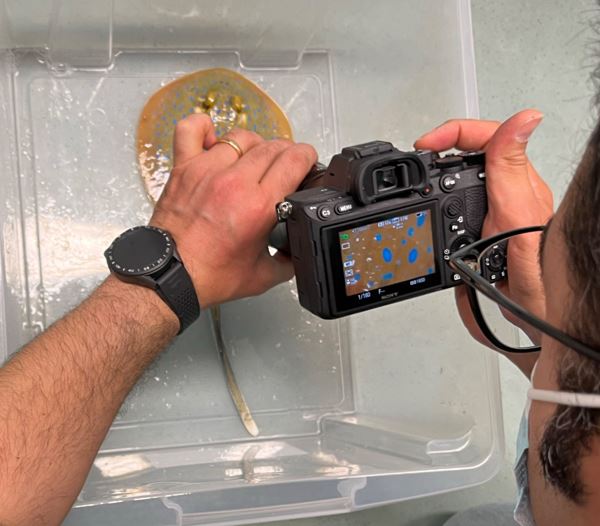
Lyndell is a graduate student in North Carolina, studying the feeding ecology of cownose rays.


Iris is a graduate student in Washington studying habitat use and feeding habits of juvenile Pacific salmon and herring in Puget Sound.


Michael is a graduate student in Maryland investigating the visual systems of mantis shrimp.


Archives

Ethical Debate: Animal rights, human health, and government understanding of science

Image from HumaneSociety.org

I am, in general, a supporter of animal rights. Animal abuse sickens me, and I really believe Ghandi’s famous quote that “you can judge a society by how it treats its weakest members”. That said, while it’s disturbing to see a rabbit which has gone blind from exposure to a potential new shampoo, I’d rather have a rabbit go blind than a human child. More importantly, while it is troubling to infect a chimpanzee with a disease in order to study how to cure that disease, such research unquestionably saves human lives.  That’s why I was surprised to learn about the Great Ape Protection Act.

This proposed law will ban all invasive medical tests on great apes. While some animal rights groups are cheering, medical researchers are concerned. There are many human diseases that are presently being studied in laboratory animals, including AIDS and malaria, and banning this research would set the search for a cure back immeasurably. More troubling is the effect that an ape research ban would have on Hepatitis C studies.

According to the CDC, 3.2 million Americans suffer from Hepatitis C. Though some diseases can be tested in other ways, chimpanzees are the primary model system for Hep C, (other model systems, such as mice, are very early in development) which means that banning great ape research is basically equivalent to saying that scientists aren’t allowed to cure Hep C for a long time.

A comparison between co-sponsors of the Great Ape Protection Act and the Viral Hepatitis and Liver Cancer Control and Prevention Act of 2009 (which calls for increased Hep C vaccine research) shows that 16 congressman are simultaneously saying “You have to find a cure for Hepatitis C very quickly” and “You aren’t allowed to use the only functional model system to develop a cure for Hepatitis C”. All are Democrats. These represent only co-sponsors. It is likely that more people would be revealed as hypocrites if every member of congress actually voted on this bill- and many more can be revealed now by examining co-sponsors of other hepatitis C legislation.

Arguments made for the law imply that great ape research is the Wild West, and that mad scientists torture chimpanzees for their sociopathic pleasure. This is simply not the case. As an open letter to Congress signed by numerous scientific organizations states, “scientists take research using non-human primates extremely seriously, and multiple protections exist in law and through accreditation to ensure these animals are well-treated and used with respect.”

Here are some other facts about this proposed law.

-It not only bans the use of apes to find cures to deadly human diseases, but also the use of apes to find cures to deadly ape diseases. You can bet that many more gorillas will die from this strain of malaria than would die from research to cure it. The same is true of the chimpanzee strain of ebola.

-The phrasing of the law includes gibbons as great apes. This is news to primate biologists who have long considered them a separate group.

Though there are many excellent scientific organizations that oppose this law, I want to refer you specifically to the statement put out by the American Academy for the Advancement of Science, one of the most prestigious scientific societies in the world.

I know that we have many animal rights activists among our readers, and I invite you (as always) to join in the discussion. However, I fervently believe that If the Great Ape Protection Act becomes law, it will be terrible news for humans as well as apes. Animal rights are extremely important, but human lives are more important.

Also, while this discussion is primarily about the ethics of saving human lives through research, I’d be remiss if I didn’t mention Dr. Free Ride’s recent post about how the lives of human researchers are threatened more directly by animal rights activists, PZ Myers recent list of overzealous animal rights activists,  and Orac’s description of a frightening new tactic used by some of them. Whatever our views are on the ethics of animal research, surely we can all agree that threatening researchers and their children is a completely unacceptable way of accomplishing goals… right?

Do you think that it is acceptable to protect animal rights at the expense of human lives?

Do you think that saving human lives justifies experimenting on animals?

Are rules that protect animals in laboratory studies good enough the way they are? Are they too powerful already?

~WhySharksMatter

111 comments to Ethical Debate: Animal rights, human health, and government understanding of science

  • J. Smalls

    As much as I completely understand both sides, I personally agree with the laws of preventing numerous testing on various chimps and gorillas. Though it is understood that they are the closest to human being characteristics and internal functioning, there still is an overwhelming degree of testing. As much as there is a need for testing various diseases, there are still lives at risk regardless of it being animals. I agree with there being a strict regulation. Though the lives of the chimps are at risk, I’d rather it be a risk due to natural causes rather than experimental testing. There should be a better sense of consideration rather than the lack there of.

    Like or Dislike: Thumb up 0 Thumb down 0

  • Emily

    It amazes me how these animal rights activists and politicians can make all of there decisions based solely on their own supposed “moral fiber”. It is truly not a large percent of animals that are subjected to these studies and at least when they are, they are kept in excellent and standard conditions, that are checked on. They do not realize how far back they would be setting our society at large if they allow this ban. We haven’t just made great strides in diseases but so much more including neurological studies, cognitive and behavioral studies and genetics just to name a few. Sperry’s split-brain experiments jump-started our understanding of how the brain works and therefore provided all sorts of insight into neurological disorders and behavioral as well as mental problems due to contusions. Deep Brain stimulation is used as a treatment for Parkinson’s disease and approximately 20,000 patients have received this treatment. It has nothing to do with whether a human or animal life is more important to me, what has more significance is the amazing leaps in science that are taken from this research and the many lives that are bettered because of it.

    Like or Dislike: Thumb up 0 Thumb down 2

  • ThatGuy

    “All the arguments to prove man’s superiority cannot shatter this hard fact: in suffering the animals are our equals.”

    This quote has always struck an interesting chord with me. Whose suffering is more important though? Even though I’m sympathetic to animal suffering, I’m a bit of a speciesist and tend to put human interests above others. This would put me on the animal welfare side rather than the animal rights side of the argument.

    As a moral and rational animal, we have an expressed interest in keeping a balance in our ecosystem, and finding ways to progress science without having to harm animals in the process. We just don’t have the technology yet to fully abandon animal testing.

    Like or Dislike: Thumb up 1 Thumb down 1

  • grassfed

    “You can bet that many more gorillas will die from this strain of malaria than would die from research to cure it.” This is a logical reason to oppose the Great Ape Protection Act, for their sake and for ours. I definitely feel as though a human life is more valuable than an animal. Many animals are dependent on human protection and without it would be extinct. I think that animal abuse and cruelty among lab testing is stereotyped. This may be the case for animals trained for movies but science is not Hollywood. If you have ever seen the movie “Outbreak”, this is why we use animals and keep them in captivity to try and prevent diseases. I think the words captivity carry a pejorative meaning which is unfortunate because these animals are not physically abused, they are injected with a certain disease and cared for like a sick patient. It may be immoral to inject a disease but that is not abuse. If this law passes, would you want a possibly curable disease to take the life of someone you know when it could have been avoided?

    Like or Dislike: Thumb up 1 Thumb down 2

  • Rob Butz

    Hey all, I read most of this thread (and skimmed the rest… it’s long). Sorry I’m jumping on with my question.

    I’m in an animal ethics course right now, and one thing I can’t find is any kind of history of the evolution of animal ethics boards.

    It makes it really hard to have this sort of debate or discussion because people will say “but that sort of treatment of animals is from 25 years ago!” — implying that there’s some kind of new and improved ethics boards. But, what has changed? I’ve tried searching through Google Scholar and, zip, nothing.

    Someone really ought to do a history about it. If there have been huge advances and tighter oversight in ethics approval procedures, you’d think it would help the case of animal researchers, and this history should be out there.

    For the record, I’m undecided about medical research, but I am definitely against blinding rabbits for some new shampoo. To me that kind of trivializes the whole notion of animal rights: if an animal can die for a new cosmetic product, we can put it to death for any reason at all.

    Like or Dislike: Thumb up 2 Thumb down 1

  • rindha

    just one question for those who support animal testing….would u n ur family and/or relatives like to be experimented upon for the benefit of whole human race ?

    Like or Dislike: Thumb up 2 Thumb down 1

  • rindha

    I am amazed to see people writing something supportive towards animal testing…..

    One question for u all. These animal testing is done on behalf of human disease. and
    we dont test on animals coz its illeagl..so wat if its legal? wud u go ahead?
    why dont u go ahead and test ur own kind the results of which will be more accurate!
    The same is felt by animals. sacrifice some human life in order to benefit all mankind…?hmm..?

    Talking about superior …. say if your boss is superior in your office and expect [or force] you to do something which is beyond ur capacity? Will you accept it just coz he is superior??

    if past govtof the world were superior then why were there any rebels n revolutions? Britishers were considered superior and established slave trading… why is it illegal now…just coz some stood up to speak for underprivileged… just coz animals dont have powers dont mean that u can control their life for benefit of any race even if its for their own good..
    there are tests done on humans after they agree to it.. use those guys… im ready to take place of the chimp for testing if i feel that its ok to test for entire human race.. thou im dont feel ok..im still ready to take place of that innocent chimp..

    Humans are superior cos they have freakin brains, it doesn’t mean they r the CEASERS of whole earth and have powers on every living being.

    Now comes about ABUSE …. Abuse means doing some action against one’s will , which hurts them mentally and physically? Now tell me do you think animals are so happily sacrificing their bodies for so called “advancement studies in SCIENCE”. Its brutal cos we r not even thinking that they too have a neurological structure and have to undergo the worst pain which they r not supposed to get into….

    Now stop supporting OWN RACE. Jus think if u r in first place to undergo testing , how horrible the situation will be???

    Please show compassion…. We dont need to save our lives by a medicine which takes lots of innocent lives for us to live!…. if the only option u have is to kill ur life partner in order to survive..? will u?

    Like or Dislike: Thumb up 2 Thumb down 1

    • I can’t speak for everyone, but I don’t want to die when I could instead take life-saving medicine that was derived from animal testing. I don’t want my loved ones to die when they could instead take life-saving medicine that was derived from animal testing. You can do whatever you want, but please don’t ask other people to die in the name of your particular beliefs.

      Like or Dislike: Thumb up 0 Thumb down 2

  • rindha

    exactly…wen u cant see ur loved ones die..u dont have any right to take other living beings life…they too are loved by others.. and im not asking anyone to die.. im just questioning the whole “it ok to kill others for human benefit” notion here..if the whole of human race benefits..r u ready to be tested upon?

    Like or Dislike: Thumb up 0 Thumb down 0

  • rindha

    (and small correction first para of mine in the second post)…if human testing is made legal at large..wud u go ahead?*

    Like or Dislike: Thumb up 0 Thumb down 0

  • rindha

    living by sacrificing others…wat kinda life is that??

    Like or Dislike: Thumb up 0 Thumb down 0

  • New commenters are encouraged to read the comment policy.

    Like or Dislike: Thumb up 0 Thumb down 1

  • AW

    I agree that animal testing should not be used for cosmetic products. If we can use it for cosmetics that’s not setting a very high standard for when it’s necessary to put animals through pain. However, animal testing for medicines that can save human lives as well as animals is completely a different story. Personally, if someone I loved was dying of a disease that could have been cured had scientists been allowed to experiment on animals I would be furious. I understand people’s concerns when it comes to this issue because I am sympathetic towards animal testing, but when it comes down to it i would just much rather have an animal die then a human. It is not “uncompassionate” to believe that humans are superior to animals it is just being realistic.

    Like or Dislike: Thumb up 0 Thumb down 0

  • Mike

    The topic has re-surfaced. Yesterday Rep. Roscoe Bartlett wrote an op-ed in the NYT entitled “Stop Using Chimps as Guinea Pigs:” link to nytimes.com

    This thread has been, by far, one of the better discussions on this issue I’ve seen online. Here’s how I look at it.

    I think the pragmatic argument against animal testing is baseless. Simply, there are not currently cheaper, more effective testing techniques. Computer modeling always gets tossed around as an alternative. But computer models are built on real world data, which requires testing in real systems, like animals. Also, no scientist is going to take the results of a computer model as the final word on a problem. Any result spit out by the computer has to be tested in the real world.

    If these cheaper, better methods existed, wouldn’t scientists, who are often worrying about research budgets, have explored them and used them? The fact that researchers still rely on animal testing suggests that the alternatives aren’t ready for broad use.

    So once dismissing the pragmatic argument against animal testing, there’s the stickier ethical argument. Essentially, this issue boils down to a two-part question: Does ameliorating human suffering ever justify causing animal suffering? And if so, is there a line at which the animal suffering outweighs the human suffering?

    Some animal rights advocates on here seem to imply the answer to the first part is never. But I seriously doubt anyone actually follows the moral edict: Do no harm to animals, even if it means preventing human harm. What about finding rats in your apartment building? Is it immoral for the landlord to exterminate those rats? (Let’s consider for a moment that any “humane” method of trapping the rats has failed repeatedly and the manager has to just kill them.) The animals will surely suffer, but if you allow them to run wild, they could spread disease.

    I’ll assume most people won’t balk at exterminating rats. (I know there are some who would, but they are so extreme that it’s not worth debating with them.) So if rats are OK to kill to prevent the spread of disease, why is it wrong to use mice in studies designed to cure disease?

    Then comes the final part: What about animals that seem to have higher cognitive functions, like apes? Some people call them human-like in their cognitive abilities. I’d say that’s a stretch. To steal from Noam Chomsky, would you say that a high-jumper who leaps 30 ft into the air is bird-like? Yes apes seem to be closer to us in brain power than rats, but there is still an large gap.

    But people would argue that they experience suffering fundamentally differently than mice do, a human-like level of suffering. So they get special consideration. I don’t deny that ape testing should have additional regulations compared to testing on mice. But to ban it outright doesn’t make sense.

    If the whole point that apes are different from mice is that they experience suffering at a greater, more human-like way, then we’re still left with considering the human suffering that could be eased by the research. Those people experience actual human suffering, which is greater than human-like suffering. Given that tests on a lab-full of apes could help thousands, maybe millions of people, doesn’t the human suffering side of the equation outweigh the ape suffering end?

    I’d say yes.

    Like or Dislike: Thumb up 0 Thumb down 0