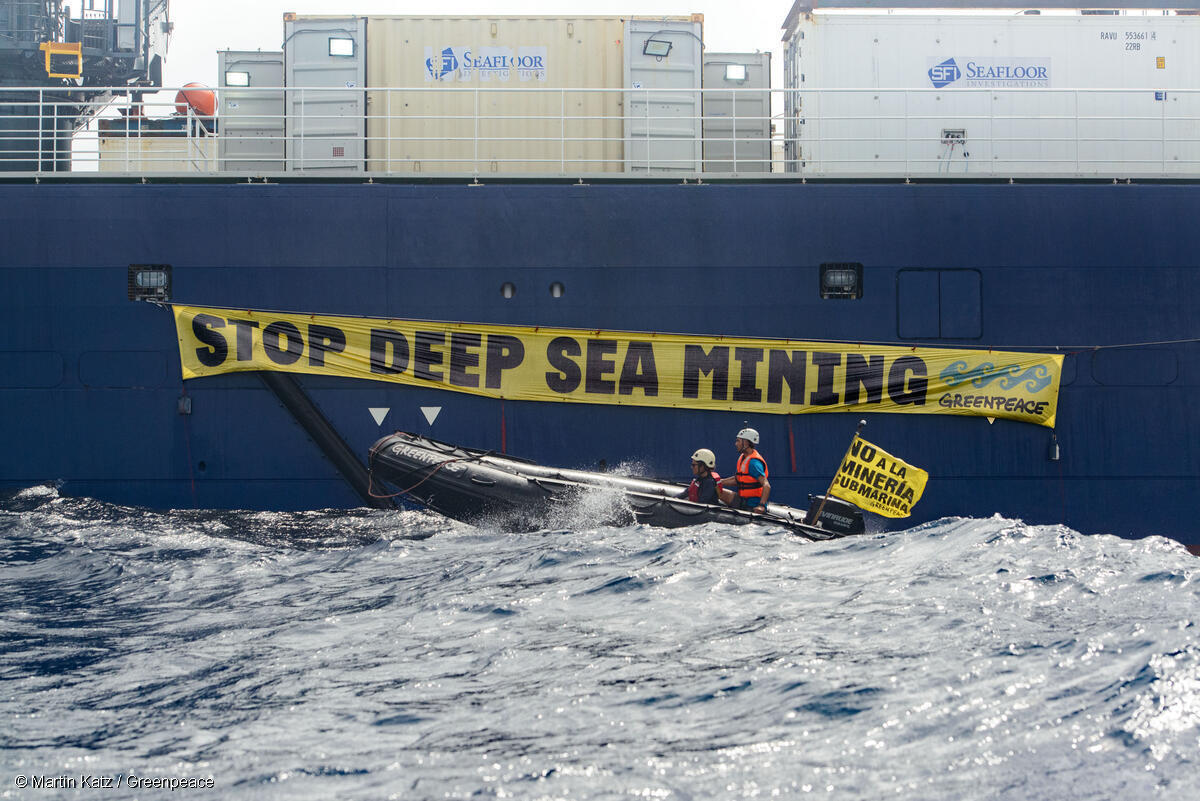
In November and December of 2023, Greenpeace activists boarded a deep-sea mining vessel conducting exploratory research in the Clarion Clipperton Fracture Zone. The executive summary is that the ISA issued interim measure pursuant to Regulation 33 of the Regulations on Prospecting and Exploration for Polymetallic Nodules in an attempt to compel Greenpeace to halt its protest action. Greenpeace said no. NORI took them to court in the Netherlands, where the Greenpeace vessel is flagged. The Netherlands affirmed Greenpeace’s right to protest at sea, but ordered Greenpeace personnel off of the mining vessel.
The details of the incident have been recounted from several perspectives:
- ISA Report from Secretary General Michael Lodge on incidents in the NORI-D contract area
- Reply from Greenpeace International
- Comments from the Republic of Nauru
- Note verbale from the Kingdom of the Netherlands
The interesting question that arises from this encounter is what authority, exactly, does the ISA have over Observers operating in the Area? Regulation 33 applies to mining contractors, entities that have entered into a contractual partnership with the ISA to explore and, eventually, exploit, seabed resources in areas beyond national jurisdiction. No such agreement exists between the ISA and Observers. Greenpeace pointed out, and the Dutch court upheld, that Regulation 33 cannot apply to Greenpeace.
Functionally, the extent of the ISA’s authority over Observers is limited to one building in Kingston, Jamaica, where the International Seabed Authority could rescind Observer status from an NGO or other entity. Note, though, that is a power held by the Assembly, the total body of member states who have ratified the UN Convention on the Law of the Sea, not the Secretariat, an administrative body within the ISA whose actions are often conflated in the popular media as being the actions of the ISA as a whole.
Personal opinions about Greenpeace’s actions aside, the Secretariat does not seem to have any ground to stand on, and may have just stepped into a geopolitical quagmire. To put it into more stark terms, the United States of America is an Observer. We never ratified the treaty. The Russian Federation is an ISA mining contractor. They have multiple exploration contracts with the ISA. The United States’ ongoing support of Ukraine, and the sanctioning of an oligarch who has been extensively involved in the development of the industry, is almost certainly impacting Russia’s ability to conduct mining exploration in its ISA leases. Can the ISA order the United States to refrain from interfering with its mining contractor?
The Holy See is also an ISA Observer, Last March, Pope Francis spoke out against deep-sea mining. Unless something truly miraculous happens this Sunday, I think it’s fair to say that the Secretary General of the ISA does not have Authority over the Pope.
Almost six years ago I wrote about the rise of private submersible assets and how the privatization of the high seas creates a massive policy gap in how we regulate activities in the Area. The ISA regulations simply don’t apply to private citizens and non-member states.
I actually wrote a book chapter, way back in 2021 and currently in extended limbo, that argued this exact point. Apologies to my editor, but it’s worth bringing at least the core conclusion to the forefront:
“If the last century of ocean exploration and exploitation has been limited to those with the financial resources to create and maintain prohibitively expensive capital equipment, creating a barrier to entry that only nations and major corporations could overcome, this century will be defined by an armada of explorers, adventurers, citizen scientists, informal researchers, environmentalists, and other ocean stakeholders armed with low-cost tools that do not need access to major funding nor need permission from any governing body to access the deep sea.
“In areas beyond national jurisdiction, the advent of low-cost tools to access the deep ocean presents additional logistical problems. The regulations currently produced by the International Seabed Authority for exploration and exploitation of the Area, as well as those under revision now, don’t account for or apply to private entities unencumbered by the UN Conventional on the Law of the Sea. Beyond a few limited rules about protesting on the high seas, predominantly related to direct action campaigns implemented by environmental NGOs, there is no regulatory system currently in place to prevent a small conservation organization, or even a private individual from deciding to take an active role in monitoring deep-sea mining in the Clarion-Clipperton Zone, chartering a vessel, sailing to the middle of the Pacific, and deploying landers or other observation systems within a contractor’s lease blocks.
“By the time the deep-sea mining industry is ready to begin large scale exploitation activities, there will likely be no technological hurdle in place, either.”
Andrew Thaler, Emerging technologies for exploration and independent monitoring of seafloor extraction in Areas Beyond National Jurisdiction (unpublished)
Oddly enough, I asked the Secretary General back in 2019 if there were any existing regulations that would give the ISA authority over private vessels engaging in protest or independent monitoring of mining sites in the Area (in the context of private submersibles). His response: “Unfortunately, I am sorry, but it is not possible for me to answer this kind of speculative question.”
In 2024, the question is no longer speculative.
Southern Fried Science is free and ad-free. Southern Fried Science and the OpenCTD project are supported by funding from our Patreon Subscribers. If you value these resources, please consider contributing a few dollars to help keep the servers running and the coffee flowing. We have stickers.
Feature photo: © Martin Katz / Greenpeace