Skip to content

Southern Fried Science

Over 15 years of ocean science and conservation online

  • Home
  • About SFS
  • Authors
  • Support SFS

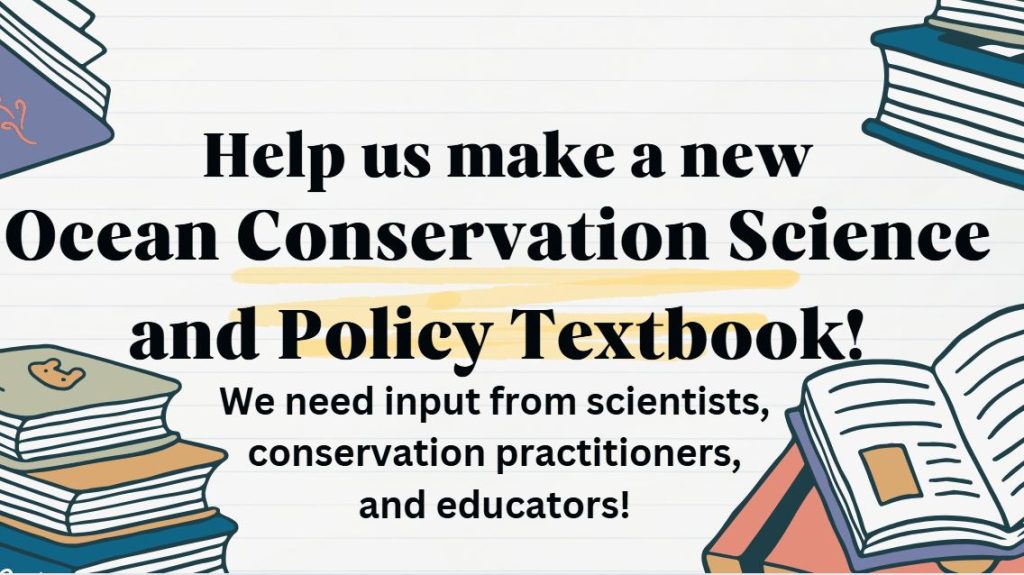
We’re making a new marine conservation science and policy textbook. What do you want to be in it?

Posted on February 5, 2025 By David Shiffman
Academic life, Conservation, Science

The leading textbook in Marine Conservation Biology (Norse and Crowder) is 20 years old. It’s great and it shaped the field for a generation, but a lot has happened since it came out. There are new conservation threats, new policy tools, and new research methods to study them. And in that time, we’ve radically changed how we approach a lot of these questions.

It’s time for something new, so we’re making a new textbook, and we need your help.
Who are we? 

Longtime readers know that I am a Ph.D. conservation scientist and author, and that I teach ocean conservation policy at Georgetown. I’m collaborating with longtime colleague Dr. Catherine Macdonald, a Ph.D. interdisciplinary marine scientist who teaches marine conservation biology at the University of Miami. Together we are the lead authors of the new book. 

We also have assembled a team of subject matter experts including deep-sea ecologist Dr. Diva Amon, and marine mammal biologist Dr. Asha de Vos. We will likely be seeking additional subject matter experts- stay tuned! 

The book will be published by Johns Hopkins University Press.

What is our goal for the book? 

Our goal is that this book will be rigorous enough to be used as a textbook for an undergraduate or graduate level course, but accessible enough for the interested public or for a frontline practitioner without an advanced degree. 

The book will focus on conservation threats as well as their solutions (including policy/regulation/law solutions and voluntary behavior change solutions.) It will focus on success stories as case studies. And it will focus on the science showing how we know. It will be interdisciplinary, addressing the role of humans in creating and solving conservation problems, including the need to approach these problems with an understanding of the need for environmental justice.

It will contain practical, evidence-based advice for all levels of decision-making, from individuals to community organizations to national governments. 

It will contain diverse perspectives, interviews, and case studies from experts and key stakeholders all over the world. 

And it will contain an extensive focus on careers and professional development, including key skills and how to learn them, for aspiring ocean conservation professionals. 

What do we need from you?

If you teach ocean conservation science and/or policy, we’d love to hear about resources or exercises that you use for your class that you would recommend to other teachers. And we’d love to hear about any features of our book that would make it more useful for your class and your students, or more likely that you’d use it for your course. 

If you are an ocean conservation professional, we’d love to get suggestions from you on topics or perspectives to include, on case studies to feature, on things you wish early-career professionals learned in school, and more. 

And if you’re interested in potentially contributing as a subject matter expert, let us know on what topic and in what way.

How can you get in touch with us? 

You can provide feedback using this Google Form, you can email me directly at WhySharksMatter at Gmail, or you can join a session of an upcoming Zoom LIstening Tour where we’ll talk about this together.

Dates/times where we are hosting Zoom sessions include (all times are US east coast time, all sessions are one hour):

Tuesday, February 25th at 9:00 a.m.
Thursday, February 27th at 4:00 p.m.
Monday, March 17 at 9:00 a.m.
Friday, March 21 at 4:00 p.m.

Sign up here. And if you’d like to share information but can’t make one of these Zoom talks, please share it via this form, or email me.

Share this:

  • Share on Bluesky (Opens in new window) Bluesky
  • Share on Facebook (Opens in new window) Facebook
  • Share on Reddit (Opens in new window) Reddit
  • Share on Threads (Opens in new window) Threads
  • Share on WhatsApp (Opens in new window) WhatsApp
  • Share on Mastodon (Opens in new window) Mastodon

Related

Tags: academic writing conservation poliy marine conservation ocean conservation ocean conservation science textbook

Post navigation

❮ Previous Post: A tongue-eating isopod takes a 5-million+ year journey through fossilized feces
Next Post: NOAA carries a two century legacy of America’s first government science agency ❯

You may also like

Conservation
A scientifically accurate list of the most endangered sharks in the world
November 2, 2017
Conservation
Desert island discs – the marine conservation edition
August 4, 2017
Conservation
Huge win for orca advocates as #SeaWorld announces an end to circus-style shows, orca breeding and pledges more conservation
March 17, 2016
Conservation
So what might Scottish independence mean for marine conservation ?
September 17, 2014

Popular Posts

What Ocean Ramsey does is not shark science or conservation: some brief thoughts on "the Shark Whisperer" documentaryWhat Ocean Ramsey does is not shark science or conservation: some brief thoughts on "the Shark Whisperer" documentaryJuly 2, 2025David Shiffman
Alberta, Canada is the proud owner of the largest man-made pyramid on the planetAlberta, Canada is the proud owner of the largest man-made pyramid on the planetOctober 16, 2012Andrew Thaler
That's not a blobfish: Deep Sea Social Media is Flooded by AI SlopThat's not a blobfish: Deep Sea Social Media is Flooded by AI SlopDecember 19, 2025Andrew Thaler
Shark of Darkness: Wrath of Submarine is a fake documentaryShark of Darkness: Wrath of Submarine is a fake documentaryAugust 10, 2014Michelle Jewell
The story of the pride flag made from NASA imagery: Bluesky's most-liked imageThe story of the pride flag made from NASA imagery: Bluesky's most-liked imageSeptember 27, 2024David Shiffman
Here are some ocean conservation technologies that I'm excited aboutHere are some ocean conservation technologies that I'm excited aboutFebruary 19, 2026David Shiffman
Oarfish: The true tale of the fish we can’t seem to get enough ofOarfish: The true tale of the fish we can’t seem to get enough ofAugust 19, 2015Guest Writer
Here's what I teach my students about finding jobs in marine biology and conservationHere's what I teach my students about finding jobs in marine biology and conservationApril 10, 2024David Shiffman
A quick and dirty guide to making custom feeds on BlueskyA quick and dirty guide to making custom feeds on BlueskyFebruary 7, 2024Andrew Thaler
Florida Senate fails basic biology, accidentally outlaws sex.Florida Senate fails basic biology, accidentally outlaws sex.May 11, 2011Andrew Thaler
Subscribe to our RSS Feed for updates whenever new articles are published.

We recommend Feedly for RSS management. It's like Google Reader, except it still exists.

Southern Fried Science

  • Home
  • About SFS
  • Authors
  • Support SFS


If you enjoy Southern Fried Science, consider contributing to our Patreon campaign.

Copyright © 2026 Southern Fried Science.

Theme: Oceanly Premium by ScriptsTown