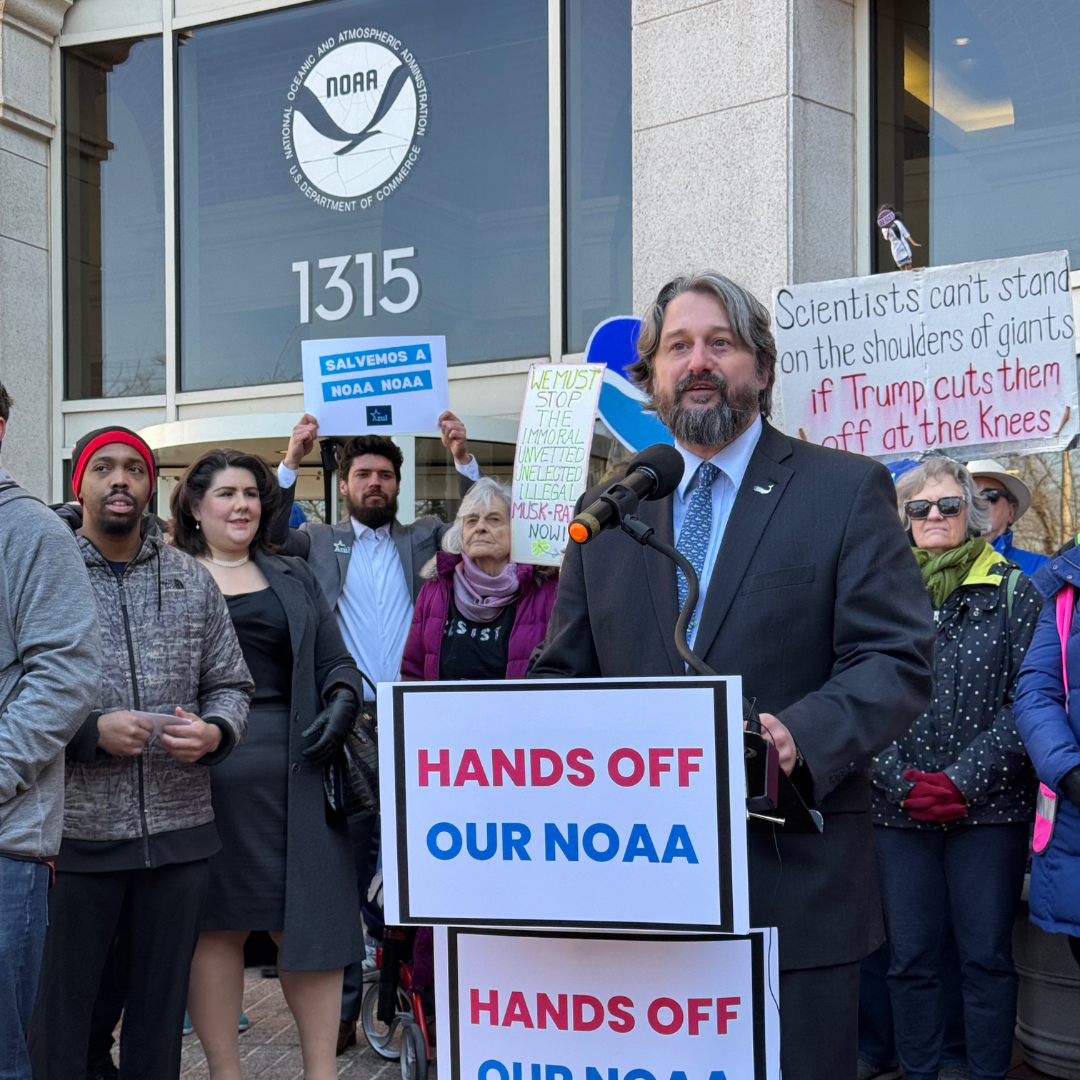
On March 3, 2025, hundreds of people gathered in front of NOAA headquarters to protest the illegal, wasteful, and capricious firing of career civil servants at the National Oceanic and Atmospheric Administration. I was invited to speak on the value of NOAA scientific research. Below is a transcript of my remarks.
NOAA is the original public science agency. Thomas Jefferson created the direct precursor to NOAA in 1807. They mapped the country and the world. They tracked whales. They tracked currents. They tracked coastlines. The creation of the agency that would become NOAA marked a turning point in the history of this country, from a place for Europeans to extract resources to a nation of American-led scientific discovery.
In 1884, the agency which would become the National Marine Fisheries Service, conducted the first comprehensive assessment of overfishing in US waters and invented fisheries management. For 140 years, the fisheries of the United States, for better or worse, have been the most successful and best managed fisheries in the world.
During World War II, the agency produced over 100 million charts for the Allied forces. The hydrologists and meteorologists of the agency planned the day and the hour that American troops would land on Normandy Beach, turning the tide of the war.
The survey and bathymetric work conducted by NOAA has been instrumental for navigation, national security, and commerce, but it is also critical for basic scientific research. Bathymetry—the mapping of the seafloor—is the heart of ocean discovery. Bathymetry is the difference between the pragmatic question “how shallow is this harbor?” and the profound question “how deep is the ocean?” NOAA, more than any other organization in the history of the world, has answered those questions.
In 1955, the agency towed an experimental magnetometer across the Pacific and discovered magnetic striping on the seafloor. This discovery would ultimately confirm the theory of plate tectonics. It was NOAA who taught us that continents move.
There are few greater examples of the power of basic research than the discovery and exploration of deep-sea hydrothermal vents. For 30 years, NOAA ran the Vents Program, an effort to map, study, and understand hydrothermal vents. It was pure, basic science, motivated by a need to know more about these strange and wonderous ecosystems.
From bright-red tubeworms growing around cracks in the ocean’s crust, we learn about endosymbiosis and chemosynthesis, rewriting our understanding of how life evolved. From the microbes that thrived in a boiling chemical stew on the bottom of the ocean, we mastered how to replicate DNA in the laboratory. Modern medicine, including the genetic approach to disease management, rapid synthesis of new vaccines and therapeutics, and viewing the human body as not just a person, but a person living in symphony with a billion beneficial microbes, owes its advancements to the desire to explore the deep places beyond the shore.
What do we lose if we lose NOAA? On Friday, we learned that the Ocean Acidification team, whose work is essential to dozens of shellfish fisheries and any business that depends on coral reefs, has been gutted. Without this critical data, oyster farmers will suffer. Coral reefs will die.
Without NOAA, we lose the capacity to detect Vibrio vulnificus. Vibrio is the leading cause of fatal food poisonings in this country. The Vibrio labs that monitor the spread of this lethal pathogen in Maryland, in Delaware, in Virginia, and in North Carolina depend on NOAA’s support. Without NOAA, eating raw oysters is playing Russian roulette.
Without NOAA, we lose the ability to monitor Harmful Algal Blooms, whose toxins destroy fisheries, beaches, and our lungs. We lose the tidal data that is essential to navigation, stormwater management, and flood mitigation.
Without NOAA, we have no well-managed fisheries. There is no future for Blue Crabs without NOAA. There no future for Oysters without NOAA. There is no future for Stripers without NOAA. Get used to eating Snakeheads and Blue Catfish, because there is no invasive species management plan without NOAA. There is no Seafood without NOAA.
Without NOAA, a million novel lines of inquiry end. Our children don’t get to sail along with the Okeanos Explorer and watch octopuses guard their eggs in nurseries at the bottom of the sea. Our teachers don’t get to join expeditions through NOAA’s Teacher-At-Sea program, bringing hands-on scientific discovery back to their classrooms. Our grandfathers lose one final chance to honor their shipmates as NOAA maps the maritime battlefields of the Pacific and discovers ships long lost to the fog of war.
We are a maritime nation. NOAA is our legacy and NOAA is our future.
Watch the entire rally below, or check out my portion at 42:00.00.
Southern Fried Science is free and ad-free. Southern Fried Science and the OpenCTD project are supported by funding from our Patreon Subscribers. If you value these resources, please consider contributing a few dollars to help keep the servers running and the coffee flowing. We have stickers.