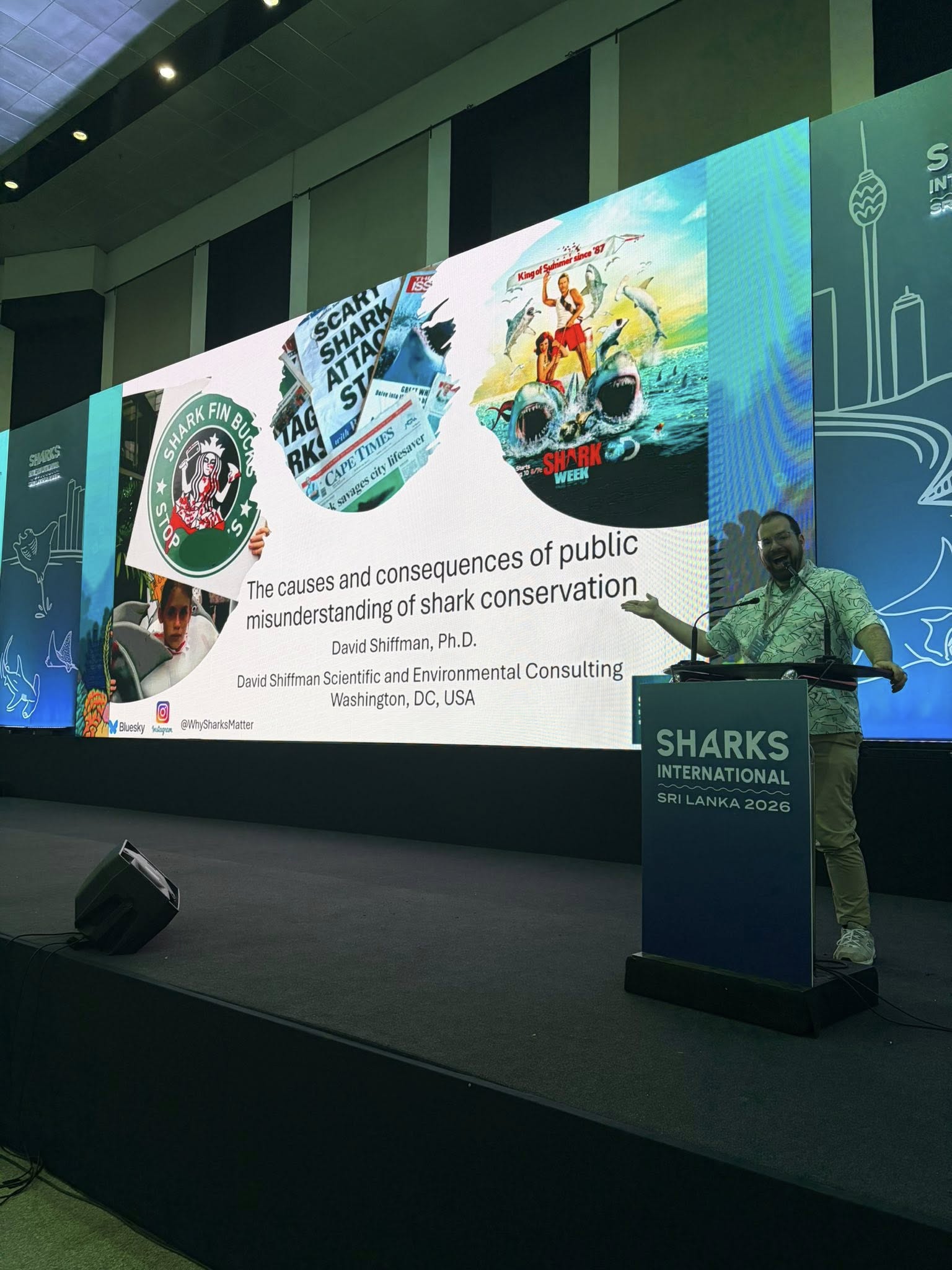
At the 2026 Sharks International conference in Colombo, Sri Lanka, I was invited to present my research on the causes and consequences of public misunderstanding of shark conservation issues. The meeting brought together more than 850 shark scientists and conservation professionals from 84 countries, a new record for the conference. Here’s what I told them.
All the amazing science presented at this conference will not by itself save sharks. Saving sharks requires policy change, and policy change requires public support.
And to get the kind of public support we need, it’s vital not only that the public wants to save sharks in general, but that they understand at least some technical details about the threats to sharks and what solutions exist. After all, “save the sharks” means many different things, as there are many threats to sharks, and many policy solutions to each.
My research tracks what the public knows about shark conservation threats and their solutions, where they learned it, whether or not it is correct, and what we can do about it. Here are some key results from the last few years of my work.
One of the most important information channels by which the public learns about environmental threats and their solutions is through the popular press. Our team analyzed over 2,000 newspaper articles about shark conservation from the past decade, and found that media coverage focuses on the flashiest issues, not the most important issues. The biggest threats to sharks, the most effective policy solutions to resolve those threats, and the most useful ways for concerned members of the public to help get much less attention than dramatic-sounding nonsense. As one example, consumer boycotts of companies with an extremely tenuous connection to shark conservation issues like Starbucks and Shake Shack, got more media coverage than *all sustainable fisheries management tools combined,* despite the fact that sustainable fisheries management tools are the preferred shark conservation policy solution of 90% of surveyed scientists and 78% of surveyed environmental advocates.
Shark Week is another major contributor to public misunderstanding of shark conservation. These annual “documentaries,” seen by millions of people around the world, promote pseudoscience and fringe figures, and barely mention conservation. Despite claims of “raising awareness,” our analysis found that in over 200 episodes of Shark Week, there were only *six* mentions of any actionable step that Shark Week’s huge audience could take to save sharks, and four of those were “don’t eat shark fin soup”—something that their primarily-Western audience is already not doing. What a waste.
Finally, while many wonderful environmental advocates work closely with scientific experts and are themselves experts in conservation policy, social media has empowered an eco-extremist pseudoscientific fringe. Their large megaphone drowns out evidence-based data-driven advocacy in favor of dramatic-sounding nonsense. As one recent example, a widely-followed on social media conservationist urged his huge audience not to buy fossil shark tooth necklaces because they lead to killing sharks.
These factors, along with others I don’t have time to mention today, lead to widespread public misunderstanding of shark conservation threats and their solutions. There are many well-intentioned but uninformed citizens who want to help, but don’t know how to do so usefully, and are driven towards flashy nonsense, a dynamic exploited by pseudoscientific extremists.
Lots of people want to help sharks, and that’s great. But widespread misunderstanding of the actual threats to sharks, and what policy solutions actually help save sharks, hinders the implementation of effective solutions.
What can we do about it? We need more people who know real things about shark conservation threats and their solutions, such as the people at this conference, to engage with the public, with the media, and with decision-makers. And I can help teach you how to do that! I offer professional development training focusing on teaching scientific experts how to share their expertise with the public through writing op-eds and public-facing blog posts, speaking to journalists, and social media. I can deliver these workshops virtually to your team anywhere in the world.
Thanks for listening.