Is deep-sea mining inevitable? Can deep-sea mining be sustainable? Will the deep-sea mining community ever agree on a payment regime under the common heritage principle? Can the United States issue deep-sea mining licenses in the high seas without ISA approval? Will deep-sea mining awaken eldritch horrors vast and unknowable, from their millennia of slumber? These are the question that plague an industry that has been on the cusp of commercialization for nearly a century.
Of all the debates in deep-sea mining, none is more inconsequential that the enduring question of the desultory hyphen. Is it “deep-sea mining” or “deep sea mining”?
The deep sea in “deep-sea mining” is a compound adjective, two words that describe a single concept. Which means “deep-sea” should always be hyphenated when, and only when, it comes directly before “mining”. It’s “deep-sea mining” when you “mine the deep sea.”
Confused? That’s because English is a dozen different languages in a trench coat pretending that it’s internally consistent. Much like countries who have failed to ratify UNCLOS yet abide by customary maritime law, the rules are largely ceremonial.
So what do the people say?
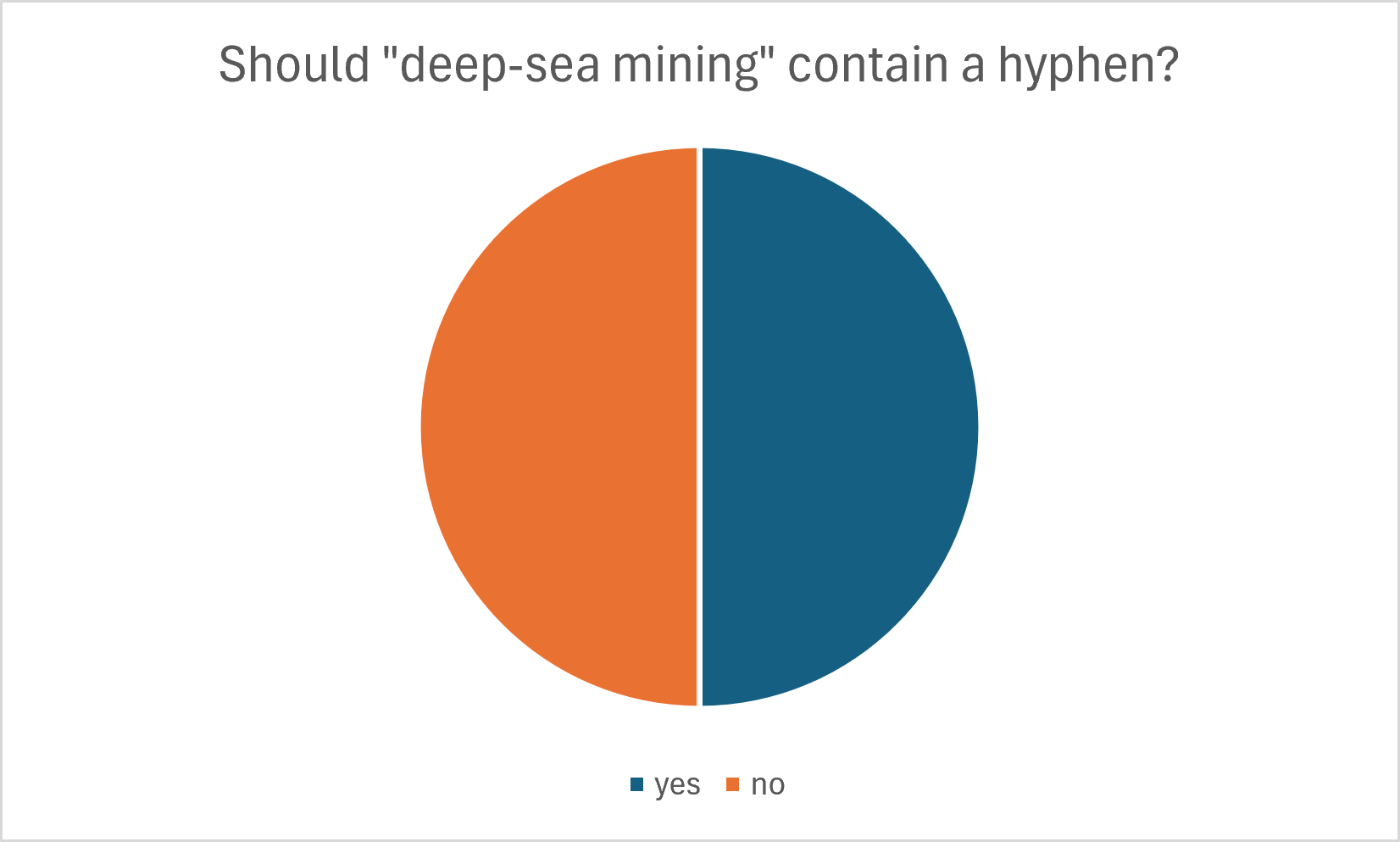
Back when I ran the Deep Sea Mining Observer, which did not use the desultory hyphen, for legacy reasons, I polled the mailing list of nearly 700 people directly involved in the industry. About 250 people responded, revealing perhaps the single most divided and least significant disagreement in all of deep-sea mining.
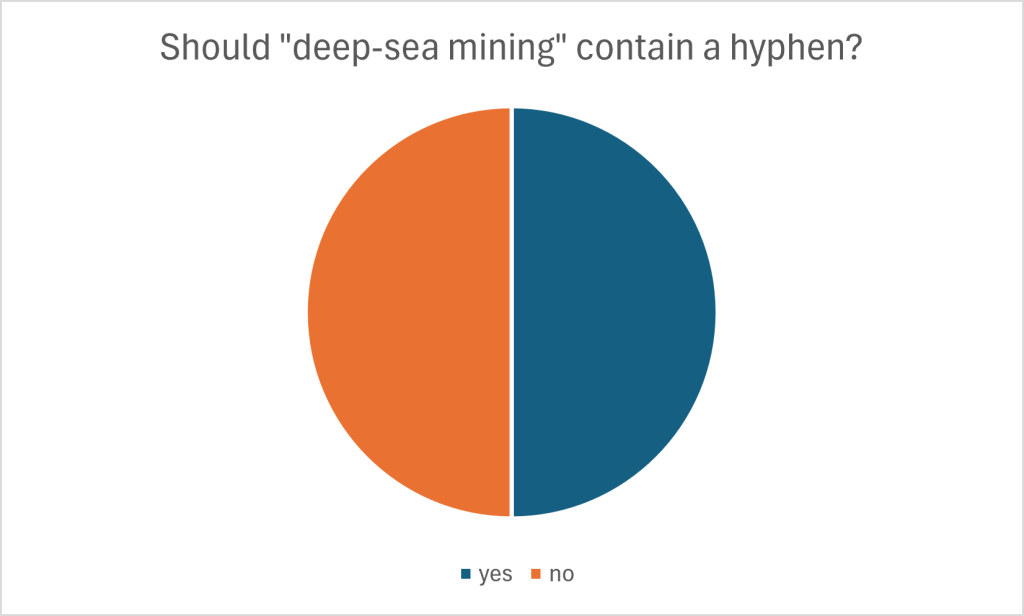
Thanks, folks. That clears up everything.
Of course, you could always skip the debate entirely and call it “deep seabed mining”. But where’s the fun in that?