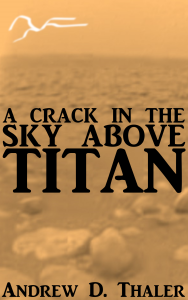
 This Monday I launched A Crack in the Sky above Titan, a science fiction adventure framed around the seemingly simple question: What is it like to sail across the methane seas of Titan?
While Southern Fried Science is all about ocean science and conservation, we do make the occasional foray into space. From celestial navigation on Mars, do diving robots on Europa, to exploring other (fictional) worlds to learn something about our own, we haven’t shied away from the ‘other’ final frontier. So, in honor of A Crack in the Sky above Titan (available now on Amazon*) here is a selection of our favorite space nerdery from Southern Fried Science.
(Note: Some of these are from our month of ocean science fiction. While the framing for these pieces is fictional, the science itself is sound)
The Extraterrestrial Ocean: Could OpenROV Trident explore the seas of Europa?
Our planet is an ocean, and it is almost entirely unexplored. OpenROV, and their new Trident underwater drone is one of many tools that will help change that by democratizing exploration, conservation, and ocean science. We are poised atop the crest of a wave that may change how humans interact with the ocean as profoundly as the invention of the aqualung.
Earth is not the only body in our solar system that hosts an ocean. As we (slowly) venture out into the stars, could OpenROV Trident dive in extraterrestrial seas?
Gliding on starlight: Celestial Navigation for Martian Explorers
The greatest challenge for Martian navigators will be finding the celestial poles. In the southern hemisphere, Kappa velorum hangs just 3 degrees of from the celestial south pole. This is good enough for emergency navigation. A careful navigator would make sure to sight at the same time every night and attempt to compensate for the 3 degree list. They won’t be using their measurement to launch rockets, but for a few days of sandgliding, it should be serviceable.
What Star Wars can teach us about the ecology of a Type I civilization
It is a trope long held that there are some *problems* with the ecosystems of the Star Wars universe. The worlds of Star Wars are monobiomes. We have the desert planets of Jakku and Tatooine; the ice planet of Hoth; the forest moon of Endor; the jungles of Yavin IV; the lava world of whatever that mess was in Revenge of the Sith. This is, of course, not limited to Star Wars, science fiction is resplendent with monobiomes. But natural worlds are not uniform. Diversity builds over distance. Isolation shapes and reshapes population. Ecosystems do not generally strive to approach a global equilibrium state.
Even though all known viable planets have ecosystem diversity, this trope continues to dominate popular science fiction. We love monobiomes.
A Natural History of the Starwhale
Whales, those magnificent leviathans of the deep, have an uncanny knack for ending up in space. Science fiction is flooded with stories of starwhales–sometimes entirely new creatures that happen to resemble terran cetaceans in either behavior or appearance, sometimes evolved leviathans from our own world, and occasionally hapless, confused, ordinary whales. This is no fluke. Space is big, whales are big, so why shouldn’t there be whales in space?
You can read the first chapter of A Crack in the Sky above Titan. As a special bonus, my other science fiction novella, Prepared, is free until the end of today (Friday, March 25).
*I know some people have issues with Amazon, but, at the moment, they provide the best financial model for small-time independent authors. I provide my books DRM-free and you can download the free Kindle reader app to any tablet, smartphone, or computer.