Skip to content

Southern Fried Science

Over 15 years of ocean science and conservation online

  • Home
  • About SFS
  • Authors
  • Support SFS

Author: David Shiffman

A mega-Storify of Shark Week 2015 tweets

Posted on July 12, 2015 By David Shiffman
Science

sharkI’ve collected 1,000 Shark Week 2015 tweets from myself and other marine biologists and conservationists. They include fact-checks, commentary, reviews of each special, and suggestions for improvement. I’ll post my own more detailed reviews of each special tomorrow.

Read More “A mega-Storify of Shark Week 2015 tweets” »

8 ways to tell if Shark Week has really improved this year

Posted on July 3, 2015 By David Shiffman 1 Comment on 8 ways to tell if Shark Week has really improved this year
Uncategorized

sharkThe 27th Shark Week starts this Sunday, July 5th. It’s no secret that I’ve been very critical of Shark Week content in the recent past. However, Discovery has made a public commitment to do better this year, and everything I’ve seen suggests that they really mean it. But what exactly does “better” mean? Here are eight specific things to look out for while you watch Shark Week this year.

1) Are there any totally fake documentaries? Like, 100% fake, as in the events that take place in those documentaries did not occur at all, and everyone in the show is an actor, and all the images and videos are computer generated? It’s worth noting that the new Discovery President has specifically promised not to do this anymore.  

Prediction: There will be no totally fake documentaries in 2015.  Woo hoo! Keep an eye out for “Super Predator,”though.  Some folks (incorrectly) claimed that the actual events it describes were proof that megalodon was still alive.

Read More “8 ways to tell if Shark Week has really improved this year” »

Does Shark Week portrayal of sharks matter?

Posted on June 29, 2015July 3, 2015 By David Shiffman 6 Comments on Does Shark Week portrayal of sharks matter?
Blogging, Popular Culture, Science

sharkI’ve been critical of factual inaccuracy and fearmongering on Shark Week documentaries for years. But how big of a problem is this, and how do we know? I asked some of the authors of three recent scientific studies*  to summarize the evidence.

Many species of sharks are in desperate need of conservation. Twenty-four percent of all known species of sharks, skates and rays are considered Threatened with extinction by the IUCN Red List. Using a variety of different methods, scientists have documented rapid and severe population declines in many species of sharks all over the world.

Conservation requires public support. In a participatory democracy, new policies and regulations require some public support to pass. It’s easy to get public support to conserve cute and cuddly animals, but ugly animals need protection too. So do animals that scare people, like sharks.

Read More “Does Shark Week portrayal of sharks matter?” »

For World Oceans Day, ask David anything!

Posted on June 8, 2015 By David Shiffman
Blogging

Happy World Oceans Day, everyone! To celebrate, I’m participating in the Consortium for Ocean Leadership “My Ocean Question” twitter panel, and doing a Reddit “Ask Me Anything.” From 1-5 p.m. eastern, ask questions about the ocean on twitter using hashtag #MyOceanQ , and tag @OceanLeadership ! I’m on deck to answer questions about sharks from … Read More “For World Oceans Day, ask David anything!” »

Watch James Cameron’s Deepsea Challenge and tweet along with us Tuesday at 8 p.m.!

Posted on April 13, 2015 By David Shiffman 1 Comment on Watch James Cameron’s Deepsea Challenge and tweet along with us Tuesday at 8 p.m.!
Blogging

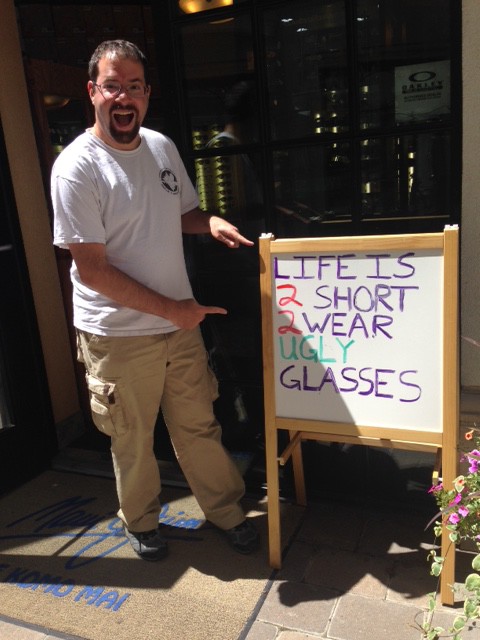
There are still a couple of days left to donate to the most important marine science and outreach crowdfunding campaign of our time, “buy David Shiffman a less ugly pair of sunglasses.” In the meantime, new rewards have been unlocked! For a $30 donation, you’ll receive a small 3D printed megalodon tooth, one of the first of … Read More “Watch James Cameron’s Deepsea Challenge and tweet along with us Tuesday at 8 p.m.!” »

A request to environmentalists and journalists discussing shark fin ban legislation

Posted on March 23, 2015 By David Shiffman
Blogging, Science

Many of the U.S. state-level shark fin bans which make it illegal to buy, sell, or possess shark fins include exemptions for smooth and spiny dogfish, i.e. by far the most common species of sharks caught by U.S. fishermen. Some of these fisheries have significant conservation concerns associated with them. Much of this fishing is not currently subject to catch limits or other basic management

You would never know that most locally caught sharks are not affected at all by fin bans by reading most of the action alerts that some conservation organizations send out to encourage ocean lovers to support these laws, by following most of the media coverage of these laws, or by reading most people’s excited posts after these laws pass. Many of these inaccurately say that shark fin bans “protect all sharks.”

I have a request to make to the conservation organizations supporting these laws, journalists covering them, and the shark and ocean lovers celebrating when they pass. If you want to support laws with an exemption for dogfish sharks, that’s fine, but let’s have an open and honest discussion about why you are doing this instead of just acting like it isn’t happening.

Read More “A request to environmentalists and journalists discussing shark fin ban legislation” »

How to write and publish a scientific paper in the field of marine ecology and conservation

Posted on March 6, 2015 By David Shiffman
Blogging, Science

Author’s note: The following blog post is an adaptation of a professional development training workshop that I gave to our lab’s interns. It is intended to serve as an introductory guide for advanced undergraduate and beginning graduate students who have never published a scientific paper before. It’s a combination of advice I’ve received from teachers, colleagues, and training workshops. This advice has worked well for me personally in the fields of marine ecology and conservation; as of this writing I have 14 published papers and have served as a peer reviewer for 26 different journals. However, there are lots of other strategies out there, and you should seek them out and figure out what works best for you, particularly if you’re in a radically different academic discipline. 

Part 1: What is a scientific paper?

The process of writing and publishing peer-reviewed scientific papers can be confusing and intimidating to beginning students, who may know that these papers are professionally important but not how to create their own. Different in scope, style, and significance from a class term paper or thesis, these papers are formal, technical writeups of a scientific research project or idea. They are written by scientists or technical experts, and peer-reviewed by other scientists or technical experts who (ideally) provide constructive criticism.

Read More “How to write and publish a scientific paper in the field of marine ecology and conservation” »

What Leonard Nimoy and Spock meant to me as a Jewish conservation biologist

Posted on February 27, 2015 By David Shiffman 4 Comments on What Leonard Nimoy and Spock meant to me as a Jewish conservation biologist
Blogging

Earlier today, the New York Times reported that actor Leonard Nimoy had died at the age of 83. Coming just two days after the death of Genie Clark, this means that I’ve lost two of my childhood heroes in one week. I’ve already briefly written about what Genie meant to me and to my friends here and here and am quoted here, but Leonard Nimoy’s impact on me  is a little harder to explain. I hope our readers will indulge me in an unusually personal post.

I’ve been a big fan of science fiction, something I’ve always loved sharing with my mother, since I was a kid. A world where science and intellect and technology, not brute force, are used to solve problems holds obvious appeal. To a kid who grew up struggling with some anti-Jewish discrimination, the diversity featured on shows like Star Trek was inspiring. People that were different didn’t have to hide their differences and lay low and try to avoid standing out in a crowd of people different from you, like I did. Not only did the main characters not tease and attack each other because they were different, but this behavior was actively portrayed as a problem on several episodes. The Federation wasn’t successful despite including different cultures and religions and even species, they were successful because of it.  The environmental conservation message in Star Trek plotlines like “the Voyage Home” made a budding young conservation biologist relate to it even more.

Read More “What Leonard Nimoy and Spock meant to me as a Jewish conservation biologist” »

Many scientists, conservationists and fishermen support our trophy fishing paper recommendations

Posted on January 21, 2015January 21, 2015 By David Shiffman
Science

Last month, a team of marine scientists (which included Andrew and I) published a paper pointing out that intentionally killing the largest and most fecund members of IUCN Red List Threatened species is not a good thing and could be easily stopped (by stopping record awards entirely for these species or moving to a catch and release model)

Our recommendations were not universally supported by scientists, and we received criticism from respected colleagues largely in the form of “this isn’t a particularly big problem, no serious people care about it.” There was also an official response from the IGFA to this effect, which we issued an official response to. Sure. It isn’t the biggest problem in the world, but it is a problem. And you’d be hard-pressed to find a conservation problem that’s easier to solve.

A petition created by the Blue Planet Society based on our recommendations has, as of this writing, surpassed 6,000 signatures from all over the world, including many from scientists, fisherman and professional conservation activists. The paper has also been widely discussed on social media

Presented here are some quotes from scientists, fishermen and conservationists supporting our recommendations. While this support does not inherently mean that the issues we raise are important, it certainly shows that lots of serious people care about it.

Read More “Many scientists, conservationists and fishermen support our trophy fishing paper recommendations” »

An open letter to new Discovery Channel President Rich Ross from a shark scientist

Posted on January 9, 2015January 9, 2015 By David Shiffman 1 Comment on An open letter to new Discovery Channel President Rich Ross from a shark scientist
Conservation, Popular Culture, Science

Dear Rich Ross, new President of the Discovery Channel,

I was excited to learn about your commitment to no longer show fake documentaries on the Discovery Channel. These shows have been incredibly damaging not only to Discovery’s goals of being the “number one non-fiction media company in the world” by”telling compelling and accurate stories,” but to public understanding of science and conservation. In recent years, the Discovery Channel has tried hard to actively muddle the fact that these documentaries were fake, including hiding vague disclaimers at the very end.  I’ve spoken to hundreds of schoolchildren about sharks, and every time someone asks me about megalodon or mermaids.  Viewers believed that they were real, and your channel actively bragged about the fact that people believed that they were real.

By claiming that megalodon isn’t extinct and mermaids are real but the government is covering this up, these shows resulted in scientists receiving threats and harassment,  and resulted in important government agencies getting so many angry phone calls that they had to issue public statements. Producers for some of these shows intentionally lied to scientists to convince them to appear onscreen, intentionally lied to journalists about the facts behind them,  and intentionally caused a real-life public panic. They actually showed a documentary about a legendary (read as “fake”)  shark called Hitler. In short, I will be glad to see Shark Week and the Discovery Channel return to your roots of fact-based programming.

However, while “we won’t actively lie to viewers anymore” is an important step that I applaud, Shark Week and other Discovery Communications programs have many other problems that should be addressed. Shark Week 2014’s “Zombie Sharks” glorified wildlife harassment for no reason, as the entire stated goal of the show was for a non-scientist with a history of wildlife harassment to try to answer a question that scientists have known the answer to for decades. This problem is not limited to Zombie Sharks, but pervades Discovery Communications shows.

Read More “An open letter to new Discovery Channel President Rich Ross from a shark scientist” »

Posts pagination

Previous 1 … 21 22 23 … 68 Next

Popular Posts

The next OpenCTD is here!The next OpenCTD is here!June 22, 2026Andrew Thaler
What Ocean Ramsey does is not shark science or conservation: some brief thoughts on "the Shark Whisperer" documentaryWhat Ocean Ramsey does is not shark science or conservation: some brief thoughts on "the Shark Whisperer" documentaryJuly 2, 2025David Shiffman
Undermining the Law of the Sea. Some additional thoughts following my OpEd in the Hill.Undermining the Law of the Sea. Some additional thoughts following my OpEd in the Hill.June 22, 2026Andrew Thaler
What is a Sand Shark?What is a Sand Shark?November 12, 2017Chuck Bangley
The story of the pride flag made from NASA imagery: Bluesky's most-liked imageThe story of the pride flag made from NASA imagery: Bluesky's most-liked imageSeptember 27, 2024David Shiffman
Ageism in the conservation job marketAgeism in the conservation job marketJune 19, 2026Chris Parsons
That's not a blobfish: Deep Sea Social Media is Flooded by AI SlopThat's not a blobfish: Deep Sea Social Media is Flooded by AI SlopDecember 19, 2025Andrew Thaler
Our favorite sea monsters – Ningen (#4)Our favorite sea monsters – Ningen (#4)September 7, 2010Andrew Thaler
Rice’s whale and the curious case of the disappearing species.Rice’s whale and the curious case of the disappearing species.June 25, 2026Southern Fried Science
Screaming into the void - Why your scientific paper doesn’t matterScreaming into the void - Why your scientific paper doesn’t matterJune 18, 2026Chris Parsons
Subscribe to our RSS Feed for updates whenever new articles are published.

We recommend Feedly for RSS management. It's like Google Reader, except it still exists.

Southern Fried Science

  • Home
  • About SFS
  • Authors
  • Support SFS


If you enjoy Southern Fried Science, consider contributing to our Patreon campaign.

Copyright © 2026 Southern Fried Science.

Theme: Oceanly Premium by ScriptsTown