Another example of the Trump Administration ignoring science
There are many ways to make an endangered species less inconvenient. You can weaken regulations. You can exempt industries from environmental review. You can convene the Endangered Species Committee—the infamous “God Squad”—to override protections. Or, apparently, you can simply question whether the species exists at all.
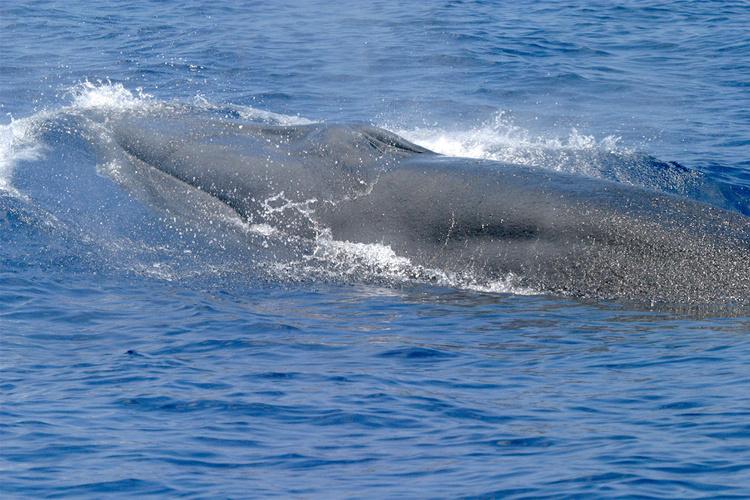
The latest effort to undermine protections for the critically endangered Rice’s whale (Balaenoptera ricei) represents one of the strangest attacks on modern conservation science in recent memory. After years of research by some of the world’s leading cetacean scientists, after formal taxonomic review, after acceptance by major scientific bodies, and after federal recognition under the Endangered Species Act (ESA), political appointees now appear eager to revisit a question that the scientific community largely settled years ago.
The timing is difficult to ignore. Rice’s whales occupy the same region of the Gulf of Mexico that is central to American offshore oil and gas development. With perhaps only 50–100 individuals remaining, the whale is one of the most endangered marine mammals on Earth. It is also an inconvenient species for those seeking fewer restrictions on industrial activity in the Gulf.
The species was described by Government Scientists
Let’s start with an awkward fact. The scientific paper formally recognizing Rice’s whale as a distinct species was not written by environmental activists, celebrity conservationists, or some fringe academic working from a garage laboratory. It was written by scientists from NOAA Fisheries.
In 2021, Patricia Rosel, Lynsey Wilcox, and colleagues published the peer-reviewed description of Balaenoptera ricei, concluding that the Gulf population previously treated as a form of Bryde’s whale was genetically, morphologically, and ecologically distinct enough to warrant species status. The designation was based on multiple independent lines of evidence, including genetics, skeletal morphology, distribution, and evolutionary history.
This was not a hasty decision. Scientists had been investigating the status of these whales for decades. The formal species description represented the culmination of years of research and review. The classification was also verified by Scientists at the Smithsonian, where the type specimen for the Rice’s whale currently sits. NOAA itself continues to state that Rice’s whales are “genetically and morphologically distinct” from Bryde’s whales and recognizes them as a unique species.
So, to summarize: federal scientists conducted the research, federal scientists published the evidence, and federal agencies accepted the findings. Now federal political leadership appears prepared to argue that the federal scientists were wrong. That is not how science is supposed to work.
The scientific community has already accepted Rice’s whale as a species
Species descriptions are not determined by political vote. Taxonomy is ultimately accepted (or rejected) through scientific scrutiny. In the case of Rice’s whale, the taxonomic conclusion has been broadly accepted by the professional scientific community. The Society for Marine Mammalogy’s Committee on Taxonomy recognizes Balaenoptera ricei as a valid species. NOAA Fisheries recognizes it as a valid species. The International Whaling Commission (the international, intergovernmental competent authority on cetaceans) has also recognized it as a valid species. The IWC made a statement reiterating the fact that it recognizes the Rice’s whale as a species in its most recent Scientific Committee.
It is impossible to be more officially approved and scientifically recognized by the marine mammal science community than this.
Could future research modify our understanding of Rice’s whale? Of course. Taxonomy evolves as new evidence emerges. But there is a substantial difference between scientific uncertainty and politically motivated skepticism. The former is a normal feature of science. The latter is what happens when conclusions become inconvenient.
Here’s the part that makes the whole thing weird…
Even if Rice’s whale were not a full species, it would still be protected. This is the part that suggests many of the people pushing this argument fundamentally do not understand how the Endangered Species Act works. The ESA does not protect only species. It also protects subspecies and, uniquely among conservation laws, Distinct Population Segments (DPSs) of vertebrate species.
In fact, before the formal description of Balaenoptera ricei, the Gulf population was already listed under the ESA as the Gulf of Mexico Bryde’s whale (a distinct taxonomic unit recognized as endangered). NOAA explicitly notes that when the species description was accepted in 2021, the change from subspecies to species status did not alter its ESA protections.
The whales did not suddenly become endangered because taxonomists changed a label. They were endangered because there are very few of them, they occupy an extremely restricted range, and they face substantial threats from vessel strikes, industrial activity, noise, and oil spills.
If someone were somehow able to overturn the species designation tomorrow, the population would still almost certainly qualify as a protected subspecies or DPS. This makes the recent taxonomic attack legally, and biologically, irrelevant.
Taxonomy does not override extinction risk
The entire debate also misses the central point. Whether you call these whales a species, a subspecies, or a DPS, there are still only about fifty individuals left. A vessel strike does not care what taxonomic rank appears in a Federal Register notice. An oil spill does not check the latest edition of a mammal checklist before causing harm. Extinction is remarkably indifferent to nomenclature. The conservation concern arises from the whale’s tiny population size and restricted distribution, not merely from the rank assigned by taxonomists.
Did someone ask AI to write this?
One increasingly difficult question hangs over many recent federal environmental decisions. Did anyone involved actually consult the relevant scientific literature? Because some of the arguments being advanced have the familiar feel of a poorly prompted chatbot trying to summarize conservation law after skimming a few web pages.
The logic seems to proceed as follows:
- The species receive ESA protection.
- Rice’s whale is protected.
- Therefore, if Rice’s whale is not a species, protections disappear.
That conclusion would earn a failing grade in an undergraduate conservation biology class. The ESA has protected subspecies and DPSs for decades. Any serious review of the statute would reveal this almost immediately.
Of course, there is another possibility. Perhaps the goal was never really to engage with taxonomy at all. Perhaps questioning the species designation simply provides a convenient narrative for weakening protections that constrain offshore oil and gas development. If so, the debate is not about taxonomy, it is about politics.
The bigger picture
Rice’s whale has become a symbol of something larger than a taxonomic dispute. The species was discovered, described, and recognized through the normal scientific process. The evidence was evaluated by experts. The findings were accepted by the relevant scientific institutions. The species remains recognized by NOAA, the Society for Marine Mammalogy, and the International Whaling Commission. Attempting to relitigate that science for political convenience sets a dangerous precedent.
Today it is the Rice’s whale. Tomorrow it could be any species whose existence creates regulatory complications. Science is not perfect. Scientists revise conclusions all the time when new evidence emerges. But evidence should drive those revisions, not the location of an oil lease.
References
Rosel, P.E., Wilcox, L.A., Yamada, T.K., Mullin, K.D. (2021). A new species of baleen whale (Balaenoptera) from the Gulf of Mexico. Marine Mammal Science, 37, 577–610.