Skip to content

Southern Fried Science

Over 15 years of ocean science and conservation online

  • Home
  • About SFS
  • Authors
  • Support SFS

Author: David Shiffman

Background information on our “trophy fishing for species threatened with extinction” paper

Posted on August 11, 2014September 4, 2014 By David Shiffman
Conservation, Science
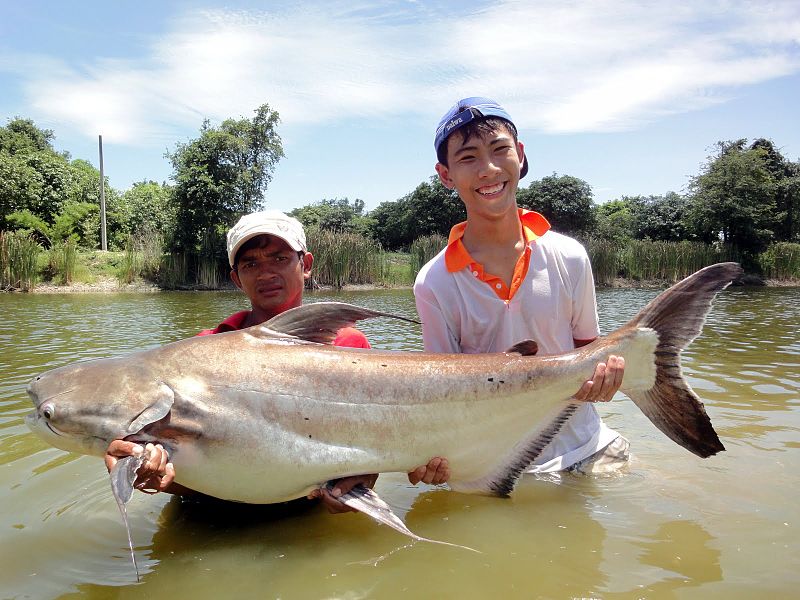
A giant pangasius, one of the Endangered species of fish that is targeted by trophy fishermen. Photo by user GV_Fishing, WikiMedia Commons

Andrew and I (along with several co-authors) have a new paper out in the journal Marine Policy entitled “Trophy Fishing for Species Threatened with Extinction: A way Forward Based on a History of Conservation.” You can read the paper here, and view the official press release here (will be up soon) .

We believe that this is an important topic that does not get enough attention, and we wrote the paper to review the scope of the problem, propose an easily achievable solution, and facilitate a long overdue discussion. Although we intentionally wrote the paper to be accessible to anyone, this blog post serves to explain the concepts and issues in the paper even further.  We are happy to answer any questions people have about the paper, just ask them in the comments section below.

Read More “Background information on our “trophy fishing for species threatened with extinction” paper” »

Megalodon: the New Evidence is a fake documentary

Posted on August 7, 2014 By David Shiffman 3 Comments on Megalodon: the New Evidence is a fake documentary
Blogging, Popular Culture, Science

So was last year’s “Megalodon: the monster shark lives.”  Both Shark Week specials claim to show evidence that Carcharocles megalodon, the largest predatory shark that ever lived, is still alive. In both cases, the evidence is 100% completely and totally fake. A disclaimer from “the monster shark lives” Video evidence is CGI, images are photoshopped, and … Read More “Megalodon: the New Evidence is a fake documentary” »

Cascading planetary-wide ecosystem effects of the extirpation of apex predatory Krayt dragons on Tatooine

Posted on July 22, 2014 By David Shiffman
Blogging, Conservation, Popular Culture, Science

Author’s note: this post is part of the “Science of Tatooine” blog carnival. Though obviously about science fiction and not the real world, it includes real ecological theories,  and it uses some real peer-reviewed scientific papers as references. Whenever possible, I’ve linked to accessible copies of those papers and explainers of these ecological terms. Many of the same issues are associated with shark population declines. 

ABSTRACT

Predators play an important role in structuring ecosystems, with predator population declines being linked to a variety of negative ecological effects. Here, we present evidence that the planet Tatooine, famous throughout the Galaxy for being a desert planet, experienced desertification as a result of unintended changes in herbivore populations caused by the intentional large-scale killing of apex predators by offworld colonists. Fossil evidence and interviews showing traditional ecological knowledge suggest that once-abundant Krayt dragons were hunted to near extinction by early human colonists. As a result of the decline in predation, populations of large herbivorous banthas populations grew out of control and overgrazed the plants once found throughout Tatooine.

INTRODUCTION

Studies of numerous ecosystems have consistently shown the importance of intact populations predators to healthy ecosystems, with a recent review (Estes et al. 2011 “trophic downgrading of planet Earth”) noting that “the loss of apex consumers is arguably humankind’s most pervasive influence on the natural world.” Population declines of top predators can cause a trophic cascade, resulting in unintended consequences that ripple through a food chain. Sea otter population declines in the Pacific Northwest of the United States resulted in predation release of otter prey (sea urchins), and an overabundance of sea urchins destroyed entire kelp forest ecosystems by overgrazing (Estes et al. 1998 “killer whale predation on sea otters linking oceanic and nearshore systems.) Wolf population declines in Yellowstone National Park resulted in predation release of wolf prey (elk,) and an overabundance of elk destroyed aspen pine forests by overgrazing (Ripple et al. 2011 “trophic cascades among wolves, elk, and aspen on Yellowstone National Park’s northern range.”)  Ecosystem-wide effects stemming from the loss of predators has also been listed as the proximate cause of disease outbreaks (Pongsiri et al. 2009 “biodiversity loss affects global disease ecology,”), increasing destructive wildfires (Perrings et al. 1997 “biodiversity resilience and the control of ecological-economic systems: the case of fire-driven rangelands,”) and overall biodiversity loss (Paine 1969, “Pisaster-tegular interaction: prey patches, predator food preference, and intertidal community structure.”)

Though the planet Tatooine in the Tatoo system of the Outer Rim is known by researchers to have once been covered by oceans and lush vegetation, it is commonly known now as a desert planet (source). While it is famous in Republic circles primarily for being the home of Jedi Master Skywalker, Tatooine also has native sentient species, including Jawas and Tusken Raiders (the latter are derisively referred to by locals as “sand people” ).  Native non-sentient animals include banthas (large herbivores used as beasts of burden) and the now mostly extinct Krayt dragon (a large predatory species that fed on banthas).

Read More “Cascading planetary-wide ecosystem effects of the extirpation of apex predatory Krayt dragons on Tatooine” »

Frequently asked questions about Rosie O’Donnell killing an endangered shark for fun

Posted on July 13, 2014July 13, 2014 By David Shiffman
Science

On Friday afternoon, Slate published an article I wrote about Rosie O’Donnell killing an endangered hammerhead shark. Since that time, there has been an active discussion about the article and the surrounding issues on twitter (follow me here) and Facebook (like my page here). Some of the same questions keep coming up, so I decided to gather these questions, and their answers, in one place.

1) Why are you writing an article about this instead of going to the police / isn’t this illegal?

Since January 1, 2012, it has been illegal to kill great, smooth or scalloped hammerhead sharks in Florida state waters. They must be “immediately released, free alive and unharmed.” Rosie killed this hammerhead before 2012, so it was not illegal at the time. I never said it was illegal.

2) If it wasn’t illegal, what’s the problem?

“Not illegal” is not synonymous with “there are no negative consequences to this action, and it is above reproach.” There are lots of things you can do that are legal but bad. There are some things that are illegal but are not bad. “Legal” and “ethically acceptable” are different thing. I do not think that it is ethically acceptable to kill an endangered species for fun and then yell at conservationists and scientists who criticize this action. Also, if the best you can say about an action is “it wasn’t technically against the law when I did it,” you may want to reconsider the ethics of your hobbies.

Read More “Frequently asked questions about Rosie O’Donnell killing an endangered shark for fun” »

Can the world’s luxury yacht owners help reduce ocean scientists’ biggest expense: ship time?

Posted on July 7, 2014 By David Shiffman 1 Comment on Can the world’s luxury yacht owners help reduce ocean scientists’ biggest expense: ship time?
Blogging, Science

The International SeaKeepers Society is offering yachts for marine science expeditions, free of charge.

Marine scientists perform research ranging in scope from global food security to threatened species conservation to climate change, research that is critical to a healthy environment. As with other scientific disciplines, however, funding cuts threaten the future of this research. A recent Joint Ocean Commission Imitative report gave the United States government a D minus on funding for ocean sciences, and one of the primary funding programs for ocean exploration has been proposed for termination.

Even as funding is reduced, costs associated with ocean science research are rising. In particular, the fuel costs for research vessels, of which there are fewer and fewer each year, are increasing. Ship time often costs tens of thousands of dollars each day. This huge expense is critical, as researchers have to get to their study area before they can begin to study it. The International SeaKeepers Society, a non-profit founded by a group of luxury yacht owners, wants to help reduce or eliminate this cost by hosting marine science expeditions on private yachts. “By providing scientists in need of a research platform at sea with the opportunity to work off a privately owned vessel at little to no cost, SeaKeepers helps remove one of the most costly aspects of data collection: access to the water,” says Brittany Stockman, Director of Programs and Policies for the International SeaKeepers Society.

Read More “Can the world’s luxury yacht owners help reduce ocean scientists’ biggest expense: ship time?” »

Absurd headlines about sharks, adjusted for accuracy

Posted on June 11, 2014June 11, 2014 By David Shiffman 1 Comment on Absurd headlines about sharks, adjusted for accuracy
Blogging

The mainstream media doesn’t always have the greatest reputation for accuracy when it comes to reporting stories about sharks. Inspired by this brilliant campaign, I decided to “adjust” the headlines of some particularly absurd recent news stories about sharks.

This story about a shark that may have been eaten by another shark. 

1


Read More “Absurd headlines about sharks, adjusted for accuracy” »

Selected conference tweets from Sharks International #Sharks14

Posted on June 9, 2014June 9, 2014 By David Shiffman
Conservation, Science

I’ve just returned from the second Sharks International, a scientific conference for shark and ray researchers, which was held in South Africa. With nearly 300 researchers and conservationists from more than 38 countries in attendance, the conference was a fantastic learning and networking experience, and a huge success.

In addition to countless talks focusing on cool discoveries about amazing animals and important conservation issues from all over the world,  I don’t think I ate one meal at a table with fewer than 4 countries represented.   Our lab, the RJ Dunlap Marine Conservation Program at the University of Miami, gave 3 scientific  presentations, including my own, which was well-received and resulted in some fascinating discussions. The “social media for scientific outreach” workshop I gave had more than 50 people attend, resulting in a couple of dozen scientists newly joining twitter.

Speaking of twitter, more than 7,000 tweets (including re-tweets) were shared using the conference hashtag #Sharks14 ! Below are links to 8 Storify stories I made: 4 plenary sessions and 4 days of scientific presentations. * Scientists, if any of the tweets about your talk are incorrect, please alert me in the comments and I’ll edit or delete them immediately. *

Read More “Selected conference tweets from Sharks International #Sharks14” »

Dawn take you all: Bilbo Baggins’ approach is better than “don’t feed the trolls”

Posted on May 21, 2014 By David Shiffman 4 Comments on Dawn take you all: Bilbo Baggins’ approach is better than “don’t feed the trolls”
Blogging, Science

“Dawn take you all, and be stone to you!”For just at that moment the light came over the hill, and there was a mighty twitter in the branches. William never spoke for he stood turned to stone as he stooped; and Bert and Tom were stuck like rocks as they looked at him. And there they stand to this day, all alone, unless the birds perch on them; for trolls, as you probably know, must be underground before dawn, or they go back to the stuff of the mountains they are made of, and never move again. – “The Hobbit,” J.R.R. Tolkien. (Yes, it really says twitter in this section of text. This is the only place in “The Hobbit” or any of the Lord of the Rings books where the word twitter appears.)

Trolls at the world premiere of "The Hobbit: An Unexpected Journey". Creative Commons license from Flickr user Kewl
Trolls at the world premiere of “The Hobbit: An Unexpected Journey”. Creative Commons license from Flickr user Kewl


Though I have largely enjoyed my experiences with online outreach, there are, to put it mildly, lots of unpleasant people on the internet. An extremist opinion and an anonymous forum for expressing it can be a recipe for some particularly nasty conversations. Some people seem to take pleasure in disrupting a conversation even when they have no particular stake in it, and these people are commonly referred to as “trolls.” There are various strategies for dealing with them (for example, here’s an explanation of this blog’s comment policy). In general, “don’t feed the trolls”  is a common piece of advice for those engaged in online discussions. “Don’t feed the trolls” means that if someone is behaving in an inflammatory manner, you should simply not respond. While it’s certainly true that many internet trolls enjoy a combative discussion and that engagement may give an extremist idea more exposure than it would otherwise receive, I’ve never liked the idea of “don’t feed the trolls.”

Read More “Dawn take you all: Bilbo Baggins’ approach is better than “don’t feed the trolls”” »

24 species of sharks that have killed fewer people than Jack Bauer on 24

Posted on May 6, 2014May 7, 2014 By David Shiffman 6 Comments on 24 species of sharks that have killed fewer people than Jack Bauer on 24
Uncategorized
Promotional photo for "24: Live Another Day" from the 24 Facebook page, https://www.facebook.com/24fox
Promotional photo for “24: Live Another Day” from https://www.facebook.com/24fox

After four long years of being cancelled, Fox finally brought back ’24’ this week! Star Kiefer Sutherland plays Jack Bauer, a counter-terrorism agent and general badass. Jack has had to kill in the line of duty many times. In fact, as of this past Monday’s premiere of “24: Live Another Day,” Jack Bauer has killed 273 people. How does this record stack up to a cause of death that so many people fear, death by shark bite?

Here are 24 species of shark that have killed fewer people than Jack Bauer has killed on ’24,’ according to the International Shark Attack File.  All fatalities reference the time period 1580-2013, and encompass the whole world. Only fatalities where the shark species has been identified are included here

Read More “24 species of sharks that have killed fewer people than Jack Bauer on 24” »

Announcing a F1000 research collection on shark biology and conservation

Posted on May 6, 2014May 6, 2014 By David Shiffman
Blogging, Science

An announcement from Cesar Berrios-Otero, Outreach Director at Faculty of 1000:

f1000-researchShark Week is fast approaching and with it the potential for misinformation (re Megalodon special 2013) as well as an excellent opportunity for public education and outreach. Furthermore, with 25% of all sharks and their relatives in danger of extinction due to over fishing, at F1000Research (a new open science journal launched in 2013) we believe this is the ideal opportunity to raise awareness of elasmobranch biology and conservation efforts. In order to support these efforts we are planning the release of an article collection to coincide with this event. We are encouraging authors to contribute their work in order to highlight the importance of these indispensable apex predators.


We are looking for passionate shark biologists who would like to publish articles in the following areas:

  • Policy, regulations and laws regarding shark conservation.
  • Migration, feeding, ecology and behavior of sharks.
  • Profiles of shark fisheries and future needs.


Read More “Announcing a F1000 research collection on shark biology and conservation” »

Posts pagination

Previous 1 … 23 24 25 … 68 Next

Popular Posts

The next OpenCTD is here!The next OpenCTD is here!June 22, 2026Andrew Thaler
What Ocean Ramsey does is not shark science or conservation: some brief thoughts on "the Shark Whisperer" documentaryWhat Ocean Ramsey does is not shark science or conservation: some brief thoughts on "the Shark Whisperer" documentaryJuly 2, 2025David Shiffman
Undermining the Law of the Sea. Some additional thoughts following my OpEd in the Hill.Undermining the Law of the Sea. Some additional thoughts following my OpEd in the Hill.June 22, 2026Andrew Thaler
What is a Sand Shark?What is a Sand Shark?November 12, 2017Chuck Bangley
The story of the pride flag made from NASA imagery: Bluesky's most-liked imageThe story of the pride flag made from NASA imagery: Bluesky's most-liked imageSeptember 27, 2024David Shiffman
That's not a blobfish: Deep Sea Social Media is Flooded by AI SlopThat's not a blobfish: Deep Sea Social Media is Flooded by AI SlopDecember 19, 2025Andrew Thaler
Tagging Bull Sharks in the Neuse RiverTagging Bull Sharks in the Neuse RiverAugust 4, 2011Guest Writer
Our favorite sea monsters – Ningen (#4)Our favorite sea monsters – Ningen (#4)September 7, 2010Andrew Thaler
Rice’s whale and the curious case of the disappearing species.Rice’s whale and the curious case of the disappearing species.June 25, 2026Southern Fried Science
Shark of Darkness: Wrath of Submarine is a fake documentaryShark of Darkness: Wrath of Submarine is a fake documentaryAugust 10, 2014Michelle Jewell
Subscribe to our RSS Feed for updates whenever new articles are published.

We recommend Feedly for RSS management. It's like Google Reader, except it still exists.

Southern Fried Science

  • Home
  • About SFS
  • Authors
  • Support SFS


If you enjoy Southern Fried Science, consider contributing to our Patreon campaign.

Copyright © 2026 Southern Fried Science.

Theme: Oceanly Premium by ScriptsTown