Skip to content

Southern Fried Science

Over 15 years of ocean science and conservation online

  • Home
  • About SFS
  • Authors
  • Support SFS

Author: David Shiffman

SciFund challenge background: 6 questions you can answer about shark feeding ecology with stable isotope analysis

Posted on January 14, 2014August 24, 2017 By David Shiffman
Science

scifundAs many of you have heard, I have a project in the 4th SciFund Challenge, a scientific research crowdfunding organization.  My project, entitled “You are what you eat: non-lethal feeding ecology to help conserve threatened sharks,” is part of my Ph.D. dissertation research. You’ll be hearing a lot more about it over the new few weeks here, on twitter, and on my Facebook page once the challenge officially starts on February 1st. I’d really appreciate your support of my research!

I’ll be using a research technique called stable isotope analysis to study the diet and food web interactions of shark species in Florida. My project (and the research technique) will be briefly explained on my SciFund site, but I wanted to go into more detail about the type of research questions that stable isotope analysis can answer, as well as why this kind of data is significant.

Feeding ecology is important to the conservation and management of sharks.

An emerging trend in marine conservation is “ecosystem based fisheries management”, which means that managers would consider the diet and food web interactions of species of interest. An effective ecosystem-based fisheries management plan would require, among other things, detailed diet and food web interaction data. We can better conserve and protect threatened marine life such as sharks if we better understand their biology and ecology, including what they eat. Over 100 priority research questions for shark conservation were identified in a 2011 research paper (available open access here), and several of these are related to feeding ecology and ecosystem role.

The traditional method for studying the diet of sharks is called stomach content analysis, which typically involves cutting open the stomach of a shark to examine what is inside. Southern Fried Science writer Chuck used a non-lethal alternative that involved pumping the sharks’ stomachs, but that is far less commonly performed. While direct and effective, this kind of lethal sampling research may not be appropriate for certain threatened species of sharks. Stable isotope analysis, which requires only a small tissue sample, can be performed non-lethally.

Stable isotope analysis background information

Read More “SciFund challenge background: 6 questions you can answer about shark feeding ecology with stable isotope analysis” »

Public passion for shark finning bans is great. How do we channel it towards other issues?

Posted on January 9, 2014January 9, 2014 By David Shiffman 14 Comments on Public passion for shark finning bans is great. How do we channel it towards other issues?
Conservation, Science

A recent proposal in New Zealand to outlaw shark finning received more than 45,000 public comments from all over the world, a staggering amount of public interest in fisheries policy. This is great news, because though many activists don’t really know what it means, shark finning is a major threat. Shark finning may well be the most brutal and wasteful method of gathering food in the history of human civilization, and  New Zealand was one of the few developed nations that still legally allowed any form of  the practice. Though there are still some significant issues with New Zealand’s proposal, it was  still very exciting to see so much public passion for an issue that few cared about, or even knew about, when I was growing up.

However, a finning ban is merely a first step, for the most part only controlling how sharks are killed, not how many are killed. A recent study showed that finning bans alone were insufficient to ensure sustainable fisheries. In many nations (including the United States), the interested public has a role to play in implementing all or most of the next steps a comprehensive sustainable fisheries policy for sharks and other fishes. Unfortunately, we haven’t seen anywhere near the same level of public engagement in other shark conservation issues as we see for big, flashy issues like bans on finning.

Read More “Public passion for shark finning bans is great. How do we channel it towards other issues?” »

3 sharks that were on twitter before being a shark on twitter was cool

Posted on January 3, 2014January 15, 2014 By David Shiffman 3 Comments on 3 sharks that were on twitter before being a shark on twitter was cool
Science

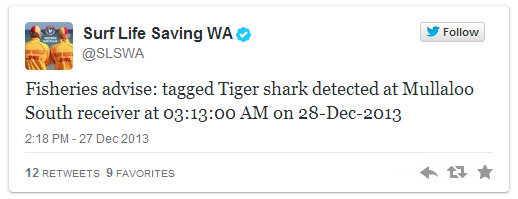
Recent plans in Western Australia to place acoustic tags in sharks and have them tweet their location when they approach a beach have resulted in a sharknado of media coverage. The plan has been covered by internet technology news giant Mashable, Fox News, NPR news, Popular Science, and NBC news (which, with “sharks with frickin’ tweets,” has what I believe to be the best headline. That one also interviews me.) When a tagged shark approaches the beach, a tweet like this results:

tweet


I can understand why a project involving both sharks and twitter caught the media’s eye… and why about a billion of you e-mailed or tweeted the news to me. However, these aren’t the first sharks to be on twitter!

Read More “3 sharks that were on twitter before being a shark on twitter was cool” »

Here’s how you can tell that the “shark” photobombing kids is actually a dolphin

Posted on December 31, 2013December 31, 2013 By David Shiffman 10 Comments on Here’s how you can tell that the “shark” photobombing kids is actually a dolphin
Blogging, Science

When California resident June Emerson snapped a photo of her children playing at the beach, she didn’t expect it to generate international news. Although the kids seem to be adorable, that isn’t what captured the attention of the media. In a wave behind them, you can see the outline of a large animal swimming by (or being “terrifying” and “creeping up on them,” as the Daily Mail called it).

Photo by June Emerson, snarky comments by yours truly

The media, including local, national, and international outlets, wasted no time in calling it a shark. However, as Jason Goldman wryly noted, “not all grey things with dorsal fins in the ocean are sharks.” This animal  is almost certainly a dolphin. I asked a dozen shark scientists and a handful of dolphin scientists, and all quickly agreed that this is a dolphin.

As I’m no fan of merely appealing to authority (though I’ll trust someone with years of training over the painful to read comments on many of the news pieces), I’ll share with you how we can tell. First, let’s clean up and brighten the image. Since I am not a photoshop master, let’s borrow a cleaned up and enhanced image from KTLA.

Original image by June Emerson, enhancement done by KTLA.
Original image by June Emerson, enhancement by KTLA.

Even though the image is somewhat blurry (understandable, as June was trying to photograph her children and not the animal behind them,) there are still easily identifiable features that clearly show that this is not a great white shark, but a dolphin.

Read More “Here’s how you can tell that the “shark” photobombing kids is actually a dolphin” »

13 amazing things scientists discovered about sharks in 2013

Posted on December 28, 2013December 30, 2013 By David Shiffman 5 Comments on 13 amazing things scientists discovered about sharks in 2013
Conservation, Science

Other than a certain week in August whose name we shall not speak here, 2013 was a great year for both shark science and the communication of that shark science. There were many important and fascinating discoveries, and many of the world’s top media outlets covered them. Presented here is a list of 13 amazing scientific discoveries made in 2013, in no particular ranking order. To make the list, research must have been published in a peer-reviewed scientific journal in 2013, and someone else other than me must have also thought it was awesome (i.e. it received mainstream media or blog coverage). In the interest of objectivity, I did not include any papers that I or my lab were directly involved with. Whenever possible, I’ve linked to an accessible version of the paper.


1) A two-headed bull shark!

From Wagner et al. 2013


Citation: Wagner, CM, Rice, PH, and Pease, AP 2013. First record of dicephalia in a bull shark Carcharhinus leucas foetus from the Gulf of Mexico. Journal of Fish Biology 82: 1419-1422.

Brief description: Researchers presented the first case of a bull shark embryo with 2 heads (the mother was caught by a Florida fishermen). In response to the most common question I received about this study, no, this animal would not have survived to adulthood.  While this is a cool discovery, the broader significance is somewhat minimal. As I told science writer Douglas Main in an interview about a similar study, “There have been a number of reports of deformed shark and ray embryos in recent years— two heads, one eye, etc. There’s no evidence to suggest these defects represent a new phenomenon or that they are harmful to shark populations as a whole.”

Media coverage highlights: A figure from this study was named one of the coolest science photos of the year by the International Science Times. It was also covered by National Geographic, the Guardian, and TIME magazine.

Read More “13 amazing things scientists discovered about sharks in 2013” »

More than 100 shark scientists, including me, oppose the cull in Western Australia

Posted on December 23, 2013December 23, 2013 By David Shiffman 10 Comments on More than 100 shark scientists, including me, oppose the cull in Western Australia
Uncategorized
Image via Terry Goss, Wikimedia Commons

Following the tragic fatal bite of surfer Chris Boyd, the government of Western Australia has again proposed a misinformed policy that would harm populations of threatened animals without making surfers or swimmers safer. By targeting any large shark that swims within a specific area, including endangered species and species not considered a safety risk to humans, this policy is essentially a cull. The family of one of the victims of a fatal shark bite opposes the cull, as do scientific experts,  local surfers and thousands of concerned environmentalists around the world.

Dr. Ryan Kempster, shark biologist and founder of Support Our Sharks, provided a brief statement on this issue:

There is no denying that each and every shark fatality is a tragedy and our sympathy is, of course, with the family and friends of the victims. However, based on statistical data, the number of shark related fatalities is negligible when you consider the vast and increasing number of swimmers entering our coastal waters every year.

So often the argument in favour of a cull comes down to the emotional question of who is more important: a human or a shark. Rather, we need to ask the question, will culling sharks actually reduce the risk of an attack?

The answer is likely to be no. In fact, when shark culling was carried out in Hawaii, between 1959 and 1976, over 4,500 sharks were killed and yet there was no significant decrease in the number of shark bites recorded. We need to invest in more research to better understand the movement patterns of sharks and learn more about the cues that entice sharks to bite people in the first place so that we can avoid these situations in the future.

Dr. Kempster also drafted an open letter to the government of Western Australia. This letter, which has been co-signed by more than 100 shark scientists from all over the world (including me), is reproduced below. It highlights why a shark cull is ineffective at reducing shark bites and why culls harm threatened species, in addition to proposing alternative suggestions. Additionally, shark biologist Dr. Barbara Wueringer started an online petition, which currently has over 34,000 signatures.

I urge the government of Western Australia to enact the alternative policies proposed by Dr. Kempster and other experts. Culls do nothing to help make people safer, and they can do great harm to populations of threatened (and legally protected) species.

Read More “More than 100 shark scientists, including me, oppose the cull in Western Australia” »

Submit your short marine science or conservation films to the Beneath the Waves Film Festival

Posted on December 17, 2013 By David Shiffman
Uncategorized

The Beneath the Waves Film Festival, a student run film festival that brings scientists, filmmakers, and the interested public together,  is now accepting submissions for the 2014 season! Any short film (less than 15 minutes) about a marine or coastal topic is welcome, including shorts by professional filmmakers, video abstracts by researchers, student films, and … Read More “Submit your short marine science or conservation films to the Beneath the Waves Film Festival” »

Rest in peace, “ocean addict” Paul Walker

Posted on December 2, 2013 By David Shiffman 1 Comment on Rest in peace, “ocean addict” Paul Walker
Blogging

Much of the media coverage of the life of Paul Walker, who died tragically this past weekend at age 40, has focused on his successful film career. A rare celebrity who even the gossip-obsessed never heard a bad word about , Walker was beloved by his colleagues. However, he once noted that “I’m an actor, that’s my job but it’s … Read More “Rest in peace, “ocean addict” Paul Walker” »

Check out Musingo, the music trivia app that helps save the ocean

Posted on November 21, 2013 By David Shiffman
Conservation

MusingoThis week saw the launch of Musingo, an interactive music trivia app for iOS. The developer, Good World Games, lets users make an impact in the real world through the game apps they play, and Musingo is no different.

Though the app is free, there are opportunities for in-game purchases of additional game tokens, as well as the opportunity to buy the songs you hear through iTunes. 50% of the profits from those in-game purchases are donated to my lab, the RJ Dunlap Marine Conservation Program, where they will be used to help support our many ongoing research projects.


GHOF-Musingo-ad05


Read More “Check out Musingo, the music trivia app that helps save the ocean” »

What’s turning dolphins in South Carolina into half dolphins?

Posted on November 15, 2013November 15, 2013 By David Shiffman 4 Comments on What’s turning dolphins in South Carolina into half dolphins?
Science

One of the many perks of spending lots of time on boats is that you get to overhear some pretty strange radio conversations. The strangest I ever heard took place in the summer of 2002 in the Gulf of Maine, when the captain of a fishing vessel was calling the Coast Guard to report that he was looking at half of a dolphin swimming around. I was shocked, but the Coast Guard radio operator had apparently heard of this, and replied, “No, sir, that’s a mola mola. It’s a fish, and it’s supposed to look like that.” Everyone on the bridge of the sailing vessel I was on laughed.

I hadn’t thought about the idea of “half of a dolphin” for more than 10 years… until last week, when I saw this photo of an animal which had washed up on Folly Beach, South Carolina, only a few miles from where I used to live (and swim). According to marine mammal expert Wayne McFee of NOAA’s National Centers for Coastal and Ocean Science, this is the second time in recent weeks that half a dolphin has washed up on the shores of South Carolina.  Although more than twice the average number of dolphins have stranded in South Carolina this year, seeing two bitten in half ” is an unusual occurrence,” he told me.

Read More “What’s turning dolphins in South Carolina into half dolphins?” »

Posts pagination

Previous 1 … 26 27 28 … 68 Next

Popular Posts

The next OpenCTD is here!The next OpenCTD is here!June 22, 2026Andrew Thaler
What Ocean Ramsey does is not shark science or conservation: some brief thoughts on "the Shark Whisperer" documentaryWhat Ocean Ramsey does is not shark science or conservation: some brief thoughts on "the Shark Whisperer" documentaryJuly 2, 2025David Shiffman
Undermining the Law of the Sea. Some additional thoughts following my OpEd in the Hill.Undermining the Law of the Sea. Some additional thoughts following my OpEd in the Hill.June 22, 2026Andrew Thaler
What is a Sand Shark?What is a Sand Shark?November 12, 2017Chuck Bangley
The story of the pride flag made from NASA imagery: Bluesky's most-liked imageThe story of the pride flag made from NASA imagery: Bluesky's most-liked imageSeptember 27, 2024David Shiffman
That's not a blobfish: Deep Sea Social Media is Flooded by AI SlopThat's not a blobfish: Deep Sea Social Media is Flooded by AI SlopDecember 19, 2025Andrew Thaler
Tagging Bull Sharks in the Neuse RiverTagging Bull Sharks in the Neuse RiverAugust 4, 2011Guest Writer
Our favorite sea monsters – Ningen (#4)Our favorite sea monsters – Ningen (#4)September 7, 2010Andrew Thaler
Rice’s whale and the curious case of the disappearing species.Rice’s whale and the curious case of the disappearing species.June 25, 2026Southern Fried Science
Shark of Darkness: Wrath of Submarine is a fake documentaryShark of Darkness: Wrath of Submarine is a fake documentaryAugust 10, 2014Michelle Jewell
Subscribe to our RSS Feed for updates whenever new articles are published.

We recommend Feedly for RSS management. It's like Google Reader, except it still exists.

Southern Fried Science

  • Home
  • About SFS
  • Authors
  • Support SFS


If you enjoy Southern Fried Science, consider contributing to our Patreon campaign.

Copyright © 2026 Southern Fried Science.

Theme: Oceanly Premium by ScriptsTown