Skip to content

Southern Fried Science

Over 15 years of ocean science and conservation online

  • Home
  • About SFS
  • Authors
  • Support SFS

Category: Blogging

Social media as a scientific research tool: Background info for my #scio14 session

Posted on February 6, 2014February 6, 2014 By David Shiffman 1 Comment on Social media as a scientific research tool: Background info for my #scio14 session
Blogging, Science

ScionlineAt the 2014 ScienceOnlineTogether conference, I will be moderating a session focusing on how to use social media as a scientific research tool (2:30 P.M. on Friday, February 28th in room 3).  The hashtag is #ScioResearch , so be sure to follow along, and I’ll make a Storify afterwards. This post is primarily intended to be a source of background information for participants in my session, though feel free to read, share and ask questions in the comments if you are not planning on participating in my session.

ScienceOnline community members understand the value of social media for collaborating with colleagues and communicating science to the public, but few think of the incredible resource that these tools are for scientific research. Hundreds of millions of people all over the world are constantly sharing their experiences and opinions in a format that is public, archived, searchable, and accessible, giving researchers access to this enormous dataset without the expense or logisitical difficulties involved in organizing a large-scale survey or series of focus groups. To use a technical term, for many types of scientific research, social media and “big data” is what is called “a freakin’ gold mine.”

Onion

Below are a few examples of how social media can be used for scientific research.

Read More “Social media as a scientific research tool: Background info for my #scio14 session” »
SciFund Challenge: Help support my shark feeding ecology research

Posted on February 3, 2014February 10, 2014 By David Shiffman
Blogging, Science

I am participating in the 4th SciFund Challenge, a crowdfunding event for scientific research! My project, part of my Ph.D. dissertation research, is looking at the feeding ecology of local species of sharks with the goal of generating data that can help managers to conserve and protect these species. I’d appreciate any assistance you can … Read More “SciFund Challenge: Help support my shark feeding ecology research” »

Book review: are dolphins really smart?

Posted on January 29, 2014January 30, 2014 By Guest Writer 6 Comments on Book review: are dolphins really smart?
Blogging, Reviews and Interviews

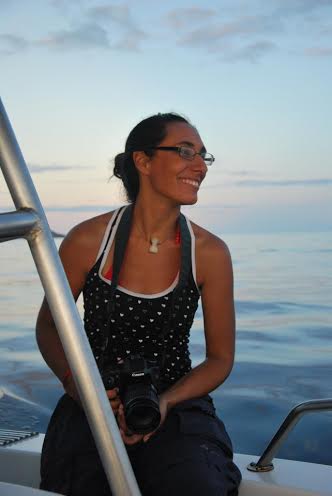
melMel Cosentino obtained her Degree in Environmental Biology at the Universidad de Málaga (Spain) and her MRes in Applied Marine and Fisheries Ecology at the University of Aberdeen (UK). She has been involved in cetacean research since 1998, starting as a volunteer for Fundación Orca Patagonia-Antártida in Argentina (her country of birth) working in educational campaigns against killer whale captivity. Since then she has participated in several research projects in Spain, Portugal and Norway.  Mel has conducted field work, both from land and at sea, focused on different cetacean species, including killer whales, Risso’s dolphins and Northern bottlenose whales. In addition, she participated in the Annual meeting of the IWC as part of the Luxembourgish delegation, both in 2011 and 2012.


“The fact that an opinion has been widely held is no evidence whatsoever that it is not utterly absurd; indeed in view of the silliness of the majority of mankind, a widespread belief is more likely to be foolish than sensible” (Bertrand Russell)

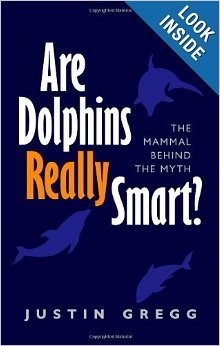
gregg bookThis is how the book “Are dolphins really smart?” by Dr. Justin Gregg starts. It has been recently published and it is available in several countries, including the US and the UK. Moreover there have been a large number of newspaper and web stories based on the conclusions of the book, most along the lines of “dolphins are no smarter than chickens” “Flipper is a thug!” and “dolphins are dumb” This led to a rebuttal article published in Southern Fried Science when David Shiffman interviewed the author and some cetacean scientists about the media frenzy spawned by the book’s release. Studying animal cognition is no easy task, and Dr. Gregg has put together a great amount of information; however, I believe the reader will be confused and misled by some of the comments and statements made by the author, a scientist who holds a PhD and who claims to be analysing the evidence “as impartially as possible with a sincere desire to let objectivity take centre stage”.

It would be impossible to critique the thesis of the book point by point, so I have compiled the topics I consider to be more problematic.

Read More “Book review: are dolphins really smart?” »

Debunking Fukushima: Your Radiation Roundup

Posted on January 8, 2014January 8, 2014 By Andrew Thaler 9 Comments on Debunking Fukushima: Your Radiation Roundup
Blogging, Science

Fukushima continues to dominate the ocean news cycle, and while no one is denying that it is a real and ongoing tragedy, the woo is strong in the Fukushima fear-mongering community. Fortunately, the scientists are out in force, debunking the bunk and cutting through the crap to keep you informed. Here is a handy collection of detailed links, from trusted source, tackling some of the most egregious pseudoscience coming out of Fukushima.

Southern Fried Science

  • 28 fallacies about the Fukushima nuclear disaster’s effect on the US West Coast

Deep Sea News

  • True facts about Ocean Radiation and the Fukushima Disaster
  • Three Reasons Why Fukushima Radiation Has Nothing to Do with Starfish Wasting Syndrome
  • Is the sea floor littered with dead animals due to radiation? No.
  • All The Best, Scientifically Verified, Information on Fukushima Impacts

Skeptoid

  • Are Your Days of Eating Pacific Ocean Fish Really Over?
  • More Fukushima Scaremongering Debunked
  • Dire Warnings and Melting Starfish: Fukushima Fearmongering, Volume 3

If you know of any other good articles debunking Fukushima fear-mongering, please leave them in the comments below.

If you feel the need to accuse any of the authors above of being shills for Big Nuclear, The Government, any Secret Board of Shadowy Figures, Tepco, or any combination thereof, I have an experiment for you: This website is ad free and run entirely by volunteers. Head on over the our “Support Southern Fried Science Page” and make a donation help to keep us running. Maybe, if you donate enough, we’ll start shilling for you (disclaimer: we won’t, but we will continue to produce high quality marine science and conservation articles from a diversity of voices).

Read More “Debunking Fukushima: Your Radiation Roundup” »

New Month, New Header Image

Posted on January 7, 2014 By Andrew Thaler
Blogging

This month we’re featuring Spot Prawn, by Lee Stevens. You can follow Lee on twitter @least_evens! If you would like to see you marine science and conservation themed image featured on Southern Fried Science, you can find more information here.

Southern Fried Science Year-in-Review

Posted on December 31, 2013December 31, 2013 By Andrew Thaler
Blogging

2013 starter with a bang. More specifically, it started with a Bang! Zop! Pow! when I published Five organisms with real super powers that rival their comic book counterparts, a post that set the tenor of my writing style for the rest of the year. The ongoing posts in “Andrew makes lists of ridiculous organisms with tenuous pop-culture connections” have been among the most widely read articles on Southern Fried Science.

David followed suit with his delightfully perverse 50 Shades of Grey Reef Shark: A Valentine’s Day Special Report on Shark Sex (With Pictures! And Video!). Amy kicked of the SFS Department of Human Dimensions in Fisheries Management with Know Your Fishermen as well as your Farmer to which Chuck adds — Fishermen Are Not Evil in his inaugural post. Iris taught us all about Issues facing Puget Sound Chinook salmon in her first post as well.

Read More “Southern Fried Science Year-in-Review” »

Here’s how you can tell that the “shark” photobombing kids is actually a dolphin

Posted on December 31, 2013December 31, 2013 By David Shiffman 10 Comments on Here’s how you can tell that the “shark” photobombing kids is actually a dolphin
Blogging, Science

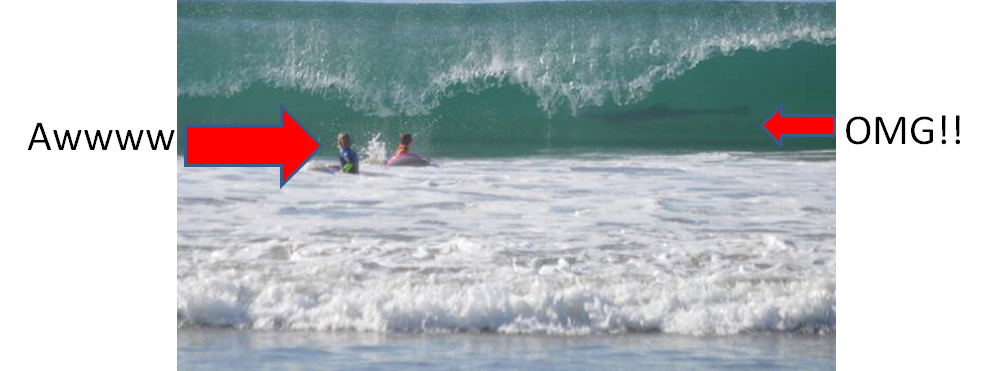
When California resident June Emerson snapped a photo of her children playing at the beach, she didn’t expect it to generate international news. Although the kids seem to be adorable, that isn’t what captured the attention of the media. In a wave behind them, you can see the outline of a large animal swimming by (or being “terrifying” and “creeping up on them,” as the Daily Mail called it).

Photo by June Emerson, snarky comments by yours truly

The media, including local, national, and international outlets, wasted no time in calling it a shark. However, as Jason Goldman wryly noted, “not all grey things with dorsal fins in the ocean are sharks.” This animal  is almost certainly a dolphin. I asked a dozen shark scientists and a handful of dolphin scientists, and all quickly agreed that this is a dolphin.

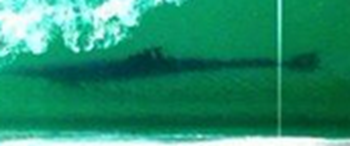
As I’m no fan of merely appealing to authority (though I’ll trust someone with years of training over the painful to read comments on many of the news pieces), I’ll share with you how we can tell. First, let’s clean up and brighten the image. Since I am not a photoshop master, let’s borrow a cleaned up and enhanced image from KTLA.

Original image by June Emerson, enhancement done by KTLA.
Original image by June Emerson, enhancement by KTLA.

Even though the image is somewhat blurry (understandable, as June was trying to photograph her children and not the animal behind them,) there are still easily identifiable features that clearly show that this is not a great white shark, but a dolphin.

Read More “Here’s how you can tell that the “shark” photobombing kids is actually a dolphin” »

The Invisible Disability: The diabetic academic manifesto

Posted on December 19, 2013January 19, 2020 By Bluegrass Blue Crab 2 Comments on The Invisible Disability: The diabetic academic manifesto
Blogging, Science

Whenever I fill out a job application, there are those little demographic questions at the end and I’m always a bit stymied. They ask if I have a disability that should be taken into account. I don’t, but in the world of academia I feel like I should say yes. I’m diabetic and due to constant fear I keep wearing diabetic socks for men so as to prevent foot complications and my post-PhD it’s starting to become a tangible hindrance for the first time in my life.

Ever the optimist, I tend to dismiss the cases in which the fact that I have a chronic disease directs my decisions. But lately, the cases have piled up to the point I need a cathartic moment to vent. And while a personal subject, I hope my thoughts can be either enlightening or instructive to those thinking about personal health in the ivory tower. Because that’s part of the problem – something held close because it’s personal keeps the issue out of public discourse, which is precisely where solutions might someday emerge.

Read More “The Invisible Disability: The diabetic academic manifesto” »

10 fish weirder than the fish in the 10 weirdest fish in the world list

Posted on December 18, 2013December 19, 2013 By Guest Writer 8 Comments on 10 fish weirder than the fish in the 10 weirdest fish in the world list
Blogging, Science

KeartesSarah Keartes  is a science blogger studying marine biology and journalism at the University of Oregon. A self-proclaimed Attenborough wannabe, and all-around shark junkie, she is dedicated to exploring new tools to promote ocean outreach through science communication.

Second string. Almost famous. Runner up. We’ve all been there—bowed out gracefully and stuffed down the BAMF within. I’m talking the missed, the forgotten, the less-than-top dogs (or in this case, fish). Such was the fate of these ten water-dwellers, left looking up at the podium of last month’s “Top Ten Weirdest Fish in the World” list.

Just keep swimming my finned-friends, I’ve got you covered. They may not be the blobbiest, the toothiest, or the most menacing—but for these creatures, weird comes naturally. In their honor, it’s time for round two: the top ten weirder than the weirdest fish in the world list.

Read More “10 fish weirder than the fish in the 10 weirdest fish in the world list” »

On the clarity of animals: the art and science of clearing and staining

Posted on December 17, 2013December 18, 2013 By Guest Writer 5 Comments on On the clarity of animals: the art and science of clearing and staining
Blogging, Science

AdamDr. Adam Summers  is trained as an engineer and mathematician, he turned to biology to satisfy a deep need to interact with nature.  His research applies simple physics and engineering principles to animals to understand the evolution of complex behaviors like feeding, movement and reproduction.  The images shown here are the raw material that underlies his research.  He is a professor at the University of Washington’s Friday Harbor Labs, author of more than 90 papers, and was the scientific consultant on Finding Nemo.  He is obsessed with fishes and has recently come to realize that the tools and aims of science, art and poetry are more congruent than he had supposed. All the cleared and stained fishes can be seen at http://www.picturingscience.com (Editor’s note: Adam was also featured in Gizmodo this week)

In my work I apply simple Newtonian physics and a bit of engineering to problems of how animals do those amazing things.  The source of questions is the natural world and there is no better skill set in my business than that of the natural historian. A keen eye for what is going on around you, and a willingness to document it, is a powerful engine for generating great questions.  Proposing answers to those questions almost always involves understanding the shape of the underlying system.  So, the second most important set of tools I have are anatomical.  Key insights are found in a deep understanding of the skeletal system and its associated soft tissue.  A common tool in my lab is clearing and staining, which results in an entire specimen that has its mineralized tissue stained red and cartilage a deep blue.

Read More “On the clarity of animals: the art and science of clearing and staining” »

Posts pagination

Previous 1 … 16 17 18 19 Next

Popular Posts

Shark scientists want their research to help save threatened species, but don’t know how. Our new paper can help.Shark scientists want their research to help save threatened species, but don’t know how. Our new paper can help.December 1, 2025David Shiffman
Norway and Cook Islands put their deep-sea mining plans on pause.Norway and Cook Islands put their deep-sea mining plans on pause.December 3, 2025Andrew Thaler
What Ocean Ramsey does is not shark science or conservation: some brief thoughts on "the Shark Whisperer" documentaryWhat Ocean Ramsey does is not shark science or conservation: some brief thoughts on "the Shark Whisperer" documentaryJuly 2, 2025David Shiffman
2025: My year in writing, public speaking, and media interviews2025: My year in writing, public speaking, and media interviewsDecember 3, 2025David Shiffman
What we know we don't know: impacts of deep-sea mining on whales, dolphins, sharks, turtles, and other migratory species.What we know we don't know: impacts of deep-sea mining on whales, dolphins, sharks, turtles, and other migratory species.November 20, 2025Andrew Thaler
The Trouble with Teacup PigsThe Trouble with Teacup PigsOctober 14, 2012Andrew Thaler
Urea and Shark OsmoregulationUrea and Shark OsmoregulationNovember 15, 2010David Shiffman
How tiny satellites are tracking marine wildlifeDecember 1, 2025Andrew Thaler
Shark of Darkness: Wrath of Submarine is a fake documentaryShark of Darkness: Wrath of Submarine is a fake documentaryAugust 10, 2014Michelle Jewell
Build a dirt cheap, tough-as-nails field computer in a Pelican caseBuild a dirt cheap, tough-as-nails field computer in a Pelican caseJuly 21, 2015Andrew Thaler
Subscribe to our RSS Feed for updates whenever new articles are published.

We recommend Feedly for RSS management. It's like Google Reader, except it still exists.

Southern Fried Science

  • Home
  • About SFS
  • Authors
  • Support SFS


If you enjoy Southern Fried Science, consider contributing to our Patreon campaign.

Copyright © 2025 Southern Fried Science.

Theme: Oceanly Premium by ScriptsTown