 There is no force more creative than the painstakingly slow process of evolution. Ever wanted to walk through walls? Naked mole rats can physically bore through concrete. How about fly? There are a couple dozen different ways to accomplish that goal, even if you’re a squid. Incredible power of regeneration? Flatworms, roundworms, and echinoderms have us beat. Among the vertebrates, species like the axolotl can regrow limbs, organs, and parts of their brain. For practically every super power we can imagine, something on the tree of life has come up with a real-world analog.
Some real super power are more super than others:
1. The immortal rotifer that absorbs the abilities of anything it touches.

Around 80 million years ago, a small, unassuming group of metazoa decided that sex just wasn’t for them. Instead of going through the effort of recombining their genetic material with a mate every generation to produce a viable offspring with a roughly 50% contribution from each parent, Bdelloid Rotifers started reproducing asexually. Males completely disappeared from class bdelloidea, leaving females to generate genetic duplicates through parthenogenesis. This is not their super power.
Bdelloid rotifers are incredibly tough. When environmental conditions are less than favorable, they can enter a dormant state. In this dormant state,they can survive the worst unscathed. Dehydrated, they can endure extreme temperatures, drought, even ionizing radiation. A bdelloid rotifer in its dormant state can even survive in space. If that isn’t enough, while dormant, these rotifers continue to produce offspring, which also remain dormant. This is not their super power.
Bdelloid rotifers’ super power appears when they recover from their dormant state. As they rehydrate and repair whatever damage their cells incurred, they incorporate DNA fragments from their environment. This includes partially digested food and any DNA in close proximity to them, even bacterial and archael DNA. It is this ability that allows bdelloid rotifers to overcome the limitations of asexual reproduction and survive for 80 million years without mates. They can literally absorb the attributes of those around them.
Their incredible toughness, celibate lifestyle, and ability to absorb the powers of anything they touch, put Bdelloid Rotifers firmly on par with X-Men perennial favorite: Rogue.
2. The deep sea snail that turns its flesh into metal.
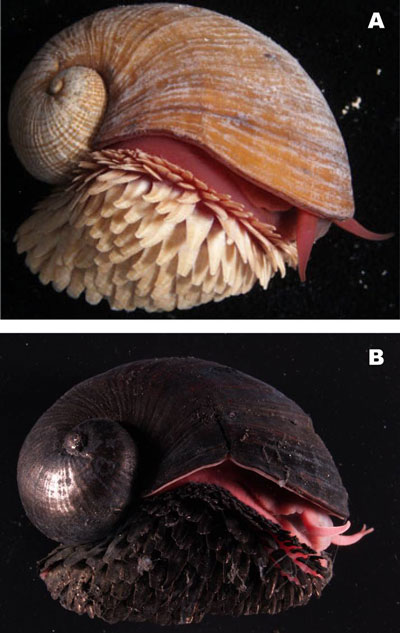
Rogue isn’t the only X-Man with an Earth-1218 counterpart. At hydrothermal vents in the Indian Ocean, a curious gastropod, Crysomallon squamiferum, dubbed the scaly-foot snail, has evolved a novel defense mechanism. Where most molluscs will produce a shell comprised of a calcium-carbonate matrix, Crysomallon squamiferum incorporates iron sulfide into both its shell and opperculum (the scale on a snail’s foot). It’s still unclear exactly why the scaly-foot snail evolved this particular strategy, but its discovery has already led to novel innovations in lighter, more durable body armor. Curiously, the same snail has been found at other sites without its iron sulfide armor.
With a sheath of metallic armor to protect itself that is not an immutable characteristic of the species, Crysomallon squamiferum is well-equipped to assume the mantle of my favorite X-Man: Colossus.
3. The parasitic barnacle that takes over your body.
What if your body wasn’t your own? What if some alien thing could swoop in while you are at your most vulnerable, take control, and bend you body to its will? What if it were so embedded that you couldn’t even feel yourself changing? If you are a blue crab, that nightmare is real, and its name is Sacculina.
How to describe Sacculina? It is a barnacle, but it’s like no other barnacle you’ve even seen. As a larva, it finds a host crab, and then hangs out on the crab’s shell until it molts. Once the crab sheds its shell, the parasite enters the host, castrates it, and emerges from the thorax as a bulbous sack, the externa, where the crab’s gonads would be. Now completely under the control of the parasite, the crab has lost its ability to molt or regenerate lost appendages.
Here’s where things get weird. The Sacculina needs a female crab to complete its life cycle. If a female Sacculina infects a male crab, it hijacks the crab’s reproductive system, chemically and physically alters it so that it appears female, and forces it to release female hormones, changing its behavior. A male Sacculina finds the female, implants himself into her body, and fertilizes her eggs. Unaware that any of this is occurring, the crab will tend to the Sacculina egg-mass as if it were his or her own.

The terrifying process by which Sacculina overwhelms its host, creating a monstrous hybrid of crab and barnacle bent to the parasite’s will, can only be matched by Spiderman’s most pernicious rival, the extraterrestrial symbiont and its human host: Venom.
4. The shapeshifting octopus.
Who wouldn’t want to be a shapeshifter? The ability to assume any form, hide in plain site, vanish without a trace is certainly compelling. The Indonesian Mimic Octopus is a favorite around the ocean blogosphere, inspiring numerous posts. It has even earned itself a comic on XKCD. Rather than wax on about this amazing species, let me share this video with you:
httpv://www.youtube.com/watch?v=H8oQBYw6xxc
There’s a few dozen comic book shapeshifters I could compare the Indonesian Mimic Octopus to, but, due to its extreme cunning and dramatic coloration, this cephalopod stands shoulder-to-shoulder with Mystique.
5. The fungus with the ultimate origin story
What good is a super power without a compelling origin story? A lab accident exposed Dr. Banner to gamma radiation, creating the Incredible Hulk. Inadequate shielding exposed Reed Richards and his family to deadly cosmic rays, creating the Fantastic Four. Spider-man was bit by a radioactive spider. Heck, even Matt Murdoch, the Daredevil, lost his vision and gained his super-senses from spilled radioactive chemicals. It seems like the comic book universe has an abundance of scientists with lousy lab technique. Have these people ever heard of PPE?
Unfortunately for would-be superheroes, exposure to high doses of radiation results in death and only rarely produces super powers.
Whoa, whoa, whoa. Hold up there, Andrew. Did you say rarely? Rarely?!? As in, not never?
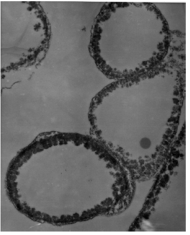
In 2007 a curious strain of black mold was discovered living in an area exposed to extreme ionizing radiation. These fungi contain high concentrations of the biopolymer melanin, which commonly protects organisms from ultra-violet and ionizing radiation. Field and laboratory test determined that, via an as-yet-uncharacterized molecular pathway, these fungi are able to generate energy through radiation exposure. Where plants are phototrophic and some deep-sea organisms are chemotrophic, these species are radiotrophic. They eat radiation.
The first species discovered that possessed this trait was Cladosporium cladosporioides. It is not a new species. C. cladosporioides is a known plant pathogen, although only this recently discovered strain is known to exhibit radiotrophism outside the laboratory. So where was this new strain found?
The remains of the Chernobyl Nuclear Power Plant.
So to recap: An otherwise unremarkable species of fungus is exposed to an extreme dose of radiation following a nuclear meltdown and develops the ability to eat radiation. That is one heck of an origin story.
The paper Ionizing Radiation Changes the Electronic Properties of Melanin and Enhances the Growth of Melanized Fungi is open access and worth a read.
Of all the super heroes and super villains that gained their powers from radiation exposure, I can think of only one that not only obtained his powers from a nuclear accident, but thrives on ionizing radiation; the ultimate foe of Captain Planet: Duke Nukem.
Don’t forget the honey badger!
I wonder if Sacculina was the basis for Applegates Animorph series and the yeerks as villains.
What about water bears? They’re practically indestructible!
enormously interesting – thank you! Any hope the radiation eating fungi can be used to clean up our mess?
You should really include Trichobatrachus robustus, the frog that breaks its own bones to produce claws! http://www.newscientist.com/article/dn13991-horror-frog-breaks-own-bones-to-produce-claws.html
This book need to be written! Yes, what about waterbears? 🙂