Skip to content

Southern Fried Science

Over 15 years of ocean science and conservation online

  • Home
  • About SFS
  • Authors
  • Support SFS

Category: Science

Rumors of the lesser electric ray’s demise have been greatly exaggerated

Posted on February 23, 2017February 23, 2017 By David Shiffman
Science, Uncategorized
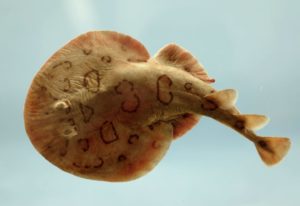
A lesser electric ray. Photo credit: Brandi Noble, NOAA Fisheries Service

The lesser electric ray, a small sand-dwelling ray that lives from North Carolina to Brazil, has been considered one of the most endangered marine fish on Earth. A 2005 paper reported that 98% of these rays had been wiped out, a decline attributed to shrimp trawling bycatch. This paper resulted in these animals getting classified as IUCN Red List “Critically Endangered,” the highest risk category for any species that is still found in the wild.

A new paper published today in the journal Endangered Species Research shows that these rays are in much better shape than previously believed. “There is no evidence of a decline in the relative abundance of lesser electric rays,” said Dr. John Carlson, a NOAA Fisheries Service Research Biologist and lead author of the new paper.

Read More “Rumors of the lesser electric ray’s demise have been greatly exaggerated” »
Conserving Chicago’s Lungfish Legacy

Posted on February 8, 2017February 8, 2017 By Solomon David
Conservation, Science
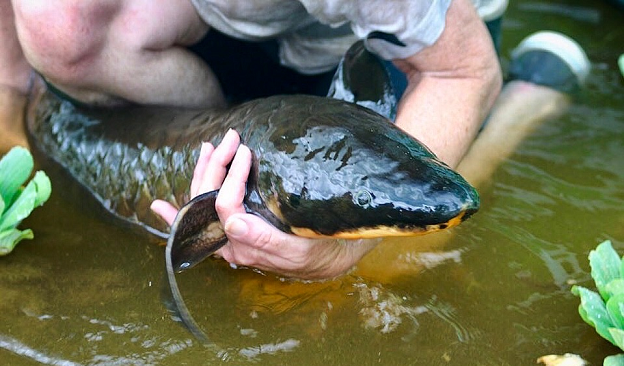
Adult Australian Lungfish, part of a captive breeding program in Queensland, Australia.
Credit: Gordon Hides (used with permission)

On Sunday, February 5, 2017, Granddad the Australian Lungfish, the oldest fish in any aquarium or zoo, was euthanized due to health complications. Although his exact age is unknown, he arrived at Shedd Aquarium in Chicago as an adult in 1933. Australian Lungfish (Neoceratodus forsteri) take over a decade to mature, so we can estimate he was over 90 years old when he passed.

The Australian Lungfish is a unique species, considered a “living fossil”, resembling its ancestors whose lineage dates back over 380 million years. The Australian Lungfish genus (Neoceratodus) itself has been around for about 100 million years. When first described, they were believed to be amphibians; one look at their elongate body and flipper-like fins, and you can imagine the classification conundrum. The fish even possesses a primitive lung, allowing it to breathe air in low-oxygen environments (although they usually breathe with their gills).

Read More “Conserving Chicago’s Lungfish Legacy” »

Bonnethead sharks, one of the smallest hammerheads, may actually be more than one species

Posted on January 5, 2017January 5, 2017 By David Shiffman 2 Comments on Bonnethead sharks, one of the smallest hammerheads, may actually be more than one species
Science

Bonnethead sharks, one of the smallest members of the hammerhead shark family Sphyrnidae, have a special place in my heart. For many years, the avatar I used for science communication efforts, including posts on this blog, was a picture of me with a bonnethead.

Remember this avatar? That’s a bonnethead (on the left).

These sharks, which can grow up to about 5 feet long, are found throughout North, Central, and South America. However, new research by Fields and friends suggests that they may actually be a species complex, not a true species. “A species complex is a group of distinct species that are incorrectly classified as one species because they look very similar to one another,” explained Dr. Demian Chapman, an Associate Professor of Biology at Florida International University and a co-author on this new study. “A great example is the white spotted eagle ray (Aetobatus narinari) that was once thought to be one, globally distributed species, but now has been shown to be a group of very similar-looking species, each of which lives in a particular region.”

Read More “Bonnethead sharks, one of the smallest hammerheads, may actually be more than one species” »

When I talk about Climate Change, I don’t talk about science.

Posted on January 3, 2017January 6, 2017 By Andrew Thaler
Conservation, Science

Climate Change is real. It’s happening now. And the best available data points to us as the cause.

That the foundational science is settled is a point of unending frustration to scientists, science writers, and policy advocates who face continuous partisan push back, from whitewashing government websites to threatening scientists with legal repercussions for reporting the data.  During my International Marine Conservation Congress keynote last year, I argued that Climate Change denial is not a science literacy problem, but rather a product of increasing political bifurcation. Political ideology is a much stronger predictor of Climate Change understanding than science literacy.

The term “Climate Change” is now loaded with so much political baggage that it becomes almost impossible to hold a discussion across political lines. In stakeholder interviews, people generally understand and acknowledge the impacts of climate change on local and regional scales, as long as you don’t call it “Climate Change”. This has been my experience working in rural coastal communities, which tend to be strongly conservative and intimately connected to the changing ocean.

Which is why, when I talk about Climate Change, I don’t talk about science. 

Read More “When I talk about Climate Change, I don’t talk about science.” »

Fun Science FRIEDay – Harnessing Synthetic Biology to Fight Ocean Pollution

Posted on December 16, 2016December 16, 2016 By Kersey Sturdivant
Conservation, Science

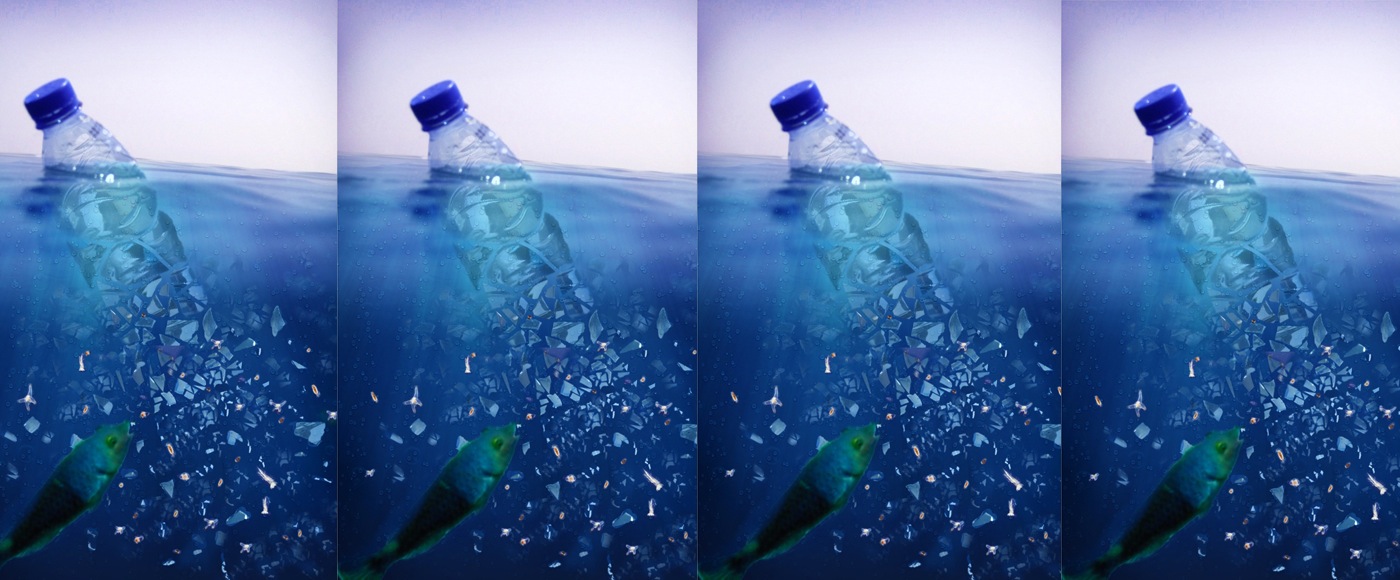
Plastics, more importantly microplastics, clog our oceans. This phenomena in the ocean has been likened to smog around cities. These plastic particles are dangerous because they can absorb toxins, subsequently be consumed by zooplankton and invertebrates, and bioaccumluate up the food web to fish that are consumed by humans. A study in Nature found that 25 percent of seafood sold contains microplastics! There has been a recent awareness of the unseen harm that exists when plastic pollution in the ocean degrades into microplastics. A report in Environmental Research Letters estimated that “accumulated number of micro plastic particles… ranges from 15 to 51 trillion particles, weighing between 93 and 236 thousand metric tons.” That is cray cray. Despite a better awareness of the impact of microplastics on marine ecology, we still have a poor spatial understanding of microplastics in the ocean. The presence and density of microplastics is determined by trawling the ocean (i.e., researchers go out with a net and physically count the pieces of plastic they pick up). As you can imagine, this is not very effective.

Conceptualization of plastic degrading in the ocean. (Photo credit: Archipelagos Institute)

Read More “Fun Science FRIEDay – Harnessing Synthetic Biology to Fight Ocean Pollution” »

37 things I learned about shark ecology and conservation for my dissertation

Posted on December 12, 2016August 24, 2017 By David Shiffman 5 Comments on 37 things I learned about shark ecology and conservation for my dissertation
Conservation, Science
The fam attending my dissertation defense

After a little more than 5 years of hard work, I’ve officially completed my Ph.D.! You can read my dissertation (“An Integrative and Interdisciplinary Approach to Shark Conservation: Policy Solutions, Ecosystem Role, and Stakeholder Attitudes”) online here in its entirety.

In case there are some among you who don’t really want to read a 281 page dissertation but are curious about what I found, I’ve prepared this blog post to summarize my key conclusions. (Note: this does not include every conclusion. Some are aggregated together, and some more technical conclusions are omitted for this summary).

Read More “37 things I learned about shark ecology and conservation for my dissertation” »

The Organism is Always Right.

Posted on December 6, 2016December 6, 2016 By Andrew Thaler
Science

Like this? Support me on Patreon!

Fun Science FRIEDay – Water to Wine? Close, CO2 to Alcohol (ethanol)

Posted on December 2, 2016 By Kersey Sturdivant
Open Science, Science

Science brings us many wonderful things (honestly if you enjoy the benefits of the modern era, go out and hug a scientist). One of humanities age old desires is the ability to convert something invaluable, or a nuisance, into something desirable. The old midas touch if you will. Recently some scientist stumbled onto the process of converting CO2, a primary culprit of anthropogenic climate change, into alcohol… though not the kind you drink, the kind that humanity could use as fuel.

(Photo credit: Getty + Space Images)

Producing fuel from CO2 is huge because it lets us take a nuisance compound, and converts it into a productive one. This was accomplished by scientists at Oak Ridge National Laboratory in Tennessee by using common materials (copper and carbon), but arranging them with nanotechnology. The researchers were attempting to find a series of chemical reactions that could turn CO2 into a useful fuel, such as ethanol. They figured they would go from CO2 to methanol, and then work out the logistics of going from methanol to ethanol, when they realized the first step in their process managed to do it all by itself. Science for the win!

Read More “Fun Science FRIEDay – Water to Wine? Close, CO2 to Alcohol (ethanol)” »

Do you see the deep sea?

Posted on November 29, 2016November 27, 2016 By Andrew Thaler
Science

Like this? Support me on Patreon!

Secrets of the Deep Sea

Posted on November 22, 2016 By Andrew Thaler
Science

Posts pagination

Previous 1 … 13 14 15 … 81 Next

Popular Posts

How close did the world's first deep-sea mining come to the dredging the world's largest cold-water coral reef?How close did the world's first deep-sea mining come to the dredging the world's largest cold-water coral reef?March 17, 2026Andrew Thaler
Tangier, an Island out of Time.Tangier, an Island out of Time.July 3, 2017Andrew Thaler
What Ocean Ramsey does is not shark science or conservation: some brief thoughts on "the Shark Whisperer" documentaryWhat Ocean Ramsey does is not shark science or conservation: some brief thoughts on "the Shark Whisperer" documentaryJuly 2, 2025David Shiffman
That's not a blobfish: Deep Sea Social Media is Flooded by AI SlopThat's not a blobfish: Deep Sea Social Media is Flooded by AI SlopDecember 19, 2025Andrew Thaler
Urea and Shark OsmoregulationUrea and Shark OsmoregulationNovember 15, 2010David Shiffman
Shark of Darkness: Wrath of Submarine is a fake documentaryShark of Darkness: Wrath of Submarine is a fake documentaryAugust 10, 2014Michelle Jewell
Alberta, Canada is the proud owner of the largest man-made pyramid on the planetAlberta, Canada is the proud owner of the largest man-made pyramid on the planetOctober 16, 2012Andrew Thaler
Here's what I teach my students about finding jobs in marine biology and conservationHere's what I teach my students about finding jobs in marine biology and conservationApril 10, 2024David Shiffman
Build a dirt cheap, tough-as-nails field computer in a Pelican caseBuild a dirt cheap, tough-as-nails field computer in a Pelican caseJuly 21, 2015Andrew Thaler
America's Second-Largest Estuary is a Lagoon Full of SharksAmerica's Second-Largest Estuary is a Lagoon Full of SharksApril 12, 2018Chuck Bangley
Subscribe to our RSS Feed for updates whenever new articles are published.

We recommend Feedly for RSS management. It's like Google Reader, except it still exists.

Southern Fried Science

  • Home
  • About SFS
  • Authors
  • Support SFS


If you enjoy Southern Fried Science, consider contributing to our Patreon campaign.

Copyright © 2026 Southern Fried Science.

Theme: Oceanly Premium by ScriptsTown