There is a war being played out in the media. A war being fought over the hearts, minds, and bodies of the people. A quiet, insidious war, fought not with guns or bombs, yet racking up a death toll none-the-less. It is a war organized by a shadowy sect of humanity, so cunning and secretive, that even the players, standing at the front lines, have no idea that they are puppets. It is the war over vaccines, and humanity is losing.
Category: Science
The shark blog-o-sphere has been busy lately. Here are some of the headlines from the world of shark science and conservation.
Chuck from Ya Like Dags has a fantastic post explaining the ecology of fear and how it relates to sharks. As it turns out, predators can have a major impact on an ecosystem just by being there- prey change their behavior in ecologically significant ways because they want to avoid being eaten. If you’re looking for scientific reasons why sharks are important to the ocean or if you’re just looking for a cool ecology story, check it out!
Al Dove of the Georgia Aquarium explains that whale sharks are curious animals that will sometimes swim over to check out humans. I’ve found that most sharks tend to avoid people, but he has a pretty convincing video.
In this edition of Shark Science Monday, James Cook University researcher Sally Whatmough discusses using content analysis of magazines to track how SCUBA diver attitudes towards sharks have changed over the last fifty years. If you have a question for Sally, leave it in the comments below. ~WhySharksmatter
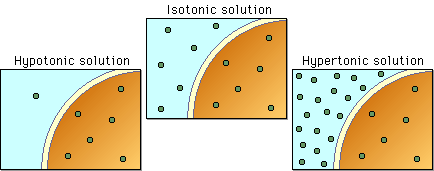
One of the challenges inherent in a marine lifestyle is in maintaining an internal balance against external osmotic pressures. Cell membranes are permeable to water, and water tends to flow from areas of low ion concentration to areas of high ion concentration (which is called ‘osmosis’). Though the cell is incredibly complex, from an osmotic perspective it is basically a small sack of water with some ions in it. If cells aren’t isosmotic (i.e. containing the same concentrations of ions) to the surrounding environment, then water will flow across a cell membrane. Depending on the relative ionic concentration of the cell to the environment, water may flow either into or out of a cell. Either way, this water flow is bad for the organism and may result in cells shriveling up or bursting.

The dissemination of science follows the conventional route of rigorous peer-review followed by publication in an accredited scientific journal. This process has been the standard foundation from which the general public can trust that the science is, at the very least, valid and honest. Of course this system is not without its flaws. Scientific papers of questionable authority, dishonest methodology, or simply flawed design frequently make it through the gates of peer-review. Politically charged papers possess strong biases and many high impact journals favor sexy or controversial topics.
Beyond the conventional route of peer-review, there exist a vast accumulation of gray literature – conference reports, technical notes, institutional papers, various articles written for specific entities that enter into general circulation without the filter of peer-review. Much of gray literature is valid, robust science, but much of it is not. The challenge is that sometimes gray literature is the only science available.
In case anyone was under the impression that the Gulf of Mexico oil spill is over just because the well has been closed, it isn’t.
We continue to maintain our Gulf of Mexico Oilspill Page and will soon be adding a post-spill section to cover the ongoing effort in the Gulf.

Overfishing is most often implicated as the cause of decreasing fish stocks and that makes a lot of logical sense if you’ve ever seen a large commercial trawler unload its catch. But there very well might be another force at work in the precipitous decline in fish stocks worldwide: pollution. The basic premise is that it takes resources to deal with pollutants that normally would be given to growth and reproduction. Through polluting the ocean, we have selected for the fish individuals that can most effectively divert those resources, inadvertently also selecting for smaller fish that reproduce less. That has huge implications for the fish’s population dynamics and potentially total fish stock. More details below the fold…
Read More “A recipe for the evolution of smaller fish stocks?” »
The stereotype of a scientific diagram is a complex, dry, boring graph. While many earn this reputation, a few make can make people do a double-take. Most of these explain research methods involving live animal test subjects. A few of my favorites are shown below.
It is important to note that these images do not show animal abuse of any kind. All of the experimental procedures shown below were approved by Institutional Animal Care and Use Committees because they are the best way to answer important questions about these animals. They were carried out by highly respected professional scientists, and some led to breakthroughs that change how we think about the natural world. They also happen to be quite funny if you view them out of context.
Read More “Great diagrams of science: What are they doing to those animals?” »
Humans, we are fragile creatures. We bend and break and tear. Lacking a rigid exoskeleton, dense armored plates, calcium carbonate shells, our skin becomes our first line of defense against a hostile, machete-filled world. Fortunately, while we do break, we can also heal ourselves through a wonderfully complex system of self-repair.
As stated earlier, this is not a medical blog and we have limited experience discussing medicine. For more detailed and experienced medical blogging, please check out two of my favorite medical blogs, Science-based Medicine and White Coat Underground. Over the next few weeks, I’ll be liveblogging my body’s own healing process as I recover from a machete blow to the head.
The physiology of wound healing and scar formation in the human body is a complicated and fascinating.
Read More “The Way We Heal – the biology of scar formation” »
Those of you following me on twitter have probably heard that I had a little accident this weekend. And by “little accident”, I mean I got hit in the head with a machete. And by “got hit in the head” I really mean hit myself in the head while clearing brush. This has afforded me two opportunities: the first was the chance to see my own skull (how often does that happen?) and the second was the chance to document the healing process.
We don’t do a lot of medical blogging, primarily because we’re not in a medical field. There are excellent resources out there if you’re interested in medical blogging – Science-based Medicine and White Coat Underground are my favorite.
Below the fold are some rather tame pictures (but perhaps disturbing if you don’t like a little gore) of my head, post stitches. Sadly I was not in the right mindset to get a good picture of the injury before repair.