Skip to content

Southern Fried Science

Over 15 years of ocean science and conservation online

  • Home
  • About SFS
  • Authors
  • Support SFS

Category: Science

Chemistry of the Great Big Blue: Nutrients

Posted on September 7, 2010September 7, 2010 By Bluegrass Blue Crab 1 Comment on Chemistry of the Great Big Blue: Nutrients
Science

The Great Big Blue looks like it contains nothing but water and maybe a little salt, especially out in the open ocean. However, this kind of sparse environment is exactly where the chemistry matters the most – it’s a fine line between not enough, too much, and just right. Given this, there’s no distinct myth here but an underlying unresolved question: what is the limiting factor that keeps the open ocean at low productivity?

Read More “Chemistry of the Great Big Blue: Nutrients” »

Ocean of Pseudoscience Shorty – Sharks and Cancer

Posted on September 6, 2010September 7, 2010 By David Shiffman 1 Comment on Ocean of Pseudoscience Shorty – Sharks and Cancer
Science

One of the most prevalent shark myths  is  “sharks don’t get cancer”. This is associated with the more troubling myth that consuming shark cartilage will cure humans of cancer. Despite the success of books with titles like “Sharks don’t get cancer: How shark cartilage could save your life” and “Sharks still don’t get cancer: The … Read More “Ocean of Pseudoscience Shorty – Sharks and Cancer” »

Greenwashing – Is there really a sustainable Orange Roughy fishery?

Posted on September 6, 2010September 13, 2010 By Andrew Thaler 9 Comments on Greenwashing – Is there really a sustainable Orange Roughy fishery?
Conservation, Science

Wandering through the grocery store the other day, I noticed something strange in the fish bin. Now, in general I’m pretty conscious of where my fish comes from, how it was caught, whether the fishery as a whole or the specific population is sustainable. I pay attention to those details and I can usually tell when a company’s branding is legitimate and when it’s just greenwashing.

Imagine my shock when I found a packet of Orange Roughy, sold by the Full Circle brand, and marketed as sustainable.

Read More “Greenwashing – Is there really a sustainable Orange Roughy fishery?” »

Chemistry of the Great Big Blue: Metals

Posted on August 31, 2010August 31, 2010 By Bluegrass Blue Crab 1 Comment on Chemistry of the Great Big Blue: Metals
Science

The ocean is full of metals and minerals that naturally occur such as zinc, copper, and cobalt and many marine organisms therefore depend upon access to those metals in small concentrations. However, inshore marine systems receive inputs from industrial, mining, and stormwater runoff that far exceed what these organisms can use. So what’s the effect?  There was recently a good review article by Mayer-Pinto et al describings the effects of these metals at the assemblage level that basically did my job for me, research-wise, covering both marine and freshwater systems.

Read More “Chemistry of the Great Big Blue: Metals” »

Death of a dinosaur: WhySharksMatter attends a loggerhead sea turtle necropsy

Posted on August 27, 2010 By David Shiffman 5 Comments on Death of a dinosaur: WhySharksMatter attends a loggerhead sea turtle necropsy
Science

Those of you who follow me on Twitter know that I recently was allowed to participate in a unique scientific and educational opportunity- my Tetrapod Biology class and I attended the necropsy of a large Loggerhead Sea Turtle. For those of you unfamiliar with the term, a necropsy is basically an autopsy for animals. The goal is to figure out why the animal died, information which can hopefully be used to protect the rest of the species in the future. Since this species is considered “Threatened” under the Endangered Species Act, this information is particularly valuable.

Many factors contributed to population declines among Loggerheads. Like sharks, they are slow growing, which makes it difficult for their numbers to quickly rebound. I’ve heard a range of numbers, but according to the National Marine Fisheries Service, they reach reproductive maturity around 35 years of age. Turtle populations have  historically taken a big beating from shrimp trawling (the turtles used to get caught in the nets and drown), but the invention of the Turtle Excluder Device has helped on this front. These animals use the beach to lay their eggs, which are vulnerable to anthropogenic disturbance (beach nourishment, riding ATV’s on beaches, poaching, etc). Artificial lighting along the beach can also distract hatchlings, which are used to crawling in the direction of the light to reach the relative safety of the oceans. Since the temperature of the beach determines what sex the turtle will become, they are also threatened by global climate change.

It is extremely important to put the photos you are about to see into their proper context- they show a team of trained professionals who care very deeply about sea turtles using the latest scientific and medical techniques to figure out what happened to an already-dead turtle. They do not show animal abuse of any kind. Some are quite graphic and if such things bother you  I’d advise against reading further.

Note: All photos were taken by me

Read More “Death of a dinosaur: WhySharksMatter attends a loggerhead sea turtle necropsy” »

The Sierra Club Presents: WhySharksMatter!

Posted on August 24, 2010 By David Shiffman 2 Comments on The Sierra Club Presents: WhySharksMatter!
Science

On Thursday, September 2nd at 7:00 P.M., I will be the South Carolina Sierra Club’s Speaker of the Month! The event will be held at MUSC’s Baruch Auditorium, which is 284 Calhoun Street. I have prepared a 45 minute multimedia presentation on shark conservation, followed by a question and answer session. If any of our … Read More “The Sierra Club Presents: WhySharksMatter!” »

Chemistry of the Great Big Blue: Petroleum Byproducts

Posted on August 24, 2010August 31, 2010 By Bluegrass Blue Crab 2 Comments on Chemistry of the Great Big Blue: Petroleum Byproducts
Science

In light of the BP oil spill, this week’s installment of Chemistry of the Great Big Blue will be particularly relevant to current events and hopefully already on the minds of everyone reading. Where do petrochemicals in the marine environment come from other than oil spills? Road runoff, refineries, plastic production, plastic degradation, atmospheric deposition and ocean circulation from other parts of the world, natural seeps, and the list goes on and on. It is important to note, however, that oil spills are not necessarily the predominant source of petrochemicals.  So what exactly is a petrochemical and what does it do?

Read More “Chemistry of the Great Big Blue: Petroleum Byproducts” »

Tyrone Hayes, Atrazine, Syngenta, and a little DMX

Posted on August 18, 2010August 18, 2010 By Andrew Thaler 28 Comments on Tyrone Hayes, Atrazine, Syngenta, and a little DMX
Popular Culture, Science

Dr. Tyrone Hayes is a professor of Biology at UC Berkley who has been at the forefront of some groundbreaking research into the developmental effects of the pesticide Atrazine on amphibians and mammals. Dr. Hayes runs the Atrazinelovers homepage, a site dedicated to educating the public about the effects of the pesticide on our environment and human health. His research and outreach have earned him the ire of many in the pesticide industry, especially from Syngenta, the company that manufactures Atrazine. The Oyster’s Garter provides a good introduction to his research here.

Below is a video of one of his talks, summarizing his research:

Read More “Tyrone Hayes, Atrazine, Syngenta, and a little DMX” »

Chemistry of the Great Big Blue: Plastics

Posted on August 17, 2010August 31, 2010 By Bluegrass Blue Crab 2 Comments on Chemistry of the Great Big Blue: Plastics
Science
thanks surfrider.org

From the microscopic to the gigantic, plastic debris has plagued our oceans since its invention. Much of the problem originated initially because we didn’t realize that plastics don’t degrade until after we had dumped tons into the ocean, largely off of ships as trash. WHOI offers a good summary of the history of plastic pollution. Many things changed since that first realization and the nature of plastics in the marine environment has a very different face nowadays.

The plastic is smaller and more widely distributed. There are fairly well-known areas that collect the plastics such as the Great Pacific Garbage Patch.  There are also other areas affected that are closer to shore and where people use marine resources. Plastic often settles in seagrass beds that serve as important nursery habitat and on beaches where turtles and shorebirds mistake them for food and nesting material. Need more details on plastic?

Read More “Chemistry of the Great Big Blue: Plastics” »

An Ancient Sea Monster’s Fearsome Fins

Posted on August 11, 2010 By Andrew Thaler 8 Comments on An Ancient Sea Monster’s Fearsome Fins
Science

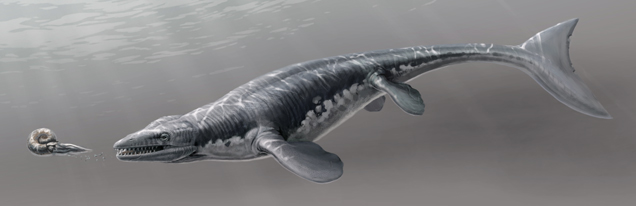
During the Cretaceous, the oceans were ruled not by sharks or aquatic mammals, but by large, predatory marine reptiles. Among these, the dominant ocean predator was the Mosasaur. Mosasaurs emerged in the Early Cretaceous from a lizard-like ancestral squamate. They thrived in warm, shallow seas. Some species could reach up to 17 meters in length. Like modern marine mammals, they breathed air yet had an entirely aquatic life history. Unlike sea turtles and other modern marine reptiles, they gave birth to live young in the water, instead of building nests on land.

Illustration by Stephanie Abramowicz, Dinosaur Institute, Natural History Museum of Los Angeles County

Read More “An Ancient Sea Monster’s Fearsome Fins” »

Posts pagination

Previous 1 … 66 67 68 … 81 Next

Popular Posts

Shark scientists want their research to help save threatened species, but don’t know how. Our new paper can help.Shark scientists want their research to help save threatened species, but don’t know how. Our new paper can help.December 1, 2025David Shiffman
What Ocean Ramsey does is not shark science or conservation: some brief thoughts on "the Shark Whisperer" documentaryWhat Ocean Ramsey does is not shark science or conservation: some brief thoughts on "the Shark Whisperer" documentaryJuly 2, 2025David Shiffman
Norway and Cook Islands put their deep-sea mining plans on pause.Norway and Cook Islands put their deep-sea mining plans on pause.December 3, 2025Andrew Thaler
What is a Sand Shark?What is a Sand Shark?November 12, 2017Chuck Bangley
Mermaids: The New Evidence is a Fake DocumentaryMermaids: The New Evidence is a Fake DocumentaryMay 28, 2013Andrew Thaler
Build a dirt cheap, tough-as-nails field computer in a Pelican caseBuild a dirt cheap, tough-as-nails field computer in a Pelican caseJuly 21, 2015Andrew Thaler
What can the funniest shark memes on the internetz teach us about ocean science and conservation?What can the funniest shark memes on the internetz teach us about ocean science and conservation?November 8, 2013David Shiffman
Breaking News! "Most Comprehensive Estimate of Mortality": Between 63 and 273 Million Sharks Killed Each YearBreaking News! "Most Comprehensive Estimate of Mortality": Between 63 and 273 Million Sharks Killed Each YearMarch 1, 2013David Shiffman
10 fish weirder than the fish in the 10 weirdest fish in the world list10 fish weirder than the fish in the 10 weirdest fish in the world listDecember 18, 2013Guest Writer
Shark of Darkness: Wrath of Submarine is a fake documentaryShark of Darkness: Wrath of Submarine is a fake documentaryAugust 10, 2014Michelle Jewell
Subscribe to our RSS Feed for updates whenever new articles are published.

We recommend Feedly for RSS management. It's like Google Reader, except it still exists.

Southern Fried Science

  • Home
  • About SFS
  • Authors
  • Support SFS


If you enjoy Southern Fried Science, consider contributing to our Patreon campaign.

Copyright © 2025 Southern Fried Science.

Theme: Oceanly Premium by ScriptsTown