The extent of migration among populations drives population structure. With enough migration, populations become homogeneous and behave as a single larger population. As migration rates decrease, populations drift apart and become differentiated. By measuring the amount of differentiation, we can determine the extent of migration between them. But what happens when there are unsampled populations also exchanging migrants?
Category: Science
Charlie helps WhySharksMatter measure a pregnant bonnethead shark by using himself for scale. This bonnethead is fully grown.
An awesome short introduction to how celestial navigation works. Hat tip: @SEA_Cramer (which happens to be my very favorite tall ship) ~Southern Fried Scientist
Welcome to the 33rd Edition of Scientia Pro Publica. Food – Input and Output The Agricultural Biodiversity Weblog asks “Why are there no perennial grain crops?” Meanwhile, on the consumption side of agriculture, Akshatrathi looks into the details of molecular gastronomy. Finally, The Rational Conservationist looks at revolutionary techniques in hazardous waste mitigation. I need … Read More “Scientia Pro Publica 33” »

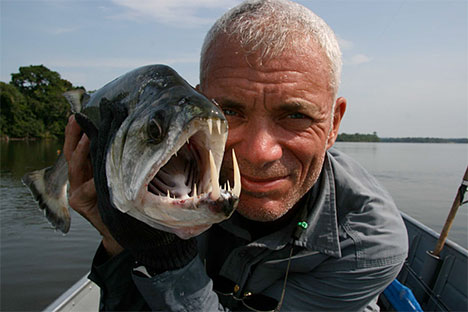
Over Memorial Day weekend, Animal Planet aired a marathon of it’s new hit show “River Monsters”. The show focuses on self-described “biologist and extreme angler” Jeremy Wade’s attempt to find some of the largest freshwater fish on Earth. I’ve heard good things about the show in the past but had never seen it before. After discovering that there were two episodes that dealt with bull sharks, and I immediately DVR-ed them to make sure I didn’t miss anything. I was absolutely shocked at what I heard Jeremy Wade say about sharks:
“In 2002, ocean explorer Gale Mead was the first person to see and film the profusion of life 200 feet down on Salt Dome Seamount — just 16 miles from where the BP oil well is now gushing out of control. Mead (daughter of oceanographer Sylvia Earle) describes the corals and fish she saw and … Read More “Off The Deep End – Oil From the BP Well Threatens Life on a Nearby Seamount” »
A while back I reviewed the many seafood guides and the various ways they rank seafood choices. They do share one thing in common, however, and that’s the special denotation of certain species as hazardous to human health because of toxin load. Specifically, high levels of mercury and PCBs as found by an Environmental Defense study.
First, kudos to EDF for making their data have immediate impact. Other studies of toxins in fish have sat around for literally decades before becoming part of the mainstream discourse about fisheries. But it does beg the question, what makes mercury and PCBs so important among the myriad toxins in our oceans and our seafood?
Last week, I wrote about National Geographic’s Expedition Great White. In that post, I mentioned that the practice of removing great white sharks from the water for research was controversial, and that I would ask the lead scientist in the show about it. Here are answers to my questions from Dr. Michael Domeier and his colleague Nicole Lucas. They also wanted me to point out that their website has an FAQ page about this technique, which can be found here.
Read More “Expedition Great White: A response from Dr. Michael Domeier” »