Skip to content

Southern Fried Science

Over 15 years of ocean science and conservation online

  • Home
  • About SFS
  • Authors
  • Support SFS

Category: Uncategorized

Vote for me in the blogging scholarship and support our shark conservation research!

Posted on November 17, 2011December 9, 2011 By David Shiffman 4 Comments on Vote for me in the blogging scholarship and support our shark conservation research!
Uncategorized

Yesterday, I asked for your support and vote in the 2011 Blogging Scholarship. Since that time, over 7,000 of you have voted for me, and as of this writing, I am in the lead! Thanks for your help and encouragement. Andrew announced earlier today that for every day I’m in the lead, he’ll post an embarrassing picture of me. For many of you, that’s incentive enough to vote for me. However, I also want to tell you what I would use the $10,000 scholarship for if I won.

In addition to boring stuff like tuition, supplies, and travel support, for my own dissertation (assessing the ecological importance of sharks to coral reefs) , I will use the money to support our lab’s ongoing shark conservation research. My lab, the RJ Dunlap Marine Conservation Program at the University of Miami, has many shark research projects taking place. Yesterday, some of that research was used by the Florida Fish and Wildlife Conservation Commission as background in their decision to make hammerheads (great, smooth, and scalloped) and tiger sharks protected species in Florida waters- a proud moment for us and for the Abess Center for Ecosystem Science and Policy, which we are affiliated with.

Read More “Vote for me in the blogging scholarship and support our shark conservation research!” »

Blogging Scholarship – what’s in it for our readers

Posted on November 17, 2011December 9, 2011 By Andrew Thaler 2 Comments on Blogging Scholarship – what’s in it for our readers
Uncategorized

You love us, I know. You want to David Shiffman win a $10,000 scholarship to help fund his education. But clicking a link, then clicking a radio button, then clicking another link is a commitment. It requires work. You deserve to be rewarded for you efforts and I’m happy to oblige. You see, I’ve know … Read More “Blogging Scholarship – what’s in it for our readers” »

2011 Blogging Scholarship: Please vote for me!

Posted on November 16, 2011December 9, 2011 By David Shiffman 1 Comment on 2011 Blogging Scholarship: Please vote for me!
Uncategorized

The finalists for the 2011 blogging scholarship were announced last night, and I’m thrilled to announce that I made the list! The scholarship provides $10,000 towards education and research expenses to the winner. Voting opened last night, and continues until November 23rd. Please consider voting for me! You can see a list of all the … Read More “2011 Blogging Scholarship: Please vote for me!” »

Happy Hagfish Day!

Posted on October 19, 2011 By Andrew Thaler
Uncategorized

It’s finally here, that momentous day where, once a year, we come together to celebrate the strange, weird, gross, and outright ugly in the animal kingdom. It’s Hagfish Day! Check out WhaleTimes for some outstanding educational material on the beauty of the ugly, including an interview with yours truly on a pair of exceptionally cool … Read More “Happy Hagfish Day!” »

The Importance of Word Choice: Terms with multiple meanings for scientists and the public

Posted on October 18, 2011January 10, 2024 By Andrew Thaler 18 Comments on The Importance of Word Choice: Terms with multiple meanings for scientists and the public
The Importance of Word Choice: Terms with multiple meanings for scientists and the public
Uncategorized

If you haven’t seen the excellent post on Mountain Beltway – Words matter – you should head over there and take a look. The post brought up some interesting ideas about word choice, and how the common definition of a word may convey a different meaning than the scientific definition. For science communicators, this may lead to confusion … Read More “The Importance of Word Choice: Terms with multiple meanings for scientists and the public” »

The Curse of Gold: Dimensions of Injustice in Gold-Mining Communities

Posted on October 11, 2011October 5, 2011 By Bluegrass Blue Crab
Uncategorized

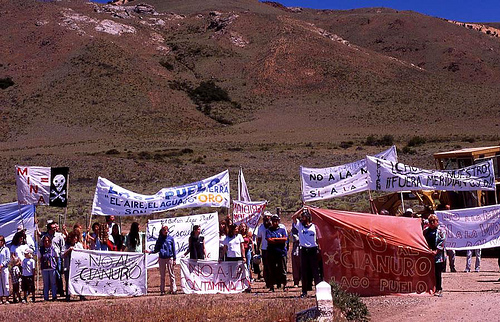
Protests at Esquel, one of the communities examined in the article. Thanks articles.riderdownload.com

Buried within the depths of Andean geology lie small seams of gold tempting worldwide investors. These money-lined pockets aid the development of new extraction methods that dissolve gold from the mountains using cyanide. Cyanide is a metabolic poison, shutting down cellular respiration. In the wake of cyanide leaching stand piles of rubble and contaminated rivers where forested mountains and their people once stood. Surprisingly, Andean residents are willing to entertain the possibility of gold mining by this poisonous method, but oppose current mine development on environmental justice measures. A recent study by Urkidi and Walter in the journal Geoforum documents the emergence of justice narratives from mining conflicts in the Andes and predicts impacts on future development planning.

Read More “The Curse of Gold: Dimensions of Injustice in Gold-Mining Communities” »

Misunderstood Marine Life #2 – moray eels

Posted on October 7, 2011October 7, 2011 By David Shiffman
Uncategorized

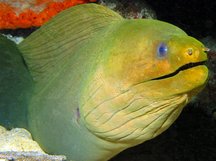
Image courtesy ReefGuide.org

Since they are typically observed hiding in dark crevices while opening and closing their mouths in an apparently menacing gesture, it isn’t surprising that moray eels get a bad reputation. The fact that their sharp teeth face backward (causing severe damage to anyone trying to pull their hand out of a moray’s mouth) doesn’t help this reputation, and neither does the recent discovery that morays have a second set of “Alien”-like jaws that drags prey deep into their mouth and throat. The truth isn’t quite so simple. Most people know very little about these amazing animals.

The green moray (pictured above) is the most famous member of this group, but there are more than 200 species in the family Muraenidae.  Green morays are not even really green (a yellow mucus deposited on a dark body creates the illusion of green skin). Snyder’s morays are less than a foot long when full grown, while giant slender morays can reach lengths of over 10 feet. Morays live in an impressive variety of habitats, including temperate and tropical seas, depths of several hundred meters, and even freshwater.

Read More “Misunderstood Marine Life #2 – moray eels” »

Deep Fried Sea: Here be dragons

Posted on October 7, 2011October 1, 2011 By Andrew Thaler
Uncategorized

Pseudoscience Redux: Greenwashing – Is there really a sustainable Orange Roughy fishery?

Posted on October 6, 2011October 4, 2011 By Andrew Thaler 6 Comments on Pseudoscience Redux: Greenwashing – Is there really a sustainable Orange Roughy fishery?
Uncategorized

This post was originally published on September 6, 2010 as a part of our first Week of Ocean Pseudoscience. Enjoy!


Wandering through the grocery store the other day, I noticed something strange in the fish bin. Now, in general I’m pretty conscious of where my fish comes from, how it was caught, whether the fishery as a whole or the specific population is sustainable. I pay attention to those details and I can usually tell when a company’s branding is legitimate and when it’s just greenwashing.

Imagine my shock when I found a packet of Orange Roughy, sold by the Full Circle brand, and marketed as sustainable.

Read More “Pseudoscience Redux: Greenwashing – Is there really a sustainable Orange Roughy fishery?” »

10 Myths About Social Science

Posted on October 6, 2011October 13, 2011 By Bluegrass Blue Crab
Uncategorized

Over the last couple of years of doing social science research at a marine laboratory, I’ve heard any number of comments about the social sciences that are rooted in a fundamental misunderstanding of the culture of a different (and relatively new) discipline. In a broader context, the Social Science, Behavior, and Economics (SBE) directorate of NSF was recently under fire and threatened to be cut entirely from NSF for ‘not being a science’. Under the umbrella of Ocean of Pseudoscience Week, I’m going to tackle some of those myths.

10. Social scientists hide the fact that they have nothing to say in impenetrable jargon.

Admittedly, many social science journals are filled with jargon and complicated theory that are impenetrable by anyone outside the discipline. Part of this is due to the fact that most social sciences are still in the young, growing stages – and this means theory-building. We’re creating new words to describe never-before-described phenomena and deciding which of those terms will work for future discussion on the matter. Many pages of our journals are therefore filled with dense social theory terms as people make tiny contributions to big understanding of the way society functions. On the flipside, there are a few journals and other outlets (such as blogs like this one) for a translated version, lots of times for policymakers, that offer easy-to-understand conclusions and empirical examples.

Furthermore, to defend our use of unfamiliar vocabulary, I’d like to point out that I never heard of the discipline ‘geography’ until I arrived in graduate school, even though that’s a field with which I largely identify today. It’s due to my particular educational history, but I’m sure I’m not alone, as geography is disappearing in secondary and higher education. In fact, up until college with its distinct disciplines physically separated on campus, “social studies” – the one class – is meant to cover all the social sciences, history, and many others in one fell swoop. I’d argue that the reason people find social scientists full of jargon is that they haven’t received the basic education they deserve that helps them understand the lingo of other disciplines.

Read More “10 Myths About Social Science” »

Posts pagination

Previous 1 … 44 45 46 … 120 Next

Popular Posts

Getting a sense of porpoiseJanuary 20, 2009Andrew Thaler
This is the worst academic presentation in the world ... tributeApril 23, 2015Chris Parsons
That's not a blobfish: Deep Sea Social Media is Flooded by AI SlopThat's not a blobfish: Deep Sea Social Media is Flooded by AI SlopDecember 19, 2025Andrew Thaler
Have we found the city of Atlantis?Have we found the city of Atlantis?September 1, 2026Chris Parsons
What Ocean Ramsey does is not shark science or conservation: some brief thoughts on "the Shark Whisperer" documentaryWhat Ocean Ramsey does is not shark science or conservation: some brief thoughts on "the Shark Whisperer" documentaryJuly 2, 2025David Shiffman
The 45 most influential female ecologists alive today according to twitterThe 45 most influential female ecologists alive today according to twitterFebruary 10, 2014Guest Writer
Ethical Debate: Killing sharks for science?Ethical Debate: Killing sharks for science?June 1, 2010David Shiffman
No, harassing a shark for fun is not ethically equivalent to scientific research that helps conserve a speciesNo, harassing a shark for fun is not ethically equivalent to scientific research that helps conserve a speciesMarch 26, 2014David Shiffman
Our favorite sea monsters – Ningen (#4)Our favorite sea monsters – Ningen (#4)September 7, 2010Andrew Thaler
Shark of Darkness: Wrath of Submarine is a fake documentaryShark of Darkness: Wrath of Submarine is a fake documentaryAugust 10, 2014Michelle Jewell
Subscribe to our RSS Feed for updates whenever new articles are published.

We recommend Feedly for RSS management. It's like Google Reader, except it still exists.

Southern Fried Science

  • Home
  • About SFS
  • Authors
  • Support SFS


If you enjoy Southern Fried Science, consider contributing to our Patreon campaign.

Copyright © 2026 Southern Fried Science.

Theme: Oceanly Premium by ScriptsTown