Skip to content

Southern Fried Science

Over 15 years of ocean science and conservation online

  • Home
  • About SFS
  • Authors
  • Support SFS

Everything is Crabs: How many crabs do you need to land on the moon?

Posted on March 15, 2024March 15, 2024 By Andrew Thaler
Education, Featured, Science

In 2011, researchers from Japan and the Center for Unconventional Computing in the UK asked one of the most important questions ever asked. How many crabs do you need to build a computer?

And then, they answered it.

  • Nishiyama Y, Gunji Y-P, & Adamatzky A (2012) Robust Soldier Crab Ball Gate. https://doi.org/10.48550/arXiv.1204.1749

If you want to build a computer from scratch, you must first invent a logic gate. Using soldier crabs, which have fairly predictable behavior, they were able to model a very reliable OR gate and a reasonably unreliable AND gate. It took 80 crabs to make one logic gate work. A working logic gate gets you a bit. 8 bits gets you a byte.

A carcinized computer runs on 640 crabs per byte.

For comparison, the Apollo Guidance Computer, which landed humans on the moon, had the equivalent of about 72 kilobytes. That works out to roughly 46 million crabs needed to land on the moon. That might seem like a lot, but there were about 152 million female blue crabs in the Chesapeake Bay last year. America’s largest and greatest estuary has the crab processing power of three lunar landers.

Incidentally, while building a computer out of crabs may seem weird, the Apollo Guidance Computer was, itself, a very weird computer. It use rope core memory, which means that the software to run the computer was literally woven, by hand, by looping wires around the core.

Between 2018 and 2021, approximately 10 billion crabs disappeared from the Bering Sea. That’s almost 16 megabytes lost. You need about 16 billion crabs to run Doom.

Models are fun, but we are makers and we are doers and it is simply not enough to sit back and imagine a computer made of crabs. We need to see it.
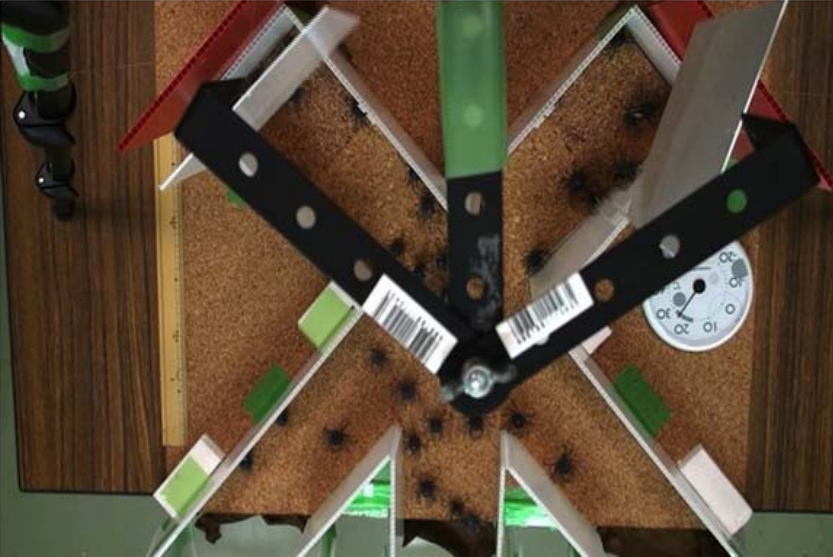
Crabs running towards outputs in the experimental logical gate. Figure from Nishiyama et al. 2013.

They did it. Crab scientists were so preoccupied with whether they could, they didn’t stop to think if they should.

  • Nishiyama Y, Gunji Y-P, & Adamatzky A (2013) Collision-based computing implemented by soldier crab swarms, International Journal of Parallel, Emergent and Distributed Systems, 28:1, 67-74

All of this happened over a decade ago, leaving one to wonder “what’s new in the world of crab computing?” In a much more recent study, researchers, including one member of the original crabputer team, demonstrated that individual soldier crabs will treat small, vibrating crab robots as members of the swarm, offering a tantalizing proposition for a future cybernetic crab difference engine.


Southern Fried Science is free and ad-free. Southern Fried Science and the OpenCTD project are supported by funding from our Patreon Subscribers. If you value these resources, please consider contributing a few dollars to help keep the servers running and the coffee flowing. We have stickers.

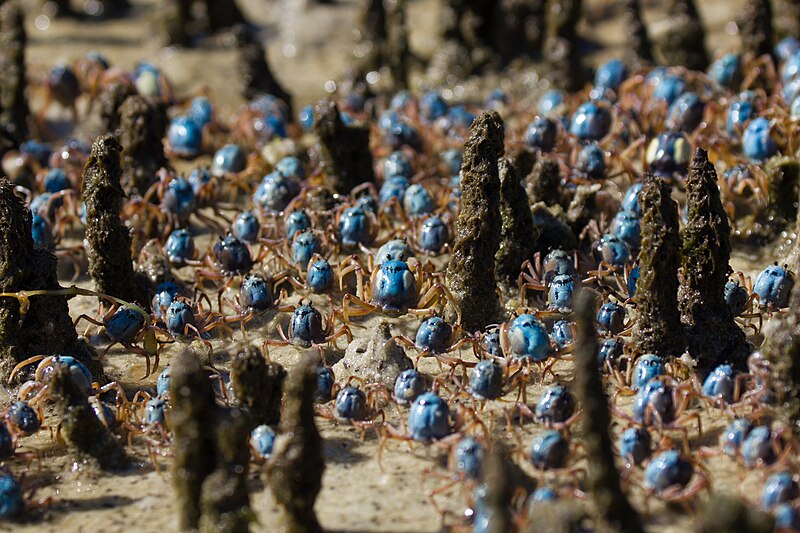
Featured Image: Soldier Crabs marching through a mangrove.

Share this:

  • Click to share on Bluesky (Opens in new window) Bluesky
  • Click to share on Facebook (Opens in new window) Facebook
  • Click to share on Reddit (Opens in new window) Reddit
  • Click to share on Threads (Opens in new window) Threads
  • Click to share on WhatsApp (Opens in new window) WhatsApp
  • Click to share on Mastodon (Opens in new window) Mastodon

Related

Tags: carcinization computers soldier crabs

Post navigation

❮ Previous Post: New Deep-sea Mining Bill Introduced in Congress
Next Post: What I’m watching for at this month’s ISA meeting: How the Council responds to the NORI-D Incident ❯

Popular Posts

Shark scientists want their research to help save threatened species, but don’t know how. Our new paper can help.Shark scientists want their research to help save threatened species, but don’t know how. Our new paper can help.December 1, 2025David Shiffman
Norway and Cook Islands put their deep-sea mining plans on pause.Norway and Cook Islands put their deep-sea mining plans on pause.December 3, 2025Andrew Thaler
What Ocean Ramsey does is not shark science or conservation: some brief thoughts on "the Shark Whisperer" documentaryWhat Ocean Ramsey does is not shark science or conservation: some brief thoughts on "the Shark Whisperer" documentaryJuly 2, 2025David Shiffman
The Trouble with Teacup PigsThe Trouble with Teacup PigsOctober 14, 2012Andrew Thaler
What we know we don't know: impacts of deep-sea mining on whales, dolphins, sharks, turtles, and other migratory species.What we know we don't know: impacts of deep-sea mining on whales, dolphins, sharks, turtles, and other migratory species.November 20, 2025Andrew Thaler
2025: My year in writing, public speaking, and media interviews2025: My year in writing, public speaking, and media interviewsDecember 3, 2025David Shiffman
Urea and Shark OsmoregulationUrea and Shark OsmoregulationNovember 15, 2010David Shiffman
Shark of Darkness: Wrath of Submarine is a fake documentaryShark of Darkness: Wrath of Submarine is a fake documentaryAugust 10, 2014Michelle Jewell
How tiny satellites are tracking marine wildlifeDecember 1, 2025Andrew Thaler
Build a dirt cheap, tough-as-nails field computer in a Pelican caseBuild a dirt cheap, tough-as-nails field computer in a Pelican caseJuly 21, 2015Andrew Thaler
Subscribe to our RSS Feed for updates whenever new articles are published.

We recommend Feedly for RSS management. It's like Google Reader, except it still exists.

Southern Fried Science

  • Home
  • About SFS
  • Authors
  • Support SFS


If you enjoy Southern Fried Science, consider contributing to our Patreon campaign.

Copyright © 2025 Southern Fried Science.

Theme: Oceanly Premium by ScriptsTown