One day, I’ll look back fondly and tell my grandkids about the week I spent flooding the planet. It began as a lark. For the past few months, I’ve been writing installments of a serialized science fiction novel about a world in which the oceans have risen nearly 80 meters and most of the human … Read More “Check out my #DrownYourTown feature at Zócalo Public Square” »
Halloween, in a lot of ways, is a celebration of fear. We dress like ghosts, goblins, and movie serial killers to give ourselves a sense of control over the things we’re afraid of. It’s also a good time of year to indulge in horror movies, where we can watch ghosts, goblins, and serial killers terrorize other people from the apparent safety of our own homes.
From an ecological standpoint, we have it pretty good. We’ve more or less tamed most environments on land and only make short forays into the oceans under conditions where we still have quite a few advantages. Most of the time we have more in common with Jason than his hapless victims. Imagine being a member of a school of menhaden or a seal that has to make daily trips through Shark Alley. It would be like spending your whole life as a camp counselor at Crystal Lake, constantly looking over your shoulder and getting picked off the second you let your guard down. If mortal terror was a regular part of your life, you’d better believe it would affect your daily habits. And if every member of your species lived with that same fear, there would be places no one in their right mind would go and choices between death by starvation and possible death by being eaten. After all, fish are always eating other fish. Let’s take a journey through the low end of the food web and see what horror can teach us about marine ecology.
Read More “Halloween Science: Fear Makes the Ocean Go Around” »
Think about the word ‘ethics’ for a moment. For some, the word creates images of smiling people sitting around a table, the picture of diversity, happily planning a future in which no one is ever taken advantage of. For others, the image may be of nun-like ascetics peering over your shoulder with an armful of paperwork tied together with a pretty bow of red tape. For still others, it’s something heartily discussed in a liberal arts course or late-night dorm philosophizing during doe-eyed college days. In reality, though, practicing ethics is never as clear-cut an image and making ethics part of daily research life is still a distant goal.
Some fields, like genetics and medicine, have had to confront ethical conundrums head-on and consequently, create a precedent for how we think about ethics in a research and institutional context. Sadly, this precedent is full of angry conflict, covering ethical missteps after-the-fact, and millions of dollars worth of lawsuits. This precedent rightfully leaves many people jumpy about addressing ethics head-on, like the proverbial third-rail of program management that no one dare touch for fear of inviting the flak created in these precedent cases. To use another cliched analogy, ethics then becomes the elephant in the room, except this elephant is staring at you over your cubicle wall and periodically sticking its trunk over the wall to search for peanuts. In reality, choosing to not address ethics amounts to consciously deciding to accept whatever emerges organically, whether you like it or not. So what does this mean for less life-or-death fields that work with stakeholders, like the marine sciences? Let’s start with the foundation that’s already laid.
Read More “A Primer on Ethics in the Human Dimensions of Conservation” »
The Fukushima Daiichi nuclear power plant is back in the news, with recent reports of continued leaks. Coming on the heels of these new reports is a viral blog post entitled 28 Signs That The West Coast Is Being Absolutely Fried With Nuclear Radiation From Fukushima. The article is a paranoid, poorly reasoned attempt to link the tragedy of the Fukushima disaster to just about every environmental issue facing the US west coast in the last few months. At its best, it’s an illogical piece of post-modern absurdism. At its worst, its empirically false and intentionally misleading, rife with out-of-context quotes and cherry-picked data. The author had 28 chances to make a single reasonable point, and every single one rang hollow.
Of course it went viral.
Read More “28 fallacies about the Fukushima nuclear disaster’s effect on the US West Coast” »
Fleet is a dystopian maritime adventure in which sea level rise and disease has driven the last survivors of the human race to sea. I’m releasing the story in serials — 3 chapters on the first Monday of each month — on Amazon. Loyal readers who can’t wait for the next installment can slate their thirst with a series of short stories set in the world of Fleet that will be published on Southern Fried Science every few weeks. Please enjoy the third of these distractions, Shut the Box, where we get to learn a little more about a few of my favorite captains and some of the tangled history of the fleet.
“Who gets the first roll?” Captain Binnacle asked as she carried four very full glasses of Gill’s special reserve into the lounge.
“Captain’s prerogative, dear.” Captain Grease-pen was sprawled across the long couch that ran the length of Shellfish Lover’s main room.
“Very well, Windlass, you’re up!” She passed the glasses to her three guests. It was a quiet mid-week night in the fleet, and the four women were gathered for their regular game of shut-the-box. With fuel rations in full effect, it seemed like they were gathering for drinks every night.
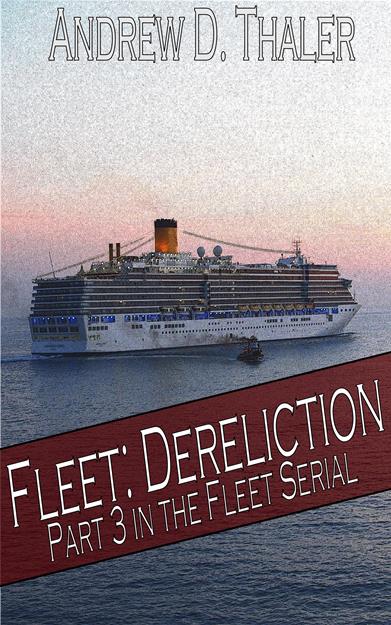
Fleet: Dereliction premiers next Monday! With the fleet split in two and its most valuable ship stolen, the Admiral has to deal with the fallout from the first mutiny in recent memory. Meanwhile, on the other side of the Reach, the trio of mutineers finally discover the dark secret behind a mysterious shipwreck.
This has been my favorite installment to write. You’re going to finally learn the truth about several characters. Motivations will be revealed. Most importantly, the story that’s been hinted out throughout the last two installments will finally be told. This was also may favorite cover to design. There’s a great story behind that image, which I can’t tell yet as it might give away some of the plot.
For almost all of our five year run, Southern Fried Science has had the same three column, blue-background scheme. It’s finally time for the old blog to get a new coat of paint. Welcome to the new, improved Southern Fried Science! We’ve stripped away the bells and whistles that began multiplying on the sidebars in … Read More “Welcome to a shiny new Southern Fried Science” »
Happy Fun Science Friday everyone! After a busy semester I hope to get into the regular groove of Fun Science Friday posts.
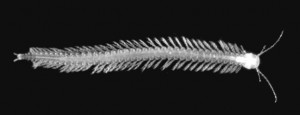
This week I bring you the first and only known venomous crustacean, the remipede Speleonectes tulumensis.

These crustaceans were first discovered in the 1980s and suspected to be venomous after documentation that behind their jaws, they had a pair of sharp, hollow-tipped fangs that were connected to glands. This was a strong indication that the fangs were being used to inject a chemical into prey, though it was never proven…. Until now! Step forward Bjorn von Reumont, from the Natural History Museum in London, whose team thoroughly described the fangs and characterized the cocktail of toxins in the venom of S. tulumensis.
Read More “Happy Fun Science Friday – First Venomous Crustacean” »
On Thursday, October 24th at 9:00 P.M. eastern time, CNN will be airing Blackfish, the critically-acclaimed documentary about orca whale captivity and SeaWorld. Be sure to check out Southern Fried Science’s review (and fact-check) of the film. Blackfish will be followed by a live debate at 11:00 hosted by Anderson Cooper. The debate will feature … Read More “CNN is airing “Blackfish” Thursday at 9. Watch with us and join the live twitter chat!” »
We’ve reached the point in the program where requests for #DrownYourTown are coming in faster than I can process. That’s great! It means people are really connecting with the #DrownYourTown hashtag as a way to bring the concept (if not the specific details) of sea level rise home. The response has been greater than I ever imagined!
So, rather than leave people high and dry (we wouldn’t want that, would we), here is a step by step guide to simulating sea level rise anywhere in the world using Google Earth and a little geographic wizardry. The best part? It can all be done with completely free software.
1. Download Google Earth — you can find it here. Take some time to play around with it. Google packed this free package with some awesome features.
Read More “How to #DrownYourTown: a step by step guide to modeling sea level rise in Google Earth” »