

Flotsam (what we’re obsessed with right now)
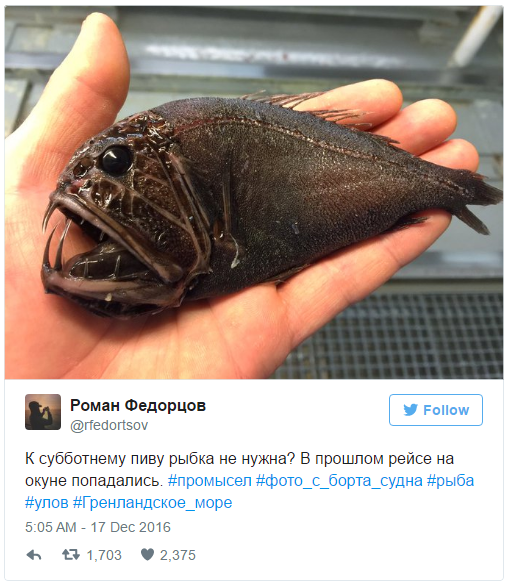
- Roman Fedorsov, a Russian fisherman who posts all the weirdest bycatch from deep-sea trawls to his twitter account.
Jetsam (what we’re enjoying from around the web)
Over 15 years of ocean science and conservation online
Flotsam (what we’re obsessed with right now)

Jetsam (what we’re enjoying from around the web)
We’ve got some small changes and new additions to the growing Southern Fried Science family. Due to their long and consistent commitment to maintaining the blog, Drs. Kersey Sturdivant and Chris Parsons have been promoted to the lofty and prestigious rank of Senior Correspondent. Congratulations! We’re also thrilled to announce the addition of a new … Read More “Small changes and new faces at Southern Fried Science” »
Cuttings (short and sweet):
Read More “Thursday Afternoon Dredging: January 5th, 2017” »
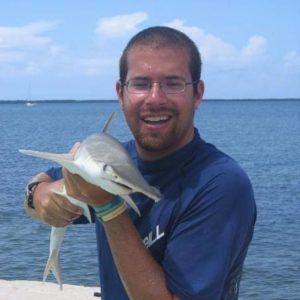
Bonnethead sharks, one of the smallest members of the hammerhead shark family Sphyrnidae, have a special place in my heart. For many years, the avatar I used for science communication efforts, including posts on this blog, was a picture of me with a bonnethead.

These sharks, which can grow up to about 5 feet long, are found throughout North, Central, and South America. However, new research by Fields and friends suggests that they may actually be a species complex, not a true species. “A species complex is a group of distinct species that are incorrectly classified as one species because they look very similar to one another,” explained Dr. Demian Chapman, an Associate Professor of Biology at Florida International University and a co-author on this new study. “A great example is the white spotted eagle ray (Aetobatus narinari) that was once thought to be one, globally distributed species, but now has been shown to be a group of very similar-looking species, each of which lives in a particular region.”
Climate Change is real. It’s happening now. And the best available data points to us as the cause.
That the foundational science is settled is a point of unending frustration to scientists, science writers, and policy advocates who face continuous partisan push back, from whitewashing government websites to threatening scientists with legal repercussions for reporting the data. During my International Marine Conservation Congress keynote last year, I argued that Climate Change denial is not a science literacy problem, but rather a product of increasing political bifurcation. Political ideology is a much stronger predictor of Climate Change understanding than science literacy.
The term “Climate Change” is now loaded with so much political baggage that it becomes almost impossible to hold a discussion across political lines. In stakeholder interviews, people generally understand and acknowledge the impacts of climate change on local and regional scales, as long as you don’t call it “Climate Change”. This has been my experience working in rural coastal communities, which tend to be strongly conservative and intimately connected to the changing ocean.
Which is why, when I talk about Climate Change, I don’t talk about science.
Read More “When I talk about Climate Change, I don’t talk about science.” »
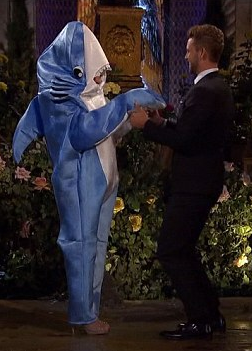
Last night was the premiere of the Bachelor, which is just about the only reality TV show that I do not watch. However, an incident occured on last night’s episode that several of you brought to my attention. Apparently, one of the contestants wore a shark costume for the entire episode…but kept referring to it as a dolphin costume. (While not everyone can reasonably be expected to know the difference between a shark and a dolphin, this contestant stated that she wants to be a dolphin trainer.)
Here is a screenshot:

Read More “Bachelor contestant wears a shark costume and calls it a dolphin costume” »
Welcome to 2017 and the ninth year of marine science and conservation at Southern Fried Science!
Flotsam (what we’re obsessed with right now)

Jetsam (what we’re enjoying from around the web)
As 2016 winds to a close, and in the spirit of the holiday season behold the world’s smallest snowman, measuring in at 3 microns. To put that into perspective, the smallest grains of sands are approximately 60 microns. This creation is the work of Canadian nanotechnologists from the Western Nanofabrication Facility. The snowman is made from … Read More “Fun Science Holidays – The World’s Smallest Snowman” »
Cuttings (short and sweet): Watch how slowly this Greenland shark swims, from a NOAA Okeanos video. These sharks have the slowest swimming speed ever measured in a fish. Follow sawfish conservation expert Dr. Tonya Wiley-Lescher @TonyaRWileyL on twitter! A Florida State research team, with help from our friends at Field School, became the first people … Read More “Thursday Afternoon Dredging: December 29th, 2016” »
Early this December, the National Park Service announced that the Marianas Trench Marine National Monument made the short list for UNESCO World Heritage designation. Though hidden beneath the water’s surface, the Mariana Trench, a unique geologic and ecologic landmark and a natural treasure, dwarfs the Grand Canyon in scale and scope.
The Mariana Trench is more than a mile deeper than Mt. Everest is high and hosts Challenger Deep, the deepest point on Earth. It is also home to numerous sites of exceptional scientific value, including submerged volcanoes that host deep-sea hydrothermal vents, the largest documented mud volcanoes, coral atolls and fringing reef ecosystems that support apex predators like sharks and whales, as well as habitat-forming stony corals.