Skip to content

Southern Fried Science

Over 15 years of ocean science and conservation online

  • Home
  • About SFS
  • Authors
  • Support SFS

Polar bear feast on seabird eggs is reason we can’t have nice things

Posted on September 29, 2015 By Michelle Jewell
Conservation

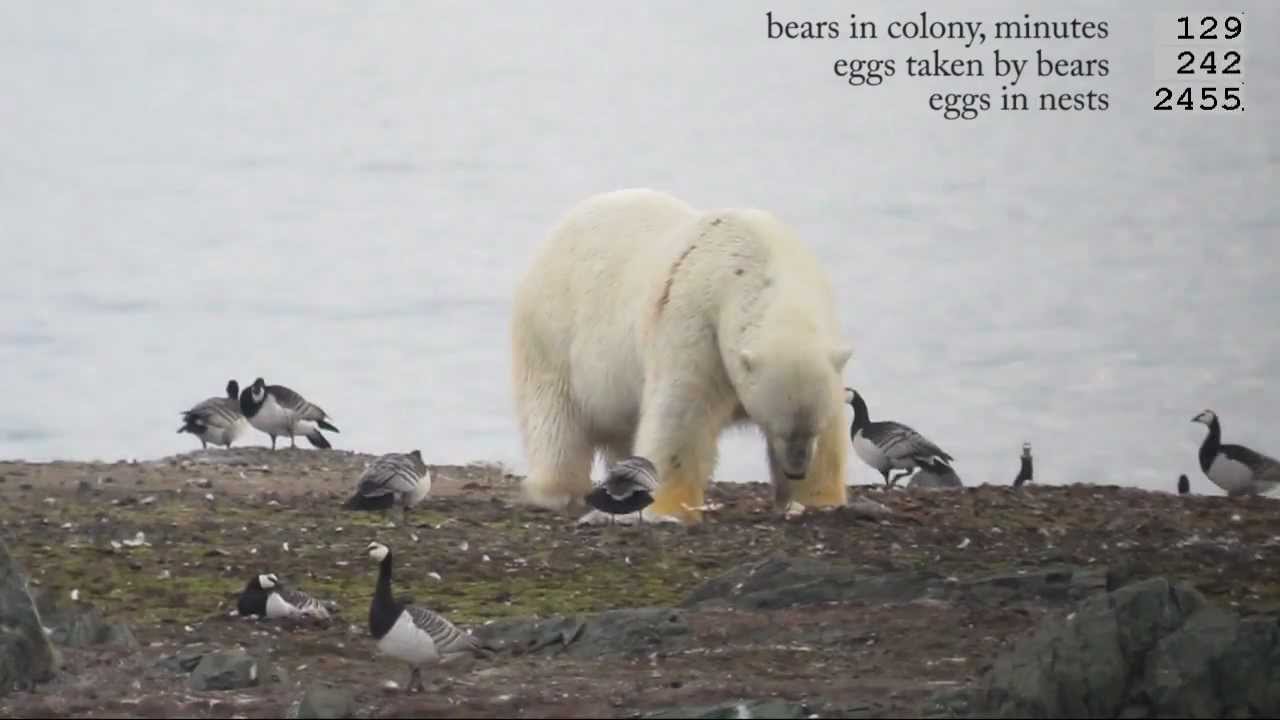
Several images circulate on the internet that capture the plight of rapid Arctic climate change, a phenomenon known as Arctic amplification.  This image, for me, is the most alarming:
polar-bears-eating-eggs
(c) Jouke Prop

No, the polar bear isn’t starving, quite the opposite.  Look closer and you will see a breeding seabird colony that has been completely destroyed.

This bear is part of a growing population at Nordenskiöldkysten, Svalbard that are swapping seal hunts for seabird eggs.  Their intake rates top out at 100 eggs/hr and the bears switch to the chicks if any eggs do survive to hatch.  The bears are arriving earlier to the site every year, a sign that they are sussing out the optimal time to predate on fresh eggs.  Last year (2014) no chicks or eggs of any of the three species that nest at Nordenskiöldkysten (barnacle geese, eiders, and glaucous gulls) survived.  This diet switch is a response to the increasingly early break up of sea ice, a platform polar bears need to hunt seals.

The researchers of this relatively new study were faced with a dilemma when polar bears began to feature in their long-term barnacle geese monitoring project, but made the heartbreaking decision many wildlife biologists do to let nature take its course.  The next few years will determine what will happen to this local seabird population, will they move breeding sites or will their ubiety forsake them?  Monitored seabirds colonies in the Canadian Arctic have also directly observed polar bears at the colony or evidence of their presence (i.e. poop full of shells), too.

Both seabirds and polar bears are declining rapidly and have highly passionate conservation groups/activists behind them.  This is only the first, certainly not the last, of these conservation clashes.  What is the answer?

Share this:

  • Share on Bluesky (Opens in new window) Bluesky
  • Share on Facebook (Opens in new window) Facebook
  • Share on Reddit (Opens in new window) Reddit
  • Share on Threads (Opens in new window) Threads
  • Share on WhatsApp (Opens in new window) WhatsApp
  • Share on Mastodon (Opens in new window) Mastodon

Related

Tags: Arctic amplification climate change Conservation polar bears seabirds Svalbard

Post navigation

❮ Previous Post: Keeping your robot invasions under control.
Next Post: Robots Versus Aliens – Anticipatory conservation in technology-drive initiatives ❯

You may also like

Science
#SciFund Challenge: Culture of Climate Change in French Polynesia
November 9, 2011
Open Science
Fun Science FRIEDay – Water to Wine? Close, CO2 to Alcohol (ethanol)
December 2, 2016
Conservation
Conservation has a Trolley Problem
February 13, 2018
Weekly Salvage
SeaWorld versus OSHA versus Brett Kavanaugh, sea lions and sucker punches, this dumpster whale is all of us, and more! Monday Morning Salvage: October 1, 2018.
October 1, 2018

Popular Posts

How close did the world's first deep-sea mining come to the dredging the world's largest cold-water coral reef?How close did the world's first deep-sea mining come to the dredging the world's largest cold-water coral reef?March 17, 2026Andrew Thaler
What Ocean Ramsey does is not shark science or conservation: some brief thoughts on "the Shark Whisperer" documentaryWhat Ocean Ramsey does is not shark science or conservation: some brief thoughts on "the Shark Whisperer" documentaryJuly 2, 2025David Shiffman
That's not a blobfish: Deep Sea Social Media is Flooded by AI SlopThat's not a blobfish: Deep Sea Social Media is Flooded by AI SlopDecember 19, 2025Andrew Thaler
Urea and Shark OsmoregulationUrea and Shark OsmoregulationNovember 15, 2010David Shiffman
Tangier, an Island out of Time.Tangier, an Island out of Time.July 3, 2017Andrew Thaler
Here's what I teach my students about finding jobs in marine biology and conservationHere's what I teach my students about finding jobs in marine biology and conservationApril 10, 2024David Shiffman
Shark of Darkness: Wrath of Submarine is a fake documentaryShark of Darkness: Wrath of Submarine is a fake documentaryAugust 10, 2014Michelle Jewell
America's Second-Largest Estuary is a Lagoon Full of SharksAmerica's Second-Largest Estuary is a Lagoon Full of SharksApril 12, 2018Chuck Bangley
The story of the pride flag made from NASA imagery: Bluesky's most-liked imageThe story of the pride flag made from NASA imagery: Bluesky's most-liked imageSeptember 27, 2024David Shiffman
Alberta, Canada is the proud owner of the largest man-made pyramid on the planetAlberta, Canada is the proud owner of the largest man-made pyramid on the planetOctober 16, 2012Andrew Thaler
Subscribe to our RSS Feed for updates whenever new articles are published.

We recommend Feedly for RSS management. It's like Google Reader, except it still exists.

Southern Fried Science

  • Home
  • About SFS
  • Authors
  • Support SFS


If you enjoy Southern Fried Science, consider contributing to our Patreon campaign.

Copyright © 2026 Southern Fried Science.

Theme: Oceanly Premium by ScriptsTown