Skip to content

Southern Fried Science

Over 15 years of ocean science and conservation online

  • Home
  • About SFS
  • Authors
  • Support SFS

Tag: anglerfish

How anglerfish hack their immune system to hang on to a mate

Posted on September 18, 2020September 17, 2020 By Andrew Thaler
How anglerfish hack their immune system to hang on to a mate
Science

This article originally appeared in the August/September 2020 issue of the Deep-sea Mining Observer. It is reprinted here with permission. For the latest news and analysis about the development of the deep-sea mining industry, subscribe to DSM Observer here: http://dsmobserver.com/subscribe/

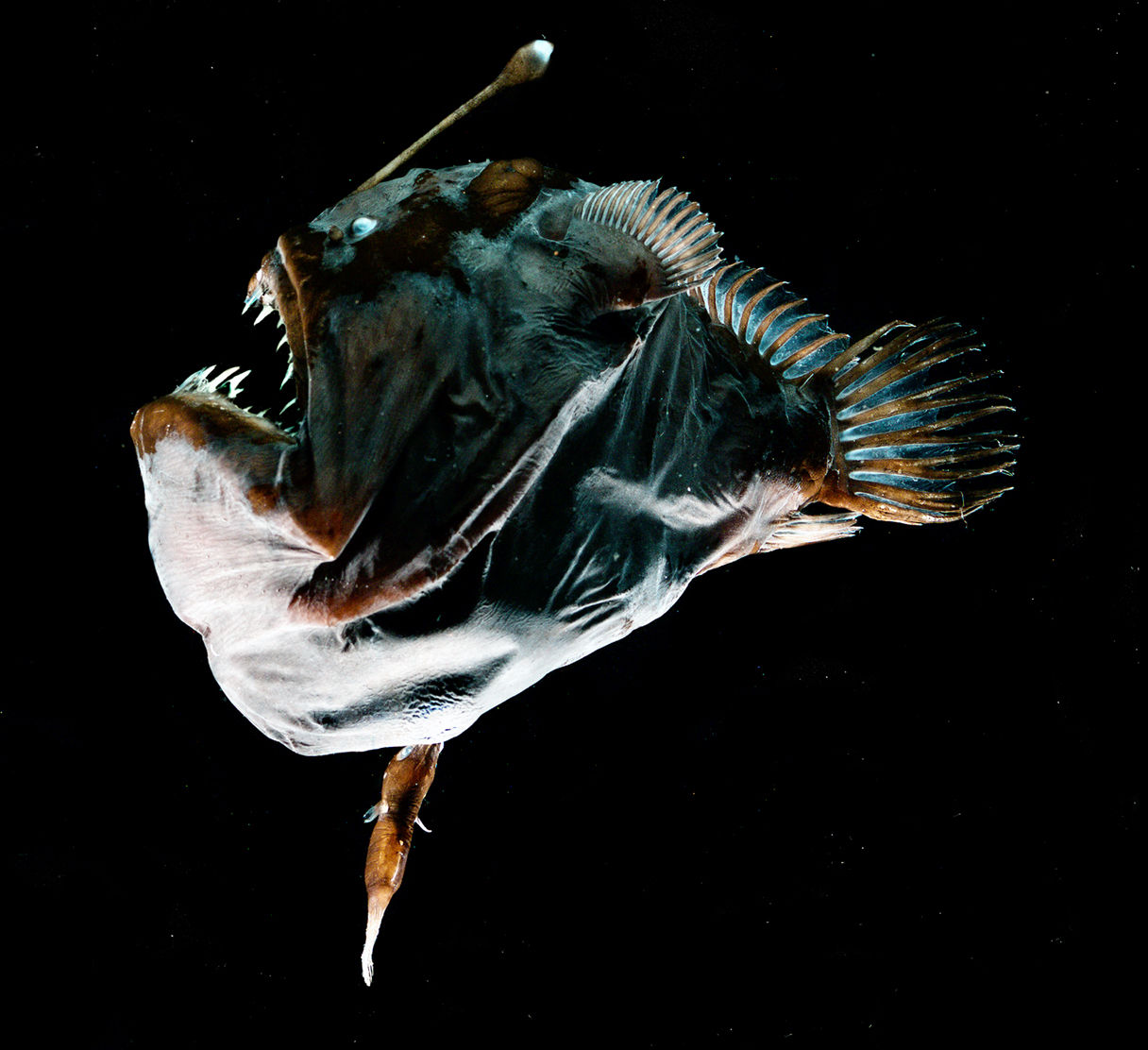
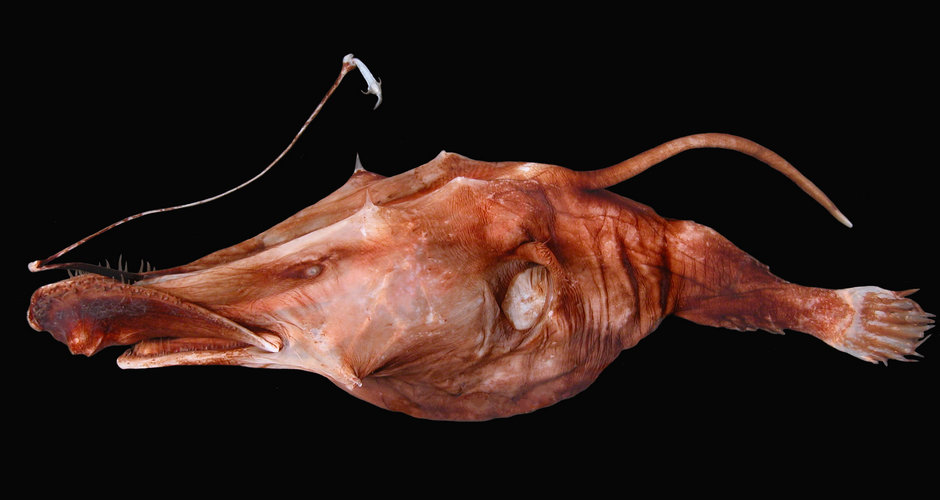
When you live in the darkness of the abyss, finding a partner is hard and keeping a partner is even harder. Deep-sea anglerfish, one of the iconic ambassador species of the deep ocean, have found a novel solution to this problem–dwarf males are sexual parasites that latch onto the body of the much larger female anglerfish and then physically fuse to their partner, becoming permanently attached to the point where they share a circulatory and digestive system. 

Parasitic dwarf males are uncommon, but not unheard of, throughout the animal kingdom. Osedax, the deep sea bone eating worm, also maintains a harem of dwarf males in a specialized chamber in their trunk. But few species, and no other vertebrates, go to quite the extremes of the anglerfish. And with good reason. 

Vertebrate immune systems have a long shared history. The Major Histocompatibility Complex (MHC) is a suite of genes shared among all gnathostomes–the taxonomic group that contains all jawed vertebrates, from fish to fishermen. It creates the proteins which provide the foundation for the adaptive immune system, the core complex which allows bodies to tell self from no-self, detect pathogens, and reject non-self invaders. Suppressing the MHC seriously inhibits a vertebrate’s ability to fight off infection. 

Incidentally, not all deep-sea anglerfish have parasitic dwarf males, and the species most often presented as a type specimen in the popular press, the humpback anglerfish Melanocetus johnsonii, is one of several that do not have permanently attached parasitic dwarf males. M. johnsonii males are free-swimming throughout their life, they’re just small and clingy.

Read More “How anglerfish hack their immune system to hang on to a mate” »
Frisky Anglerfish, Persistent Aquatic Living Sensors, Make for the Planet Borneo, Sea Cucumber Mafia, and more! Monday Morning Salvage: March 26, 2018

Posted on March 26, 2018March 25, 2018 By Andrew Thaler
Weekly Salvage

Foghorn (A Call to Action!)

  • Sign up for Make for the Planet Borneo and help push forward the next generation of conservation technology!
  • Announcing the Con X Tech Prize for Hacking Extinction! Apply for funding to create a working hardware prototype and win up to $20,000 in awards.

Flotsam (what we’re obsessed with right now)

  • This is a totally ordinary, not at all alarming, call for government bidders on a contract to build “new systems that employ natural or engineered marine organisms as sensor elements to amplify signals related to the presence, movement, and classification of manned or unmanned underwater vehicles.” They even adorably call these Persistent Aquatic Living Sensors PALS. Normal!
  • Here’s a video of anglerfish mating, because anglerfish are beauty.
  • This week in science and conservation slowly, awkwardly coming to terms with their racist history: For Decades, Our Coverage Was Racist. To Rise Above Our Past, We Must Acknowledge It and Environmentalism’s Racist History.
  • Scientists in Survival Mode: After a disastrous hurricane season, scientists in the storms’ pathways struggle to return to work.

The Levee (A featured project that emerged from Oceandotcomm)

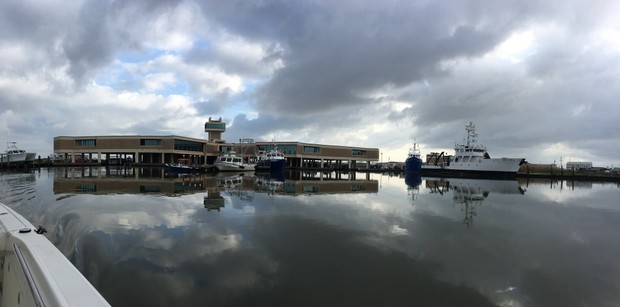
  • Marine lab has ‘front row seat’ to Louisiana coastal loss.

LUMCON by boat
Photo by Melissa Miller

Read More “Frisky Anglerfish, Persistent Aquatic Living Sensors, Make for the Planet Borneo, Sea Cucumber Mafia, and more! Monday Morning Salvage: March 26, 2018” »

Science as graphic novel, baby eels, anglerfish emoji, drone ocean rescue, and more! Monday Morning Salvage: January 22, 2018.

Posted on January 22, 2018January 21, 2018 By Andrew Thaler 1 Comment on Science as graphic novel, baby eels, anglerfish emoji, drone ocean rescue, and more! Monday Morning Salvage: January 22, 2018.
Weekly Salvage

Fog Horn (A Call to Action)

  • The US Government is shut down. This is not great news for science (at the moment, my project to train ROV technicians and deliver 5 – 10 observation-class underwater robots to the Commonwealth of the Northern Mariana Islands is on hold pending resolution). Call you congressperson and give them an earful. Call you senator and give them an earful.

Flotsam (what we’re obsessed with right now)

  • Women Writing About the Wild: 25 Essential Authors: A primer on who to start reading and who you’ve been overlooking for too long.

Nan Shepherd. (Wikimedia Commons)

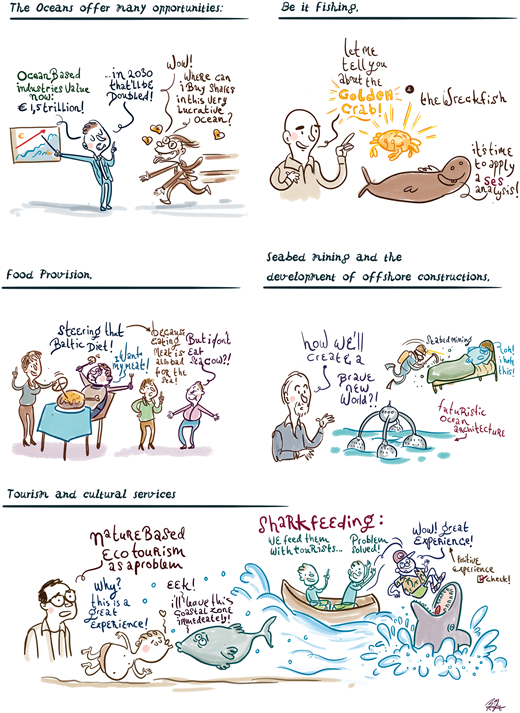
  • This paper: Managing marine socio-ecological systems: picturing the future, which, holy mola, is written in graphic novel format!

Managing marine socio-ecological systems: picturing the future
Managing marine socio-ecological systems: picturing the future.

Read More “Science as graphic novel, baby eels, anglerfish emoji, drone ocean rescue, and more! Monday Morning Salvage: January 22, 2018.” »

Do you see the deep sea?

Posted on November 29, 2016November 27, 2016 By Andrew Thaler
Science

Like this? Support me on Patreon!

Busting Ocean Myths: This anglerfish is not as kink as you think.

Posted on July 28, 2014August 4, 2014 By Andrew Thaler
Science

The claim: Deep-sea Anglerfish have parasitic dwarf males that fuse to their mates and become nothing more than wibbly gonads hanging off of the much larger female. 

Who said it: Well, pretty much everyone. This Oatmeal Comic, Ze Frank, me.

Status: Sometimes true, sometimes false.

Melanocetus johnsonii. Photo by Edith Widder.

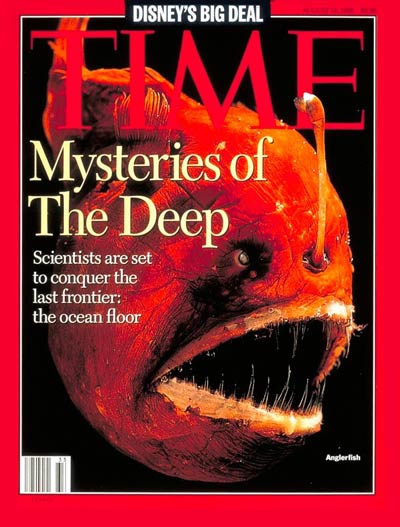
cover-Time-19950814-82066I’d like you to meet a very dear friend of mine. This is Melanocetus johnsonii, the humpback anglerfish. If you follow the deep sea at all, you’ve probably met this delightful creature. She was featured on the cover of time magazine, barely losing out to Newt Gingrich for 1995 Vertebrate of the Year. Since then, she has been a standard-bearer for the deep sea, an iconic species, immediately recognizable. Stories of her exploits abound, and no story is more compelling that the tale of the hapless male anglerfish, a parasitic dwarf that lives its entire adult life fused to the larger, more capable female angler fish.

There’s just one problem.

Melanocetus johnsonii, along with the four other anglerfish that make up genus Melanocetus, don’t have parasitic males. Males of this genus are still significantly smaller and lack lures, but they retain their free-swimming lifestyle into adulthood, occasionally biting into the side of a much larger female for a temporary coupling, where gametes and food are exchanged. This temporary coupling, in which no tissue fusion takes place, has been observed only three times: once during the filming of the BBC Blue Planet documentary; once off the coast of Japan; and once, confusingly between a male Melanocetus johnsonii and a completely different species, Centrophryne spinulosa. In none of these instances was the connection permanent, and no reduced males have even been found attached to a Melanocetus.

Read More “Busting Ocean Myths: This anglerfish is not as kink as you think.” »

The penultimate installment of the incredible biodiversity of Aquaman’s variant cover

Posted on May 9, 2014May 9, 2014 By Andrew Thaler
Popular Culture, Science

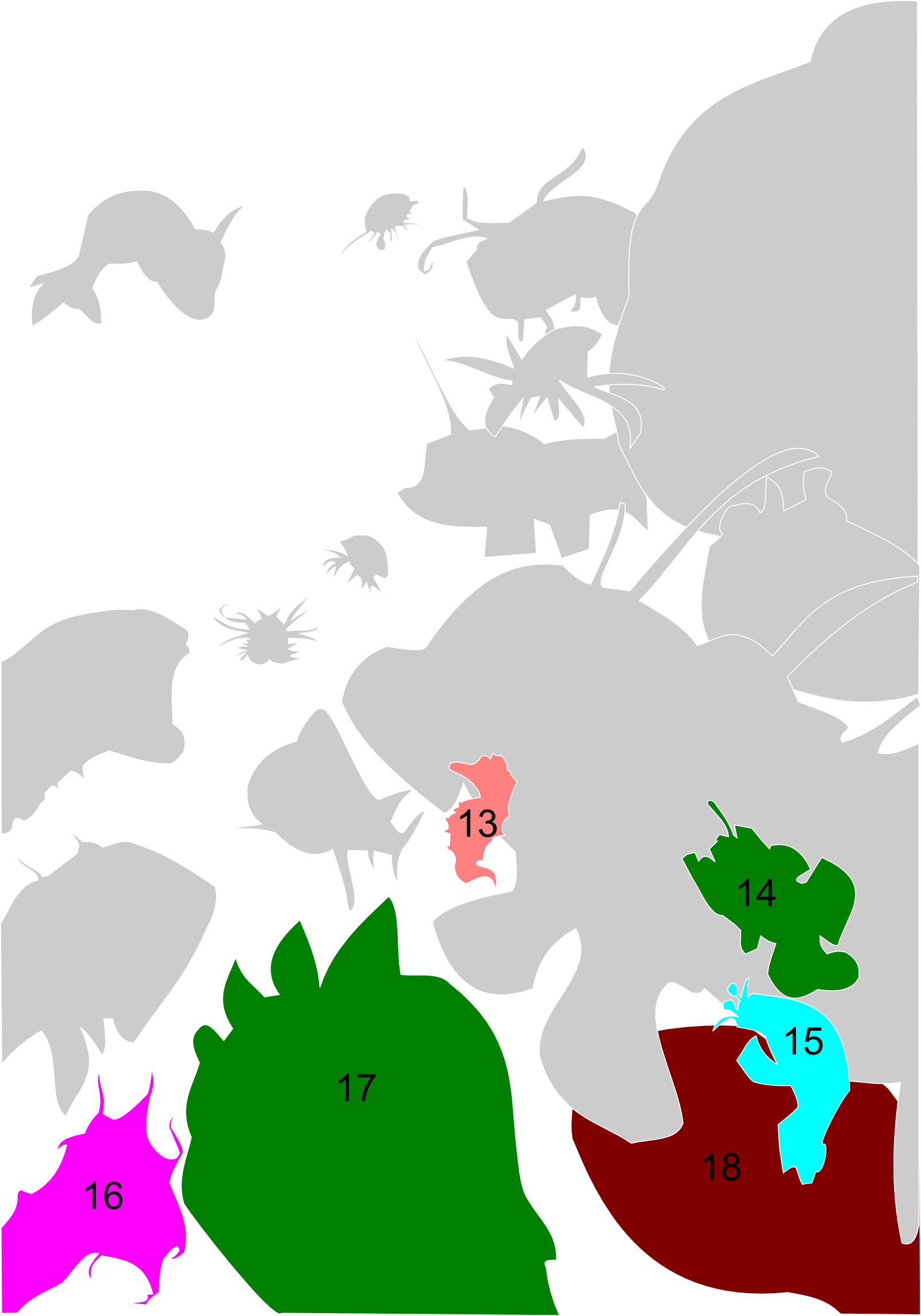
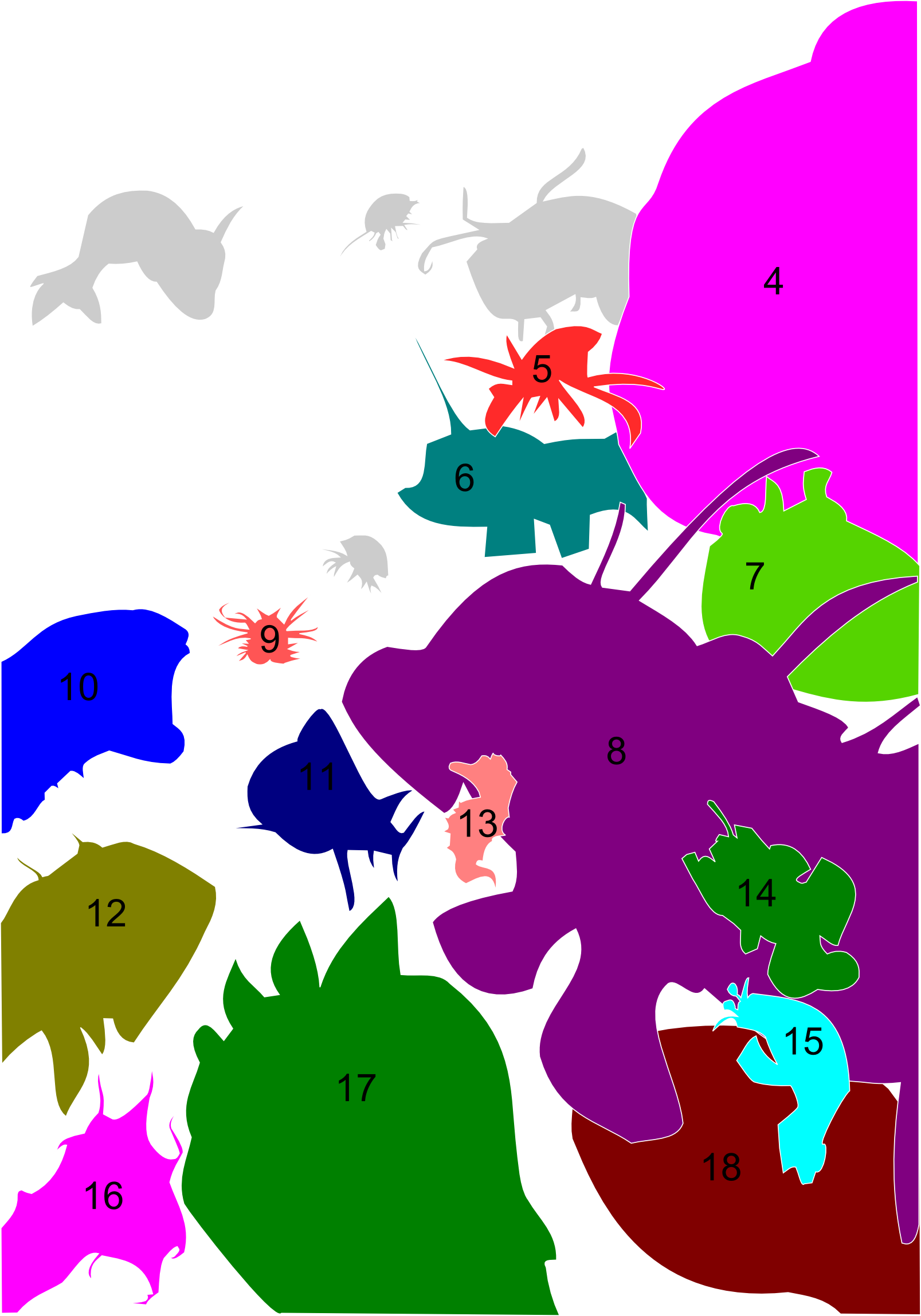
aquapurged5We are approaching the home stretch, with the second to last installment of our tour through this amazing Aquaman cover. Have you been following along? How many have you guessed so far?

If you haven’t been following along, you can catch up with the previous installments, below:

  • The incredible biodiversity of Aquaman’s variant cover
  • The incredible biodiversity of Aquaman’s variant cover: Episode 2
  • The incredible biodiversity of Aquaman’s variant cover: Halfway Home
  • The incredible biodiversity of Aquaman’s variant cover: Part four of a six part trilogy

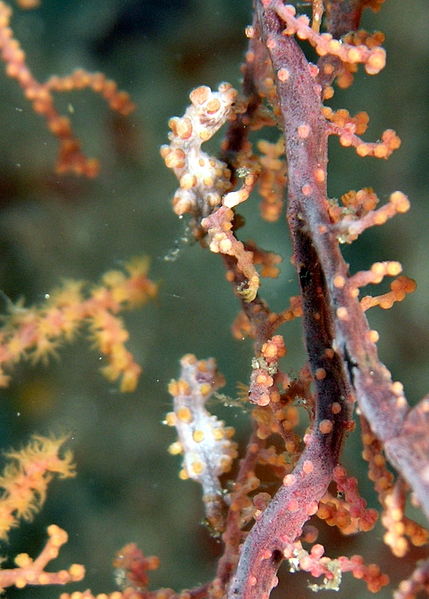
13. Pygmy Seahorse (Hippocampus bargibanti)

429px-Hippocampus_bargibanti3
Pygmy Seahorse. Photo by Jens Petersen.

seahorseI started my career in marine science working with seahorses, so these goofy, thoroughly un-fish-like fish, hold a special place in my heart. All seahorses are pretty weird, but pygmy seahorses might be the weirdest. These tiny animals, barely 2 centimeters long, live exclusively on gorgonian corals, their lump profile allows them to blend perfectly into the backdrop. Their bulbous protrusions will assume the color of their host coral.

Read More “The penultimate installment of the incredible biodiversity of Aquaman’s variant cover” »

The incredible biodiversity of Aquaman’s variant cover: Episode 2

Posted on May 6, 2014May 5, 2014 By Andrew Thaler
Popular Culture, Science

Welcome back to another exciting installment of the incredible biodiversity of this incredible Aquaman cover. Today we’re investigating species 4 through 6, where we’ll meet one of my favorite mid-water fish.

aquapurged2

fangtooth4. Fangtooth (Anoplogaster cornuta)

With the largest tooth-length-to-body ratio of any fish, the fangtooth has earned its menacing name. Unfortunately, this intimidating creature barely reaches 18 centimeters in length, hardly the massive, Batman-swallowing maw illustrated to the right. Fangtooths are among the deepest swimming fish. They can be found as far as 5000 meters down, though they are more common in the midwater (200-2000 meters).

Read More “The incredible biodiversity of Aquaman’s variant cover: Episode 2” »

A deep-sea ecologist over-analyzes Aquaman #25

Posted on November 27, 2013November 29, 2013 By Andrew Thaler 2 Comments on A deep-sea ecologist over-analyzes Aquaman #25
Popular Culture

Today marks the end of Geoff Johns’ 25-issue run as lead writer  for Aquaman. It is not hyperbole to say that he revitalized the king of Atlantis and helped cast off the stigma of the Superfriends. Aquaman was no longer a one-trick hero floundering about for relevance, trying to find his plaice in the DC Universe. Johns’ Aquaman had depth. The characters were compelling, the stories engaging. And, after more than 2 years, it was clear that this new Aquaman wasn’t just a fluke.

All puns are most definitely intended.

In honor of Johns’ 25 issue run, it’s time to plumb the depths of his ultimate issue and do what I do best: over-analyze a comic book and dredge up as much tenuous symbolism as possible. This is Southern Fried Science and I’m talking about Aquaman, what else would you expect?

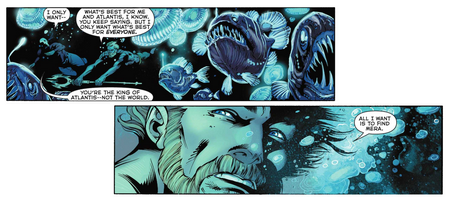
The anglerfish symbolize Aquaman’s relationship with Mera

Aquaman and Anglerfish, Aquaman #25, DC Comics

Here we find Aquaman diving deep into the Trench, searching for an army of lost Atlanteans to command. During the course of his dive, we discover that, though Aquaman is fighting to reclaim Atlantis, his one overarching goal is to find his wife, Mera. It is not a coincidence that we see him surrounded by deep-sea anglerfish — Melanocetus johnsonii to be precise. In many ways, the life-history of the anglerfish mimics Aquaman’s relationship to Mera.

Read More “A deep-sea ecologist over-analyzes Aquaman #25” »

The Sex Lives of Spoonworms: 10 marine animals with parasitic, dwarf, and otherwise reduced males

Posted on May 31, 2013September 19, 2013 By Andrew Thaler 8 Comments on The Sex Lives of Spoonworms: 10 marine animals with parasitic, dwarf, and otherwise reduced males
Science

Earlier this week, Fox News commentator and all-around terrific guy* Erick Erickson, while discussing a recent Pew Study that revealed that women were the sole breadwinners in 40% of US households that contain children, had this to say:

“I’m so used to liberals telling conservatives that they’re anti-science. But liberals who defend this and say it is not a bad thing are very anti-science. When you look at biology—when you look at the natural world—the roles of a male and a female in society and in other animals, the male typically is the dominant role. The female, it’s not antithesis, or it’s not competing, it’s a complementary role.”

source

headshot-thalerSMALL

I’m not sure where Erickson got his science education from, but it’s pretty clear he should have spent a little more time shopping around on the free market, because he sure is wrong. How wrong? I managed to assemble this list of 10 marine species with dwarf, parasitic, or otherwise reduced males (including an entire female-only class) while waiting for my toast**. So have a seat and let me show you how much weirder and more wonderful the world is than Erickson’s Disney-esque misinterpretation of biology.

1. Anglerfish

The deep-sea Anglerfish is among the most common examples of parasitic males in the marine world. Anglerfish comprise a variety of taxa in the order Lophiiformes. Almost all (females) possess a specialized appendage that acts as a lure to attract unwary prey. Life in the deep sea is rough–even though it is the largest and most diverse ecosystem on Earth, biomass is fairly low–so finding a mate is a struggle for these slow swimming fishes. The solution: carry your partner with you.

Male anglerfish are tiny, often less than 5% the size of the female, but they possess powerful olfactory receptors, allowing them to seek out females. Once a mate is located, the male anglerfish latches on to her abdomen, fuses his circulatory system with hers, and is then slowly digested until there’s nothing left but a sac of gonads surrounded by basic life-supporting tissues. Female anglerfish are not monogamous, either. At any given time she could be covered by a half-dozen parasitic males. Kinky.

Read More “The Sex Lives of Spoonworms: 10 marine animals with parasitic, dwarf, and otherwise reduced males” »

Return of the Science of Aquaman: Welcome to the Trench

Posted on September 13, 2012September 14, 2012 By Andrew Thaler 2 Comments on Return of the Science of Aquaman: Welcome to the Trench
Popular Culture, Science

Seriously, is no one else bothered by the fact that his trident has five points? Aquaman: The Trench. From DC Comics.

After reducing Aquaman to a hypothermic, hyposmotic, constantly famished, case study in psychological trauma, I figure that I owe the king of Atlantis a second chance. After all, Aquaman was and still remains the most interesting hero in the DC universe. A generous fan sent me a copy of Aquaman Volume 1: The Trench, arguing that the New 52 version of everybody’s favorite aquatic hero is even more compelling than previous incarnations, with a stronger backstory, powers that make sense, and plenty of humor.

Last time I paid the hapless mariner a visit, many readers interpreted my incisive criticism of the science behind Aquaman as evidence that I had it out for our scale-clad hero. Since you all know that I’m going to take the misguided marine science in this volume to task, let’s start with all of the good stuff in this reimagination of DC’s oft-mocked champion.

The central conceit of New 52 Aquaman is that the comic book world has the same perception of Arthur Curry that we do–a hero with oddly specific and mostly useless powers that talks to fish. In addition, the citizens of the DC Universe believe that Atlantis is a fairy tale, so Aquaman’s kingly status is meaningless to the surface dwellers. The hybrid of a human father and Atlantean mother, Aquaman feels out of place in Atlantis and chooses to return to the surface with his wife, Mera. Comparing himself to his lighthouse-keeper father, he explains that even though he loves the sea, someone must protect the shore.

Read More “Return of the Science of Aquaman: Welcome to the Trench” »

Popular Posts

What Ocean Ramsey does is not shark science or conservation: some brief thoughts on "the Shark Whisperer" documentaryWhat Ocean Ramsey does is not shark science or conservation: some brief thoughts on "the Shark Whisperer" documentaryJuly 2, 2025David Shiffman
I can serve on your graduate thesis committee. Here’s what you can expect of me, and what I expect in return.I can serve on your graduate thesis committee. Here’s what you can expect of me, and what I expect in return.October 16, 2025David Shiffman
The story of the pride flag made from NASA imagery: Bluesky's most-liked imageThe story of the pride flag made from NASA imagery: Bluesky's most-liked imageSeptember 27, 2024David Shiffman
What can the funniest shark memes on the internetz teach us about ocean science and conservation?What can the funniest shark memes on the internetz teach us about ocean science and conservation?November 8, 2013David Shiffman
Shark of Darkness: Wrath of Submarine is a fake documentaryShark of Darkness: Wrath of Submarine is a fake documentaryAugust 10, 2014Michelle Jewell
The Trouble with Teacup PigsThe Trouble with Teacup PigsOctober 14, 2012Andrew Thaler
I turned my woodshop into a personal solar farm.I turned my woodshop into a personal solar farm.June 21, 2021Andrew Thaler
"Twitter sucks now and all the cool kids are moving to Bluesky:" Our new survey shows that scientists no longer find Twitter professionally useful or pleasant"Twitter sucks now and all the cool kids are moving to Bluesky:" Our new survey shows that scientists no longer find Twitter professionally useful or pleasantAugust 19, 2025David Shiffman
Nodules, Lost Mines, and Dark Oxygen: A new documentary on deep-sea mining asks important questions about the future of the industry.Nodules, Lost Mines, and Dark Oxygen: A new documentary on deep-sea mining asks important questions about the future of the industry.July 24, 2025Andrew Thaler
Blackfish: the Science Behind the MovieBlackfish: the Science Behind the MovieSeptember 18, 2013Chris Parsons
Subscribe to our RSS Feed for updates whenever new articles are published.

We recommend Feedly for RSS management. It's like Google Reader, except it still exists.

Southern Fried Science

  • Home
  • About SFS
  • Authors
  • Support SFS


If you enjoy Southern Fried Science, consider contributing to our Patreon campaign.

Copyright © 2025 Southern Fried Science.

Theme: Oceanly Premium by ScriptsTown