As some of you probably remember, there was an oil spill in the Gulf of Mexico last year. You can be forgiven for not remembering it, as our news media hasn’t been talking about it very much lately. In fact, if your only source of oil spill news was the mainstream media, you probably think that the Gulf is doing great! A little over a year ago, CNN ran a story about how the BP oil well that caused the spill was “effectively dead” and was “no longer a threat to the Gulf”. CNBC (and many others) ran stories about how 75 percent of the oil from the spill was gone from the Gulf. Bloomberg reported that the Gulf would recovery completely by 2012. London’s Telegraph celebrated a dramatic recovery after only one year. Whew… things aren’t as bad as we feared, and the Gulf has almost totally recovered! Or has it?
Tag: Gulf of Mexico

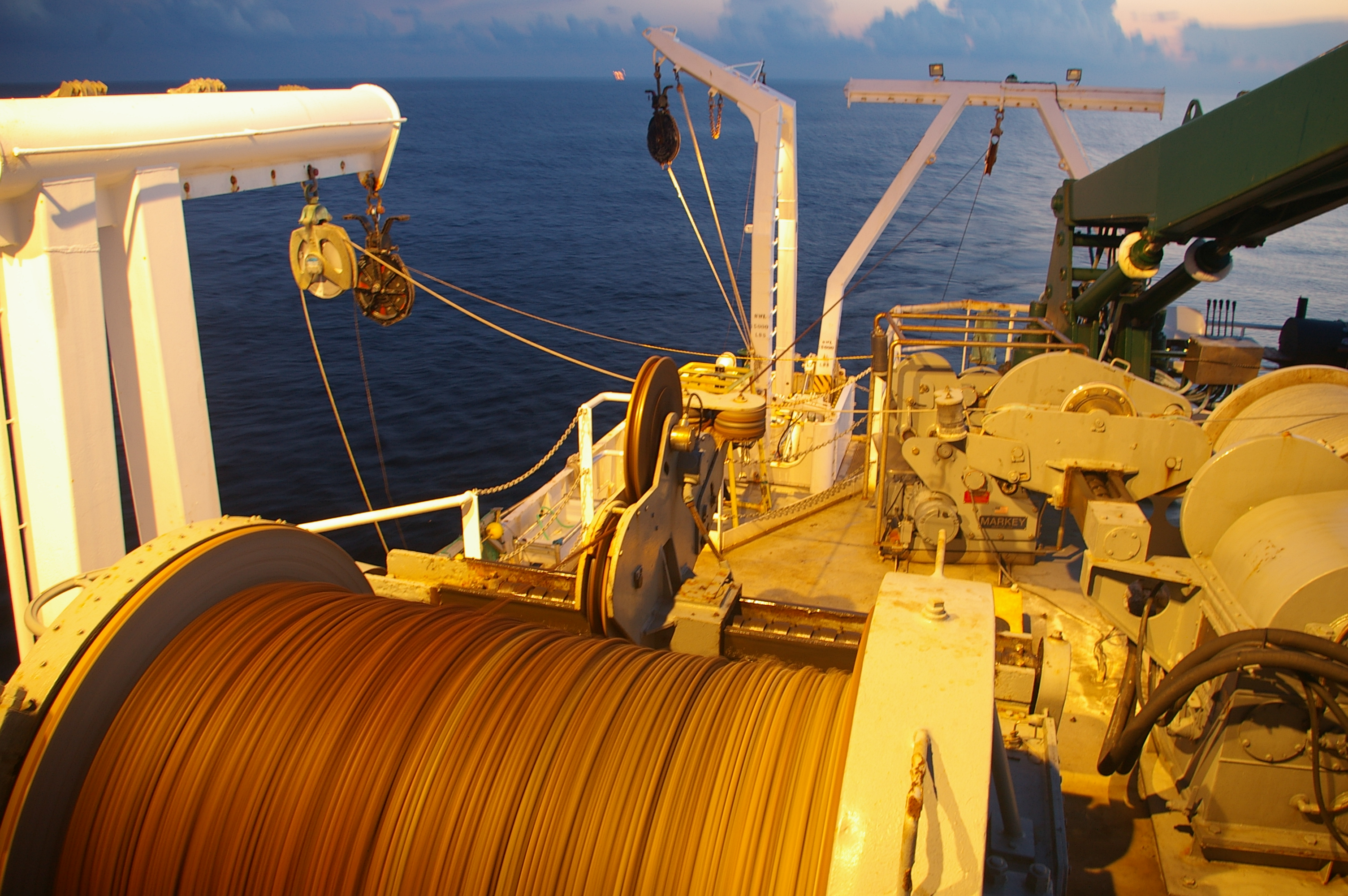
The A-frame shuddered as the box core, heavy with mud and reeking of sulfur, emerged from the water. We knew that it had found its mark 2300 meters below. Soft sediment from the seafloor oozed out the sides as I slid the safety pins into the spade arm. There was nothing visibly special about this mud. No ancient arthropods or primeval polychaetes crawled through this muck. It was a cubic meter of sticky, stinking glop. My first sample.
We were in the middle of the Gulf of Mexico, aboard the R/V Cape Hatteras. Our cruise objectives were to characterize the pelagic and benthic fauna associated with deep-sea methane seeps. For me, it was a ship of opportunity. In exchange for and extra set of hands to work the gear and process samples, I could add my own small research project to the cruise objectives. My goal was to collect sediment cores from multiple sites and survey the diversity of fungi associated with these methane seeps.
The 12 hour shifts rarely left me enough time to eat meals. Though I had never seen the equipment before we left port I became the acoustic tracking technician, out of necessity. Things consistently went wrong. Nets tore, gear broke, a misfired box core almost crushed my leg. Two hurricanes, one a category 5, hit the Gulf of Mexico while we were at sea. Work was exhausting and rest was brief, when existent. I loved every minute of it.
The end of that cruise was the high point of a 4 year project that began with unbridled optimism and early, exciting results, only to decay into drudgery, failure, desperation, and collapse. In the end, it would rise from the past for one small victory. In hindsight, so much of those four years seems painfully trivial, but this story is really about how much of a human being is poured into a scientific manuscript.
Read More “The importance of failure in graduate student training” »

In the year since the Deepwater Horizon sunk, killing 11 people and pumping untold millions of barrels of oil into the Gulf of Mexico, much has been revealed about the causes and effects of this disaster: the chain of events leading up to the explosion, the response (or lack of response) from BP and the US government, the impact of sealife and coastal fisheries. In his most recent book, A Sea in Flames, Carl Safina lays out the timeline of the disaster, the factors the lead to such an egregious lapse in safety, the role that several corporate and government entities played, and the anger. Above all else, this book is about the rage one man feels about a situation that is almost impossible to comprehend.
February 2005 – A giant in the oil industry sets out to drill what is, at the time, the deepest oil well in the world, a staggering 32,000 feet below the sea bed. The oil field, just 28 miles from the Louisiana coast, is estimated to contain up to a billion barrels of oil. The success of this well could launch a new era of offshore drilling and revolutionize an industry. And then, after 18 months and $180 million dollars, just 2,000 feet from their target, ExxonMobil halts their drill, declares Blackbeard West unsafe, and walks away.
Barely 5 years later, a similar well, deep and deeply unsafe, would suffer a catastrophic blowout, pumping millions of barrels of crude into the Gulf of Mexico. The resulting investigation revealed a history of unacceptable risk and a blasé attitude towards safety on the part of BP. While the BP blowout at the Macondo well was a disaster on a global scale, Blackbeard West was a disaster deferred. How could these two incidents, both created by nearly the same conditions, have had such dramatically different consequences? What can we learn about the culture of oil exploration and the true cost of a crude economy from Blackbeard West?
Read More “Chronicle of a Death Forestalled: the Gulf of Mexico oil spill that didn’t happen” »
Just a reminder that one year ago today, the Deep Water Horizon exploded and sunk into the Gulf of Mexico, taking 11 lives with it and starting a chain of event that resulted in the largest oil blowout in history.
This 2011 Beneath the Waves Film Festival entry comes from the Pew Charitable Trusts. Shifting Gears tells the story of longlining in the Gulf of Mexico. If you have a question for the filmmakers, please leave it as a comment below and I’ll make sure they get it.
Happy New Year to all our readers! 2010 was a big year for Southern Fried Science. We added a new blogger, moved to our own server, and launched The Gam. Along the way we’ve won a few awards, hosted the first Ocean of Pseudoscience week, cooked a whole pig, exposed some blatant greenwashing, challenged conventional … Read More “Southern Fried Scientist’s Predictions for 2011” »
In case anyone was under the impression that the Gulf of Mexico oil spill is over just because the well has been closed, it isn’t.
We continue to maintain our Gulf of Mexico Oilspill Page and will soon be adding a post-spill section to cover the ongoing effort in the Gulf.
This is what 60 days of oil pouring into the Gulf of Mexico looks like. This is what reckless disregard for safety and the precautionary principle looks like. This is what irresponsible energy policy looks like. This is what the end of Gulf Coast fisheries for the foreseeable future looks like. This is what government … Read More “god damn” »
Update: we’ve promoted this post to a full page on the blog. Please go here for the most up-to-date version. The comment thread will remain active here.